
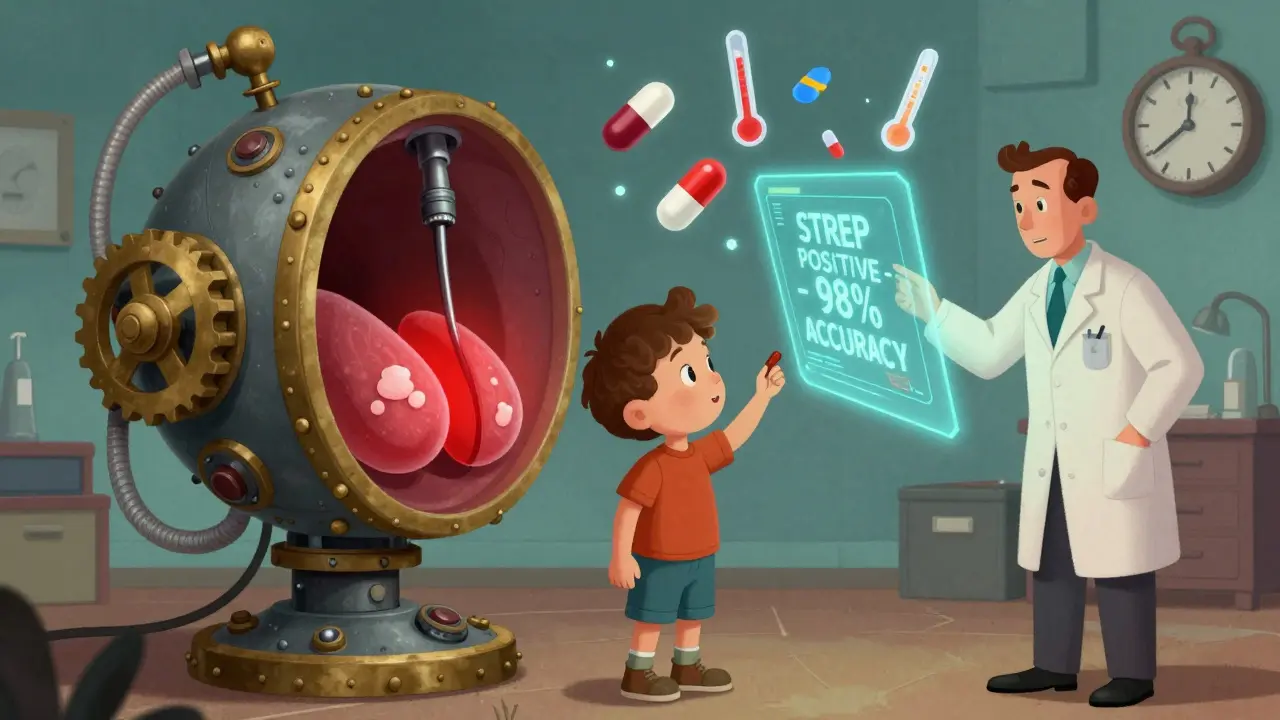
Strep throat isn’t just a sore throat. It’s a bacterial infection that can turn mild discomfort into something serious if left untreated. Unlike a cold or flu, which come with a runny nose and cough, strep throat hits fast: sudden pain, high fever, swollen tonsils with white patches, and no cough. It’s common in kids, but adults get it too. And if you ignore it, you risk complications like rheumatic fever - a condition that can damage your heart valves. The good news? It’s treatable. But only if you know what to look for, when to get tested, and how to take antibiotics the right way.
How Do You Know It’s Strep and Not Just a Cold?
Most sore throats are viral. You get them with a runny nose, sneezing, hoarse voice, or pink eyes. Strep throat doesn’t come with those. It’s different. You wake up with a throat that feels like sandpaper. Swallowing hurts. Your temperature spikes above 100.4°F (38°C). Your neck glands swell like marbles under your jaw. You might see white streaks or pus on your tonsils. Tiny red spots on the roof of your mouth - called petechiae - are a strong clue. And here’s the big one: no cough. If you’re coughing, it’s probably not strep. That’s 90% accurate at ruling it out, according to UC Davis Health.
Doctors use the Centor criteria to guess if you’ve got strep before testing. You get one point for each of these: no cough, swollen neck glands, fever over 100.4°F, and white patches on tonsils. Score 3 or higher? You’ve got a 40-60% chance of having strep. That’s when testing makes sense. Kids under 3 almost never get it - their immune systems don’t react the same way. So if your toddler has a sore throat, it’s almost always viral.
Testing: Rapid Test, Culture, or PCR - What’s Best?
You can’t diagnose strep just by looking. You need a test. The most common is the rapid antigen detection test (RADT). A swab from your throat gives results in 10-30 minutes. It’s fast, cheap, and accurate - over 95% specific. But it misses about 10% of cases, especially in young kids. That’s why, if your child tests negative but still looks like they have strep, doctors often send a throat culture. It takes 24-48 hours, but it catches almost all cases - 90-95% sensitivity. It’s the gold standard.
Now, newer molecular tests (PCR) are popping up in clinics. They’re even more sensitive - 95-98% - and give results in 24 hours. The FDA approved a new one called Strep Ultra in March 2024 that works in 15 minutes with 98% accuracy. It’s expensive right now, but by 2026, 40% of urgent care centers are expected to use it. For now, most offices still start with the rapid test. If you’re an adult with low risk (score under 3 on Centor), and your rapid test is negative, you probably don’t need further testing. But for kids? Always confirm a negative rapid test with a culture.
Antibiotics: What Works, What Doesn’t, and Why Penicillin Still Rules
Antibiotics don’t make you feel better overnight - but they do stop the infection from spreading and prevent dangerous complications. The first choice? Penicillin or amoxicillin. Both kill Group A Streptococcus with 95% effectiveness. Penicillin V is cheap - under $4 for a 10-day course. Amoxicillin tastes better, so it’s preferred for kids. You take it for 10 days. No shortcuts.
If you’re allergic to penicillin, options are limited. Cephalexin works well for most. Clindamycin is another option, but resistance is creeping up - now at 5-10% in some areas. Azithromycin (Z-Pack) is popular because it’s only 5 days, but it’s less effective - only 85-90% success. And resistance to macrolides like azithromycin is hitting 15% in parts of the U.S. That means it fails more often than you think.
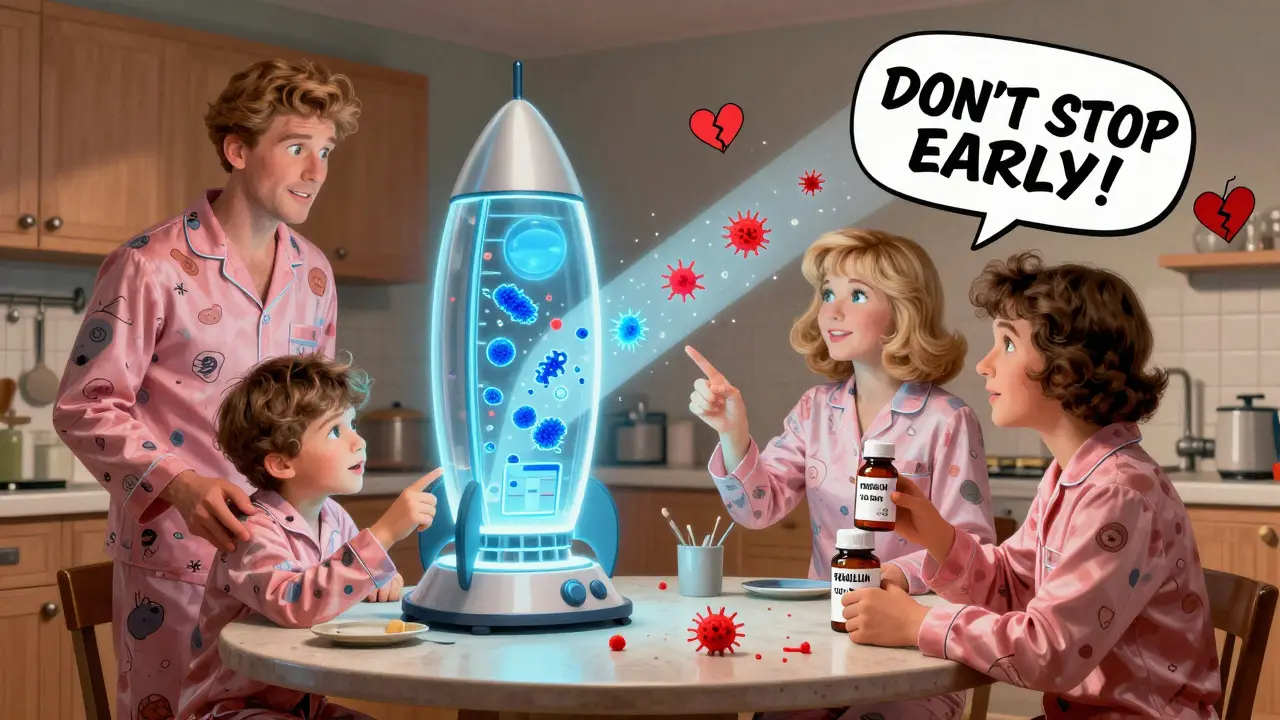
Here’s what doesn’t work: leftover antibiotics from last time, sharing pills with family, or stopping early because you feel better. That’s how resistance builds. CDC data shows 30% of outpatient antibiotics are prescribed unnecessarily - mostly for viral infections. But when you actually have strep, skipping or shortening treatment raises your risk of relapse by 5-15%. One NEJM study found 99% cure rate with full 10-day courses. Drop to 7 days? Cure rate drops to 85%.
Recovery Timeline: When You’ll Feel Better - And When You’re No Longer Contagious
With antibiotics, you’ll start feeling better in 24-48 hours. The fever breaks. Swallowing gets easier. But don’t assume you’re cured. You still need to finish the full 10 days. You’re contagious until you’ve been on antibiotics for 24 hours. That means: no school, no work, no hugging grandma. Even if you feel fine, you can still spread it. After 24 hours of antibiotics and no fever, you can return to normal activities - as long as you’re not vomiting or too weak.
Complete recovery takes 7-10 days. If you’re still sore after 48 hours of antibiotics, call your doctor. You might have a complication. Peritonsillar abscess - a pus pocket behind the tonsil - happens in 1-2% of cases. Symptoms: severe pain on one side, muffled voice, trouble opening your mouth. It’s rare, but dangerous. Abdominal pain or headaches can also be signs in kids - and they often delay diagnosis. Cleveland Clinic reports 15% of strep cases in children show these atypical symptoms.
What Happens If You Don’t Treat It?
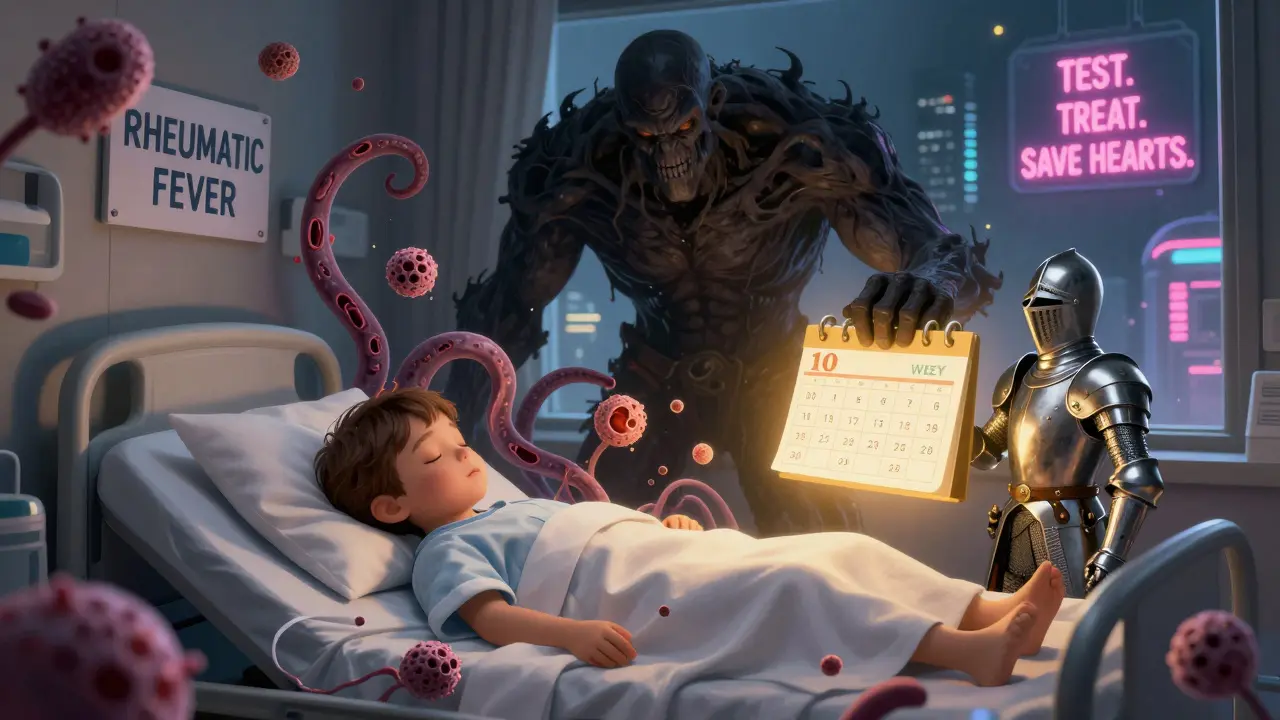
Strep throat can clear up on its own in 7-10 days. But here’s the catch: untreated, it can trigger rheumatic fever. That’s not just a bad fever. It’s an autoimmune reaction where your body attacks your heart, joints, skin, and brain. About 3% of untreated cases develop it. Rheumatic heart disease - the long-term damage - affects 325,000 children globally every year, according to IDSA. It’s preventable. But once the heart valves are scarred, you’re stuck with it for life.
That’s why the CDC and IDSA are pushing hard for accurate diagnosis and treatment. Antibiotics cut transmission by 80% within 24 hours. They prevent complications. And they stop outbreaks in schools and homes. The cost of one missed case? Not just medical bills. It’s lifelong heart damage.
Common Mistakes That Make Things Worse
Parents often stop antibiotics after 3-5 days because the child seems fine. JAMA Pediatrics found 40% of families do this. That’s a recipe for relapse. Adults are worse. A CDC survey showed 12% use leftover antibiotics for new sore throats. On Reddit, 8% of users admitted sharing their prescription with a family member. Both are dangerous. Antibiotics aren’t candy. Using the wrong one, at the wrong dose, for the wrong bug fuels resistance.
Another mistake? Testing too early. If you swab your throat on day one, before symptoms peak, you might get a false negative. Wait until day two or three for better accuracy. Also, don’t assume a negative rapid test means you’re off the hook. In kids under 5, bacterial load is lower - so false negatives happen 25% more often. Always follow up with a culture if suspicion is high.
What’s Changing in 2026?
There’s no vaccine yet. The Streptococcus pyogenes M-protein vaccine is in Phase II trials, but with over 200 different strains, it’s a moving target. So treatment remains our best tool. New rapid molecular tests are becoming more common. By 2026, they could replace traditional rapid tests in many clinics. The CDC is spending $15 million to track resistance patterns. And a big trial is underway - comparing 5-day versus 10-day antibiotic courses. Results are expected mid-2025. If 5 days works just as well, guidelines could change.
But for now, the rules are simple: test when symptoms match, treat with penicillin or amoxicillin for 10 days, and never stop early. Strep throat isn’t glamorous. But it’s one of the most preventable serious infections out there. Get it right, and you protect yourself - and everyone around you.
Can you get strep throat without a fever?
Yes, but it’s rare. Fever above 100.4°F (38°C) is present in 85% of confirmed cases. If you have a sore throat with no fever, it’s more likely viral. Still, if you have other signs - white patches on tonsils, swollen lymph nodes, no cough - you could have strep. Testing is the only way to know for sure.
How long does strep throat last without antibiotics?
Without antibiotics, symptoms usually last 7-10 days. But you remain contagious the whole time. You’re also at risk for complications like rheumatic fever, which can develop weeks after the sore throat seems gone. Antibiotics shorten the illness by about 16 hours on average, but their real value is preventing serious long-term damage.
Is strep throat contagious after 24 hours of antibiotics?
No. After 24 hours of taking the right antibiotic, you’re no longer contagious. That’s why kids can return to school and adults can go back to work after one full day of treatment - as long as the fever is gone and they’re feeling better. But you must still finish the full 10-day course to kill all the bacteria and prevent relapse.
Can you test negative for strep and still have it?
Yes. Rapid tests miss about 5-15% of cases, especially in young children. That’s why doctors often do a throat culture if a child has strong symptoms but a negative rapid test. Culture is more sensitive and catches nearly all infections. Adults with low risk scores and negative rapid tests usually don’t need further testing.
What happens if you stop antibiotics early?
Stopping early doesn’t just make you feel worse again - it can lead to relapse, antibiotic resistance, and even serious complications like rheumatic fever. Studies show 95% of people are cured with a full 10-day course. If you stop after 5 days, cure rates drop to 85%. That 10% gap is where resistant strains grow and complications start. Always finish your prescription, even if you feel fine.
Are there natural remedies that cure strep throat?
No. Honey, salt water gargles, and herbal teas can soothe pain, but they don’t kill the bacteria. Only antibiotics can do that. Relying on home remedies alone delays treatment and increases the risk of complications. If you suspect strep, get tested. Natural remedies help with comfort - not cure.
Aishah Bango
January 25, 2026 AT 20:28People still don’t get it - stopping antibiotics early isn’t just lazy, it’s dangerous. You think you’re saving money or time, but you’re just breeding superbugs that will come back to haunt your kid, your neighbor, your entire town. This isn’t opinion, it’s CDC data. Finish the damn script.
rasna saha
January 26, 2026 AT 20:25I’m a nurse in Mumbai and I see this every week - parents stop meds after 3 days because ‘the fever’s gone.’ I gently explain it’s like turning off the oven halfway through baking a cake. The inside is still raw. I’ve seen kids come back with joint pain months later. Please, just finish the course.
Neil Thorogood
January 28, 2026 AT 20:24Penicillin still rules? Bro, it’s 2025. I’m 27 and my first strep was treated with a Z-Pack. My mom’s generation still thinks antibiotics are magic beans. Meanwhile, I’m Googling ‘how to get amoxicillin without insurance’ while my throat feels like a sandpaper taco. We need better access, not just lectures.
SWAPNIL SIDAM
January 29, 2026 AT 21:00My little sister had strep last year. No fever. Just sore throat and white spots. Doctor said ‘probably viral.’ We waited 3 days. Then she couldn’t open her mouth. Turned out to be abscess. We were lucky. Please test if in doubt. Don’t wait.
Peter Sharplin
January 31, 2026 AT 00:36Just to clarify something - the 95% specificity of RADT means if you test positive, you almost certainly have strep. The problem is sensitivity. False negatives are the real issue, especially in kids. So if a child looks like they have strep but tests negative, culture is non-negotiable. Don’t let cost or convenience override clinical judgment.
Simran Kaur
January 31, 2026 AT 08:22As an Indian mom who’s watched two kids go through this - I want to say thank you. We were told ‘it’s just a throat infection’ by a clinic in Delhi. They gave us paracetamol and told us to wait. My daughter’s tonsils swelled like grapes. We rushed to a private hospital. They did a culture. It was strep. We were lucky. But so many aren’t. Please, if you’re in a place with limited care - know the signs. No cough. High fever. White patches. Swollen neck. That’s not a cold. That’s a red flag. And if you can’t get a test? Trust your gut. Don’t wait.
Rakesh Kakkad
February 1, 2026 AT 14:43Penicillin is cheaper than a Starbucks latte in India. Yet people still buy herbal syrups from street vendors. I’ve seen adults take leftover amoxicillin from their cousin’s last cold. This isn’t just ignorance - it’s a public health crisis. We need school campaigns. Not just doctors. Teachers. Grandparents. Everyone.
Geoff Miskinis
February 2, 2026 AT 12:11It’s amusing how the article treats the Centor criteria as gospel. It’s a heuristic tool from the 1980s, developed on a small cohort of American children. Modern molecular diagnostics render it obsolete. And yet, primary care still clings to it like a religious relic. The real innovation isn’t the new PCR test - it’s the cultural shift away from symptom-based guessing. But that requires admitting our diagnostic arrogance.
Betty Bomber
February 2, 2026 AT 20:31My kid got strep last winter. We did the rapid test. Negative. But she was still miserable. We waited two days, then did a culture. Positive. Turns out, the rapid test missed it. I’m so glad we didn’t take the first result as final. Don’t assume negative means clean.
Skye Kooyman
February 4, 2026 AT 13:22Just finished my 10 days. Feels weird to be done. I didn’t even know I was contagious until day 2. Now I’m just glad I didn’t give it to my roommate. Also, amoxicillin tastes like chalk. But hey, at least I didn’t die.