
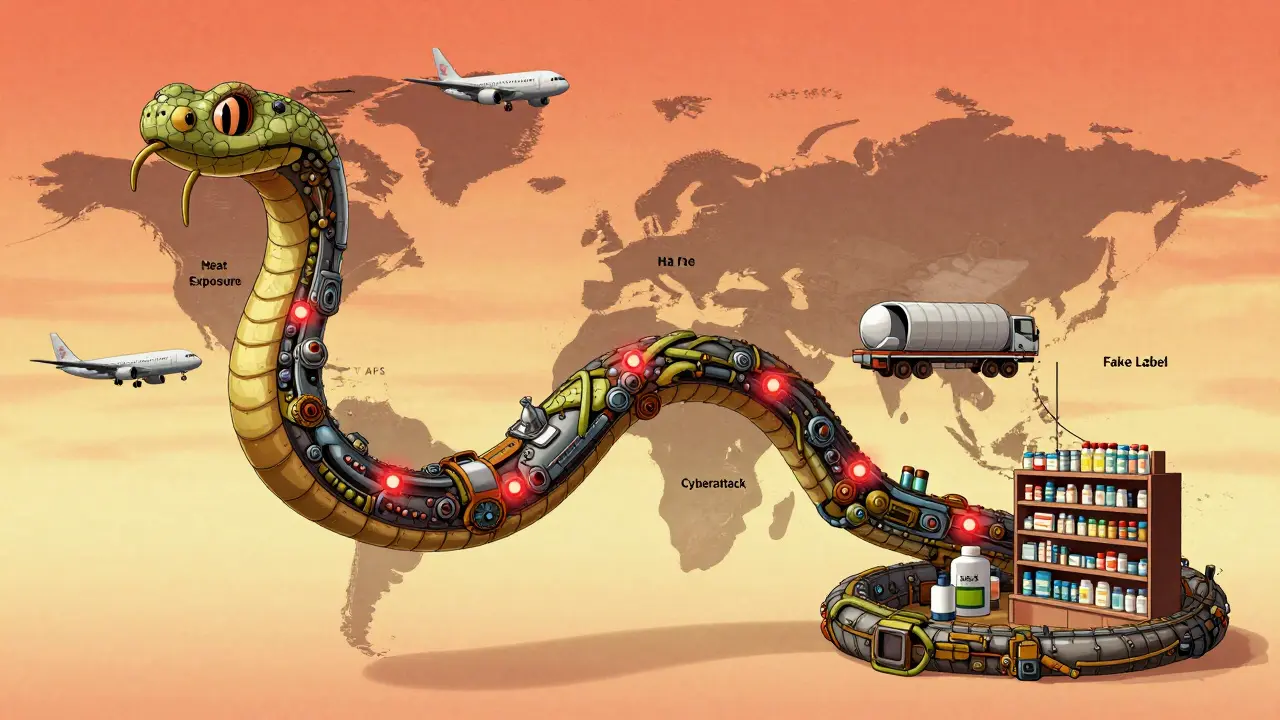
When you pick up a prescription, you assume the medicine inside is safe, effective, and exactly what your doctor ordered. But behind that simple act is a global network so fragile that a single power outage, cyberattack, or shipping delay can put your life at risk. The pharmaceutical supply chain isn’t just logistics-it’s the invisible line between life and death for millions. And right now, it’s failing more often than it should.
What’s Really at Stake When the Supply Chain Fails
Every pill, injection, or inhaler you take travels through dozens of hands across continents before it reaches you. It starts in a lab in China or India, where 78% of the world’s active pharmaceutical ingredients (APIs) are made. Then it moves to a manufacturer, often in Europe or the U.S., gets packaged, stored under strict temperatures, shipped by air or sea, distributed through wholesalers, and finally delivered to your pharmacy. One wrong turn-too much heat, a fake label, a delayed shipment-and the medicine becomes useless, or worse, dangerous. The consequences aren’t theoretical. In 2024, a software failure at CrowdStrike knocked out critical systems in 759 hospitals across the U.S., halting medication dispensing for hours. In North Carolina, Hurricane Helene shut down Baxter’s plant, triggering shortages that forced over 80% of U.S. hospitals to delay surgeries and cancer treatments. One patient with multiple sclerosis waited 17 days for her Tysabri infusion. When it finally arrived, an MRI showed two new brain lesions-directly linked to the delay. These aren’t rare cases. A 2024 American Hospital Association survey found 68% of hospitals had to substitute one drug for another because of shortages. Nearly 30% of those substitutions led to adverse reactions: allergic responses, blood sugar spikes, or organ toxicity. Patients don’t just wait longer-they get sicker.Why the System Is So Fragile
Unlike buying groceries or phones, pharmaceutical supply chains operate under extreme constraints. Most drugs have short shelf lives. Inventory buffers are 47% smaller than in other industries because storing excess medicine is expensive and risky. And yet, the system must handle 3.2 times more regulations than any other supply chain. The biggest vulnerability? Geography. Over 78% of APIs come from just two countries: China and India. That means a single political dispute, export ban, or natural disaster can ripple across the globe. During the pandemic, drug shortages jumped 300% in just six months. That wasn’t an anomaly-it was a warning. Temperature control is another silent killer. About 72% of biologic drugs-like insulin, cancer treatments, and vaccines-must stay between 2°C and 8°C. Fifteen percent need to be frozen below -60°C. If a shipment spends even a few hours outside that range, the drug can degrade. That’s why 68% of high-value shipments now use real-time temperature monitors. But not all do. Rural deliveries fail to maintain cold chain integrity 32% of the time. In the Caribbean, hospitals face a supply chain pressure index of 8.1-far above the safe target of -0.5. Patients there wait weeks for essential medicines. Some never get them.Technology Isn’t the Fix-It’s Just a Band-Aid
You’ve probably heard about blockchain, AI, and serialization as the solutions. And yes, they help. Since 2020, blockchain adoption for track-and-trace has grown by 37%. The FDA’s Drug Supply Chain Security Act (DSCSA) now requires every prescription drug to have a 2D barcode that lets pharmacies verify its origin. By 2025, full electronic tracing will be mandatory. But technology alone won’t fix what’s broken. The average hospital spends $450,000 and 8.3 months just to install a new track-and-trace system. And 76% say integrating it with their old software is a nightmare. Meanwhile, the cost of building a single cold-chain distribution center runs $2.8 million. Most small clinics and rural pharmacies can’t afford it. Even worse, 74% of cybersecurity breaches in healthcare in 2023 came from third-party vendors-suppliers, logistics firms, software providers-who aren’t held to the same standards as hospitals or manufacturers. A single weak link in the chain can expose the entire system. And here’s the truth: most of these technologies are designed to detect problems after they happen-not prevent them. Real-time monitoring tells you a shipment got too hot. It doesn’t stop the shipment from being sent in the first place.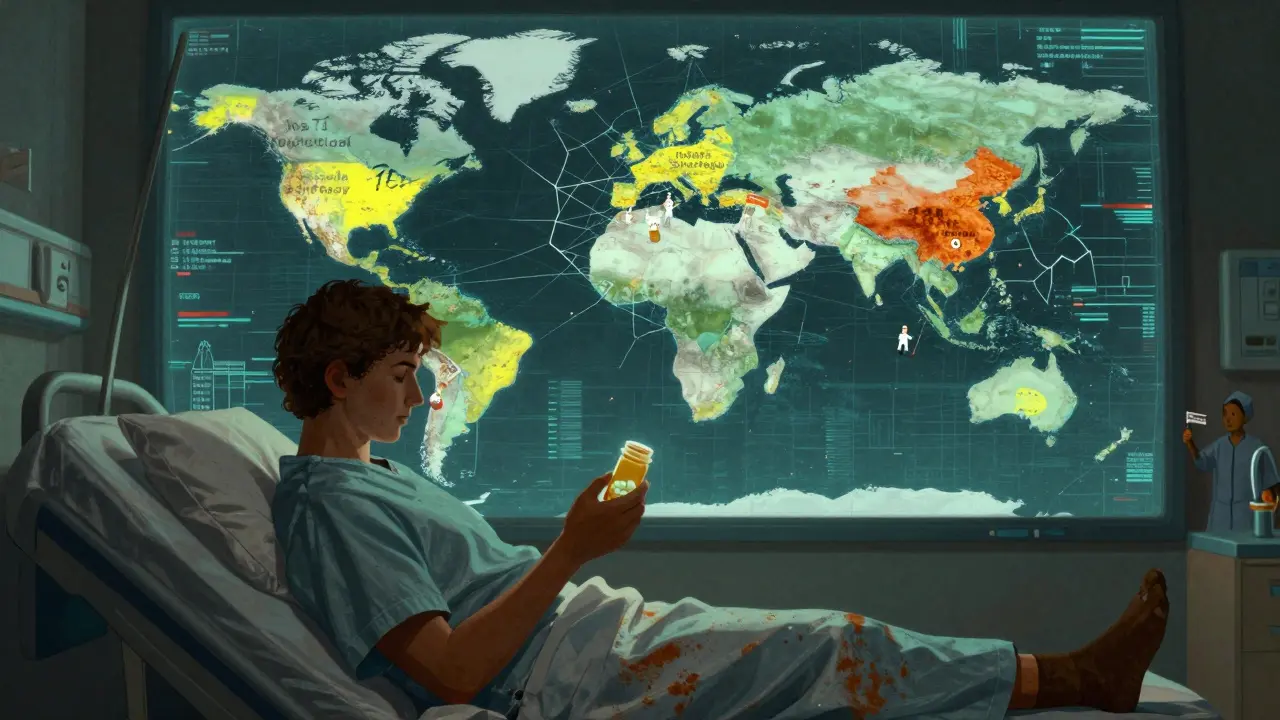
Who’s Really Responsible?
There are 12 major global distributors that control 67% of the pharmaceutical supply market. McKesson, AmerisourceBergen, and Cardinal Health alone handle more than two-thirds of all prescription drugs in the U.S. That kind of concentration means if one of them has a problem, the entire system feels it. Regulators like the FDA and EMA set the rules, but enforcement is patchy. There are 217 different regulatory requirements across 50 countries. A drug approved in the U.S. might be banned in Germany or require different labeling in Brazil. Manufacturers often cut corners to meet conflicting standards, and distributors scramble to keep up. Even the experts admit the system is broken. Dr. John Hertig of Butler University calls the supply chain the “invisible backbone” of healthcare-with “no room for error.” But when the backbone snaps, patients pay the price. And right now, it’s snapping more often.Real People, Real Consequences
Behind every statistic is a human story. On Reddit, pharmacists in r/HealthIT describe rationing epinephrine auto-injectors because they’ve run out for three months straight. Parents are forced to choose: give their child the full dose now, or save half for the next emergency. Nurses on nursing forums talk about switching insulin brands mid-treatment because the usual brand isn’t available. Different formulations mean different absorption rates. Blood sugar spikes. Hypoglycemic episodes. ER visits. One patient on RateMDs wrote: “My asthma inhaler was out of stock for six weeks. I had to use an old one I found in my closet. It didn’t work. I ended up in the hospital.” These aren’t isolated complaints. Censinet reports that medication errors tied to supply chain issues harm 1.5 million Americans every year-and cost the system $77 billion. That’s not just a financial loss. It’s lost time, lost health, and lost trust.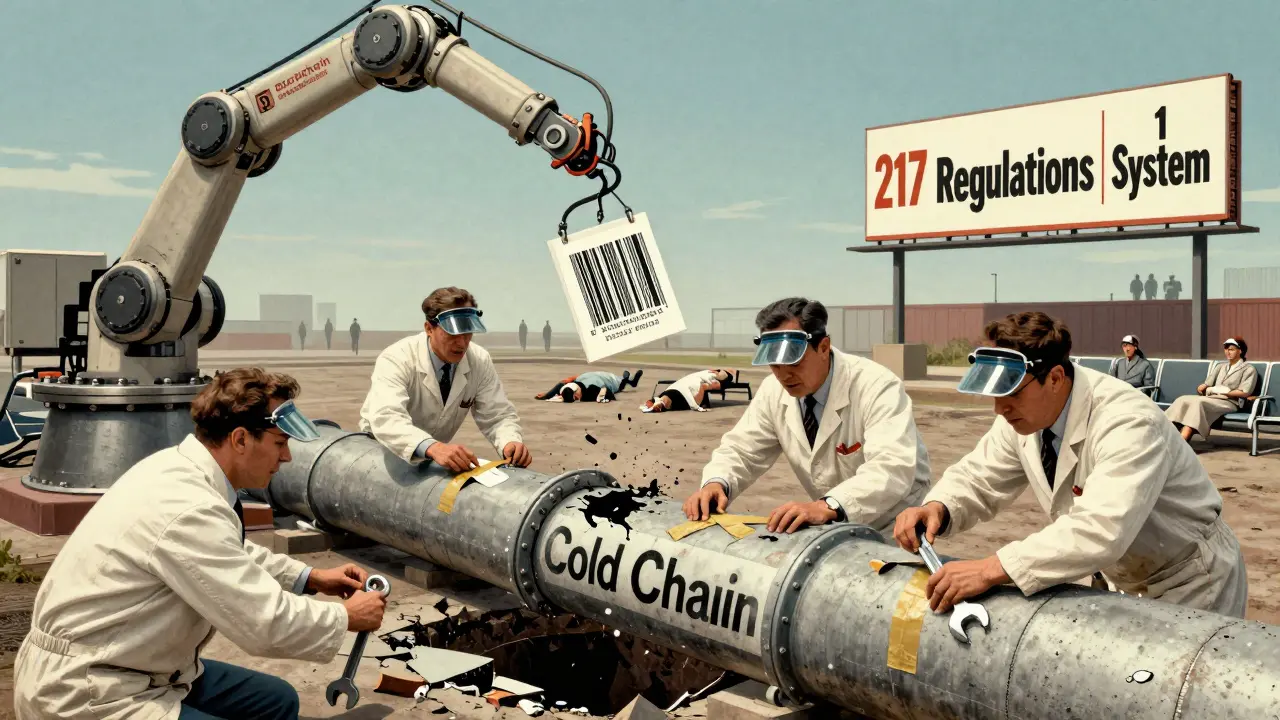
Acacia Hendrix
January 13, 2026 AT 04:09The pharmaceutical supply chain is a classic case of systemic fragility exacerbated by neoliberal optimization paradigms. We’ve outsourced API production to two geopolitical hotbeds while simultaneously dismantling domestic manufacturing capacity under the delusion of comparative advantage. The result? A brittle, single-threaded infrastructure where a single cyberattack or monsoon can trigger cascading failures across the entire therapeutic ecosystem. This isn’t logistics-it’s biopolitical negligence.
Blockchain and DSCSA compliance are merely performative technofixes that obscure the deeper pathology: the commodification of life-saving molecules as tradable assets rather than public goods. When cold-chain integrity is treated as a cost center instead of a non-negotiable biosafety imperative, we’re not just risking efficacy-we’re normalizing preventable mortality.
And let’s not pretend regulatory harmonization is a technical problem. It’s a power problem. The FDA, EMA, and WHO operate in siloed epistemic bubbles, while manufacturers exploit jurisdictional arbitrage to circumvent standards. Until we enforce global minimums with punitive sanctions-not voluntary benchmarks-we’re just rearranging deck chairs on the Titanic.
PharmChain certification? Adorable. 8,400 certified professionals won’t fix a system where 12 distributors control 67% of the market. We need structural antitrust intervention, not professional development workshops.
The real tragedy? We have the data. We have the tools. We have the expertise. What we lack is the political will to treat pharmaceutical access as a human right, not a profit margin.
Adam Rivera
January 14, 2026 AT 05:10Man, I never thought about how much goes into just getting a prescription filled. I just assume it’s there when I walk in. But reading this made me realize how lucky I am to live where I do. My cousin in rural Nigeria waited six months for her epilepsy meds last year. She had to order them from a guy on WhatsApp who said he could get them from India. She’s fine now, but I can’t stop thinking about how many people aren’t.
Maybe we need a global ‘Medicine Aid’ program-like food aid, but for drugs. If rich countries can send rice and vaccines during disasters, why not guarantee cold-chain delivery for chronic meds too? It’s not just about profit-it’s about people.
lucy cooke
January 15, 2026 AT 22:14Oh, the pharmaceutical supply chain-our modern-day Greek tragedy, written not by Aeschylus, but by McKinsey consultants and FDA bureaucrats who think ‘efficiency’ is a moral virtue.
We’ve turned the sacred act of healing into a KPI-driven nightmare. A child’s insulin is a ‘cold-chain asset.’ A cancer drug is a ‘SKU with a 14-day shelf life.’ We’ve stripped medicine of its humanity, reduced it to a supply chain metric, and now we’re shocked when people die because a truck broke down in Texas?
And don’t get me started on blockchain. Oh yes, let’s deploy a distributed ledger to track a vial of heparin while ignoring the fact that 72% of biologics are already being ruined by heat exposure in transit. We’re not solving problems-we’re automating our denial.
There’s a philosophical rot here. We treat life as a commodity to be optimized, not a miracle to be protected. And until we re-enshrine dignity over distribution, every barcode, every sensor, every ‘innovation’ is just a gilded cage for the dying.
John Pope
January 16, 2026 AT 05:21Look, I get it. The system’s broken. But let’s not pretend this is some new revelation. The FDA’s been warning about API dependency since 2012. The cold chain failures? Documented since the 2003 SARS outbreak. We’ve had 12 years of reports, white papers, task forces, and advisory committees-and still nothing changes because nobody’s got skin in the game.
Here’s the ugly truth: the people who benefit from this mess are the ones in charge. Big pharma makes more profit from shortages than they lose from recalls. Distributors get paid per shipment, not per patient outcome. Hospitals? They get reimbursed for substitutions, so they don’t care if the new drug causes liver toxicity.
And don’t even get me started on the ‘tech fixes.’ Blockchain? You think a $2.8M cold chain hub is gonna be built in rural Mississippi? Nah. They’ll slap a QR code on the box and call it ‘transparent.’ Meanwhile, the guy in Alabama still gets expired insulin because the delivery truck got stuck in a snowstorm and the warehouse didn’t have a backup generator.
Real solution? Nationalize the API supply. Make cold chain a public utility. Fire every CEO who thinks ‘just-in-time’ applies to life-saving drugs. But we won’t. Because capitalism prefers profits over patients. Always has. Always will.
Kimberly Mitchell
January 17, 2026 AT 11:52It’s not that complicated. If you outsource 78% of your critical pharmaceutical inputs to two countries, you are asking for disaster. This isn’t a supply chain issue-it’s a national security failure. We let China and India control the foundation of our healthcare system and now we’re surprised when they decide to prioritize their own citizens during a crisis?
The FDA’s regulatory chaos? That’s on Congress. They refuse to fund proper oversight while demanding ‘innovation.’ You can’t have both. You either invest in domestic production and enforce global standards-or keep playing Russian roulette with people’s lives.
And stop pretending technology is the answer. You can’t blockchain your way out of a broken policy. We need policy. Not sensors. Not barcodes. Not ‘certifications.’ We need Congress to stop being bought and start being responsible.
Randall Little
January 17, 2026 AT 16:49So let me get this straight. We’ve got a system where a single cyberattack shuts down 759 hospitals, yet we’re surprised when patients die? And the solution is… more tech? More barcodes? More $2.8 million cold chain hubs that only big hospitals can afford?
Wow. Just wow.
Meanwhile, in 2024, the U.S. spent $12 billion on military drone programs and $300 million on pharmaceutical supply chain resilience. That’s not a policy failure. That’s a moral indictment.
And yet, here we are, debating blockchain like it’s the Holy Grail instead of asking why we let a $1.2 trillion industry operate like a third-world bazaar with FDA stickers on it.
Real talk: if this were about oil, we’d invade the countries causing the shortage. But since it’s medicine? We write a blog post and call it ‘awareness.’
John Tran
January 17, 2026 AT 17:59ok so like i read this whole thing and i’m just sitting here thinking… why are we even talking about blockchain and cold chains like they’re the answer? it’s not about tech it’s about greed. pharma companies don’t want to make medicine in the us because it’s expensive. they want to make it in india and china where labor is cheap and regulations are loose. then they sell it for $500 a pill and act like they’re heroes.
and the distributors? they don’t care if the insulin gets warm on the truck as long as it gets delivered on time and they get their cut. and the government? they’re too busy taking donations from big pharma to actually do anything.
and now we’re supposed to be impressed that some guy in a lab in germany invented a sensor that tells you the drug went bad after it already did? that’s not innovation. that’s just capitalism being lazy.
we need to make it illegal to import apis from countries that don’t meet our safety standards. we need to build factories here. we need to pay people to work in them. and we need to stop pretending this is a ‘logistics problem.’ it’s a moral failure. and i’m tired of hearing about barcodes when people are dying.
mike swinchoski
January 18, 2026 AT 08:10Everyone’s overcomplicating this. The problem is simple: we don’t make enough medicine here. We outsource everything and then act shocked when it breaks. Build factories. Pay workers. Stop pretending tech fixes are magic. It’s not blockchain-it’s basic manufacturing policy. And we’ve had 20 years to do it. We didn’t. Now people are suffering. Fix it. Or shut up.
Lethabo Phalafala
January 18, 2026 AT 21:17As a nurse in Cape Town, I’ve watched mothers cry because their child’s asthma inhaler didn’t arrive. I’ve held the hand of a diabetic woman who had to choose between buying insulin or feeding her kids. This isn’t a ‘system failure’-it’s a betrayal.
When I was training in Johannesburg, we had a fridge that worked 60% of the time. We’d wrap insulin in wet towels and put it in the shade to keep it cool. That’s not innovation. That’s survival.
People in the U.S. talk about blockchain and sensors like they’re solutions. We don’t need sensors. We need someone to care. We need someone to say, ‘This child deserves medicine, no matter where they live.’
Stop writing essays. Start funding warehouses. Start paying drivers. Start treating medicine like a human right-not a commodity.
Lance Nickie
January 20, 2026 AT 02:16So you’re saying we should make drugs in the US? Lol. Good luck paying $20/hour to make pills when you can pay $2/hour in India. This is capitalism. Not a conspiracy. Stop crying.