

When you hear the word probiotics, you might think of yogurt ads or a shelf full of capsules at the pharmacy. But here’s the truth: not all probiotics are created equal. Some work. Many don’t. And if you’re taking one hoping it’ll fix your bloating, diarrhea, or IBS, you could be wasting your money-or worse, waiting while your real issue gets worse.
What Exactly Are Probiotics?
Probiotics aren’t just ‘good bacteria.’ They’re specific strains of live microorganisms that, when taken in the right amount, actually change how your gut works. The science behind this goes back to the early 1900s, when scientist Élie Metchnikoff noticed Bulgarian peasants who ate fermented milk lived longer. He linked it to the lactic acid bacteria in their yogurt. Today, we know it’s more complex than that. The International Scientific Association for Probiotics and Prebiotics (ISAPP) defines them clearly: live microbes that give a health benefit when you take enough of them. That’s the key-enough and specific.
Your gut has about 100 trillion bacteria from 1,000 different species. Most of them are harmless, some are helpful, and a few can cause trouble. Probiotics don’t permanently live in your gut like your native microbes. Instead, they pass through, do their job, and leave. Their job? Fight bad bacteria, calm inflammation, make short-chain fatty acids that feed your gut lining, and help your immune system stay balanced.
What Do Probiotics Actually Do? The Evidence
Let’s cut through the hype. There’s solid proof for just a few uses. The strongest evidence? For acute infectious diarrhea in kids. A 2020 Cochrane Review looked at 82 studies with over 12,000 children. Those who took probiotics had a 36% lower risk of diarrhea lasting more than 48 hours. That’s not small. That’s meaningful.
Same goes for antibiotic-associated diarrhea. Antibiotics kill bad bacteria-but they also wipe out the good ones. That’s why many people end up with loose stools. A review of 12 studies showed that taking probiotics like Lactobacillus rhamnosus GG (LGG) at 10 billion CFU a day cut the risk of diarrhea from 22% down to 12%. That’s a 10-point drop. For parents or older adults on antibiotics, this matters.
For ulcerative colitis, some probiotics help. A 2020 review from the American Gastroenterological Association found that certain strains, especially VSL#3 (a mix of eight strains), can help keep symptoms in remission. But for Crohn’s disease? Almost no benefit. And for irritable bowel syndrome (IBS)? Mixed results. Some people feel better. Others feel nothing. It depends on the strain, the dose, and your own gut.
Not All Strains Are the Same
This is where most people get it wrong. You can’t say ‘probiotic’ and expect the same result. Lactobacillus acidophilus has at least five different strains-LA-1, LA-5, NCFM, DDS-1, SBT-2026. Each behaves differently. One might help with lactose digestion. Another might reduce bloating. Another might do nothing at all.
Same with Lactobacillus rhamnosus GG. It’s one of the most studied strains. It’s been shown to reduce diarrhea, support immune function, and even help with eczema in kids. But if you buy a supplement that just says ‘contains L. rhamnosus’ without the ‘GG’? It might be useless. The strain matters more than the brand.
Then there’s Saccharomyces boulardii. It’s not a bacteria-it’s a yeast. And it’s one of the few probiotics that survive stomach acid without refrigeration. It’s been shown to help with traveler’s diarrhea and C. diff infections. But again-only this strain. Not others.
How Much Should You Take?
Dosing isn’t one-size-fits-all. For infectious diarrhea in kids, 10 billion CFU of LGG daily works. For antibiotic protection, 4 billion to 12 billion CFU daily for 10 days to 3 months is what studies used. But many store-bought supplements contain only 1 billion or 5 billion CFU. That might be too low.
And here’s the catch: the number on the label isn’t always accurate. A 2019 ConsumerLab test found 30% of probiotic supplements had fewer live organisms than claimed. That’s why third-party testing matters. Look for seals from USP, NSF International, or ConsumerLab. They verify what’s inside.
When and How to Take Them
If you’re on antibiotics, take your probiotic at least two hours before or after the pill. If you take them together, the antibiotic will kill the probiotic before it can help. Keep taking the probiotic for at least a week after you finish your antibiotics. That’s when your gut needs the most help rebuilding.
For general gut support, take them daily. But don’t expect instant results. Most people feel some bloating or gas in the first few days. That’s normal-it’s your gut adjusting. Full benefits usually show up in 2 to 8 weeks. If you don’t notice a difference after two months, it’s probably not working for you.
What About IBS and Bloating?
IBS is tricky. Some people swear by probiotics. Others see no change. A 2013 study gave IBS patients a rose-hip drink with L. plantarum DSM 9843. After four weeks, their pain and bloating dropped. Their gut bacteria also became more stable. But another study with a different strain showed nothing. So it’s not probiotics in general-it’s the right strain for your body.
There’s no universal probiotic for IBS. But if you want to try, stick with strains that have been tested specifically for IBS: Bifidobacterium infantis 35624, L. plantarum 299v, or S. boulardii. Avoid products with prebiotics (like inulin or FOS) if you’re sensitive-they can make bloating worse.
Who Should Avoid Probiotics?
Most healthy people can take them safely. But if you’re immunocompromised-say, after a transplant, on chemotherapy, or with advanced HIV-probiotics can be dangerous. There are rare case reports of people developing bloodstream infections from probiotic bacteria. It’s rare, but real.
Also, if you have short bowel syndrome, central lines, or are critically ill, talk to your doctor first. The risk is low, but the consequences can be serious.

What’s on the Market?
The global probiotic market is worth over $50 billion. In the U.S., nearly 1 in 5 adults take them. The top brands? Culturelle (with LGG) gets 4.1 stars on Amazon. Garden of Life gets 3.8. Why the difference? Culturelle has one well-studied strain. Garden of Life has 16 strains and 50 billion CFU-but no one knows if all of them work together.
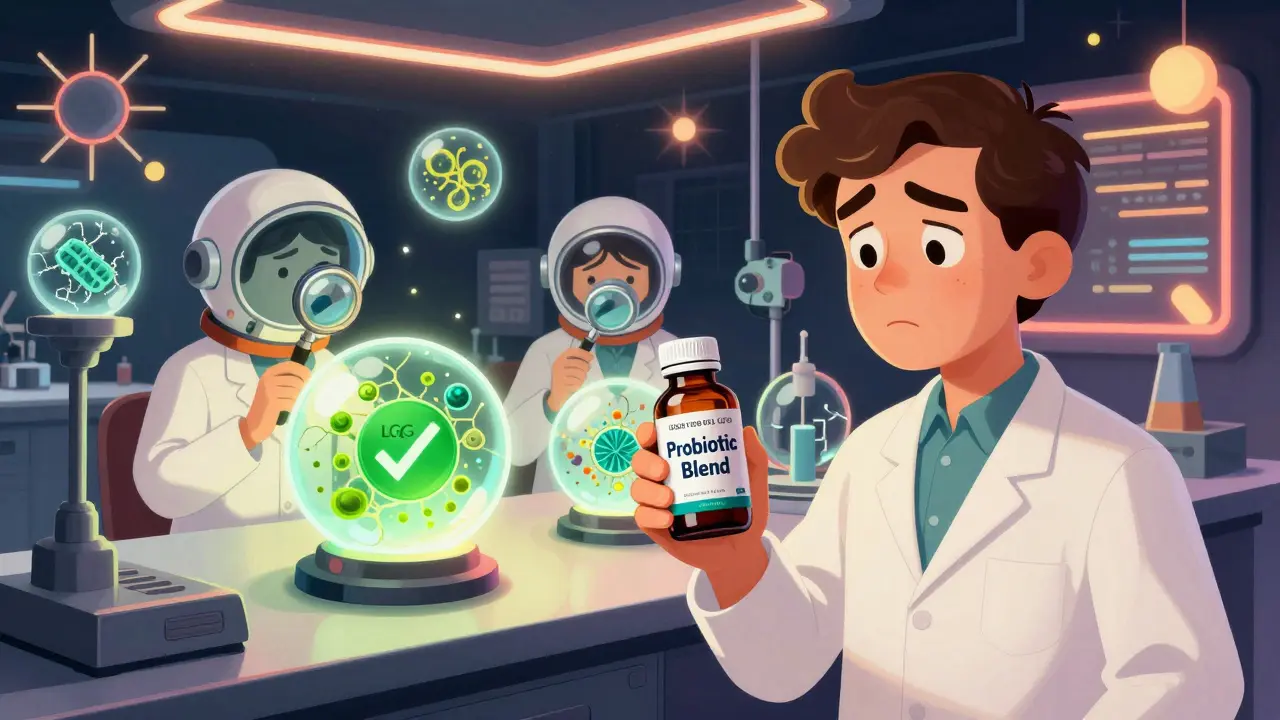
Reputable brands include Culturelle, VSL#3, Align (which has Bifidobacterium infantis 35624), and Florastor (S. boulardii). Avoid cheap store brands with no strain names listed. If the label says ‘probiotic blend’ without naming strains, walk away.
What’s Next for Probiotics?
The future isn’t in random blends. It’s in precision. Companies like Viome and Thryve now offer gut microbiome tests and then send you a custom probiotic mix based on your unique bacteria profile. It’s expensive-$150 to $300-but it’s the direction science is heading.
The FDA just gave LGG a Qualified Health Claim for reducing infectious diarrhea in children. That’s huge. It means the government officially recognizes the evidence. Other strains may follow.
But here’s the bottom line: probiotics aren’t magic. They won’t cure your IBS, reverse Crohn’s, or make you lose weight. They’re tools. And like any tool, they only work if you use the right one for the job.
Real People, Real Results
On Reddit’s r/Probiotics, one user wrote: ‘My toddler had antibiotic diarrhea for 10 days. Started LGG at 10 billion CFU. By day 3, it was gone.’ Another said: ‘Tried five brands over six months. Nothing changed.’ Both are true.
ConsumerLab found that 62% of people who saw benefits reported less bloating. 48% said they recovered faster from antibiotics. But 26% felt nothing at all. That’s the pattern. Some help. Some don’t. And you won’t know until you try-carefully.
What to Do Next
If you’re considering probiotics:
- Identify your goal: Diarrhea? Antibiotics? Bloating? IBS?
- Find a strain backed by research for that goal (LGG for diarrhea, B. infantis for IBS, S. boulardii for C. diff).
- Check the CFU count-aim for at least 10 billion for acute issues.
- Buy from a brand with third-party verification (USP, NSF).
- Take it at least two hours from antibiotics, if applicable.
- Give it 4 to 8 weeks. If nothing changes, stop.
Don’t buy a bottle because it’s on sale. Don’t follow a TikTok influencer. Use science, not hype. Your gut will thank you.
Do probiotics help with constipation?
Some probiotics may help, but the evidence is weaker than for diarrhea. Strains like Bifidobacterium lactis and Lactobacillus acidophilus NCFM have shown modest improvements in bowel frequency and stool consistency in small studies. But results are inconsistent. If constipation is your main issue, fiber, water, and movement are more reliable first steps.
Can you take probiotics every day?
Yes, most healthy adults can take probiotics daily. They’re generally safe for long-term use. But you don’t need to take them forever. If you’re using them for antibiotic recovery, stop after a couple of weeks. If you’re using them for IBS or general gut support, you can continue-but reassess every few months. If you don’t notice benefits, there’s no reason to keep spending money.
Are probiotics in yogurt enough?
Most commercial yogurts contain only a few billion CFU, and often not the strains proven to help with specific conditions. Plus, many have added sugar, which can feed bad bacteria. If you want real benefits, supplements with specific strains and higher CFU counts are more reliable. Yogurt is fine for general nutrition, but don’t rely on it as your only probiotic source.
Do probiotics need to be refrigerated?
Some do, some don’t. Strains like Lactobacillus and Bifidobacterium are often sensitive to heat and moisture, so refrigeration helps them survive. But Saccharomyces boulardii and some newer spore-forming strains are shelf-stable. Always check the label. If it says ‘refrigerate,’ do it. If it doesn’t, store it in a cool, dry place.
Can probiotics cause side effects?
Mild side effects like gas, bloating, or stomach cramps can happen in the first few days as your gut adjusts. These usually go away within a week. If they persist or get worse, stop taking them. In rare cases, people with weakened immune systems can develop infections. If you’re seriously ill, have a central line, or are post-transplant, talk to your doctor before starting.
Is there a best time of day to take probiotics?
There’s no strong evidence that taking them with or without food makes a big difference. But if you’re taking them with antibiotics, space them at least two hours apart. For general use, taking them at the same time each day helps build a habit. Many people prefer morning, with breakfast, to reduce the chance of stomach upset.
Do probiotics help with weight loss?
There’s no solid proof that probiotics cause weight loss. Some animal studies suggest certain strains might influence metabolism, but human trials are small and inconsistent. Don’t buy a probiotic because it claims to help you lose weight. Focus on proven benefits like digestion, immunity, and gut balance instead.
innocent massawe
January 4, 2026 AT 07:28Interesting post. I’ve been taking probiotics for my IBS for 6 months now - nothing changed until I switched to B. infantis 35624. Now my bloating’s down, and I don’t feel like my gut’s a warzone anymore. 🌱
Tru Vista
January 5, 2026 AT 00:08Most probiotics are snake oil. The label says ‘50 billion CFU’ but half are dead. I tested three brands - two had zero live cultures. Don’t waste your cash.
Ian Ring
January 5, 2026 AT 23:29Agreed with Tru - I bought a ‘premium’ probiotic last year. The bottle said ‘refrigerate,’ but I left it in my car for a week. Came home to find it was just… powder. 🤦♂️
Third-party certs aren’t optional. They’re essential.
Lori Jackson
January 6, 2026 AT 03:45It’s laughable how people treat probiotics like vitamins. You wouldn’t swallow a random ‘immune booster’ pill without checking the active ingredient - so why do it with gut bugs? The fact that 70% of supplements don’t even list the strain? That’s not negligence - that’s corporate malpractice.
And don’t get me started on ‘probiotic blends’ - it’s like throwing 16 different keys into a lock and hoping one turns. Science doesn’t work that way. Precision matters. Or are you just here for the placebo?
veronica guillen giles
January 6, 2026 AT 10:26Oh wow, so now we’re supposed to be microbiologists to buy yogurt? 🙄
Let me guess - next you’ll tell me I need to sequence my gut flora before I eat kimchi. Maybe I’ll just… eat food. And breathe. And not panic every time I fart.
Some of us don’t need a PhD to have a healthy gut. We just need less sugar and more sleep.
Hank Pannell
January 8, 2026 AT 04:24There’s a deeper epistemological question here: if a probiotic has no measurable effect on an individual, does it ‘work’? The science says ‘yes’ - population-level efficacy is proven. But for the individual? It’s a black box. We’re navigating a probabilistic ecosystem with binary expectations - ‘it worked’ or ‘it didn’t.’
And yet, we’re told to ‘try it for 8 weeks’ as if biology were a software update. The reductionist framing of gut health as a ‘fix’ ignores the dynamic, context-dependent nature of the microbiome. Maybe the problem isn’t the probiotic - it’s the expectation.
Angela Goree
January 9, 2026 AT 02:20Who cares about strain names?! I took Culturelle, felt better, and now I’m not spending $50 a month on little pills. You people are overcomplicating this. It’s not rocket science - it’s just bacteria. If it helps, use it. If not, stop. Done.
Wren Hamley
January 10, 2026 AT 19:25Let’s be real - probiotics are the TikTok of nutrition. Everyone’s got a ‘miracle strain’ story, and half of them are just desperate for a fix. But here’s the kicker: the ones who *do* benefit? They don’t shout about it. They just… stop having cramps. They sleep better. They don’t avoid pizza anymore.
And yeah - some of us are just lucky. Our guts don’t need a rescue team. But for others? This stuff’s a lifeline. So don’t mock the believers. Just don’t buy the crap with ‘blend’ on the label.
erica yabut
January 11, 2026 AT 03:07Of course you’re ‘just’ eating yogurt. That’s why your gut’s a mess. Real gut health isn’t for people who think ‘probiotic’ means ‘healthy yogurt.’ You need precision. You need strain-specific dosing. You need to understand that your microbiome isn’t a smoothie - it’s a symphony. And if you’re not playing the right notes, you’re just making noise.
And no, ‘natural’ doesn’t mean effective. Your kombucha is probably just sugar water with a bacterial hangover.
Sarah Little
January 11, 2026 AT 04:44Just wondering - have any of you tried taking probiotics with prebiotics? I read that symbiotics might be better for IBS, but I’m not sure which ones actually work together. Any recommendations? I’m trying to optimize.