
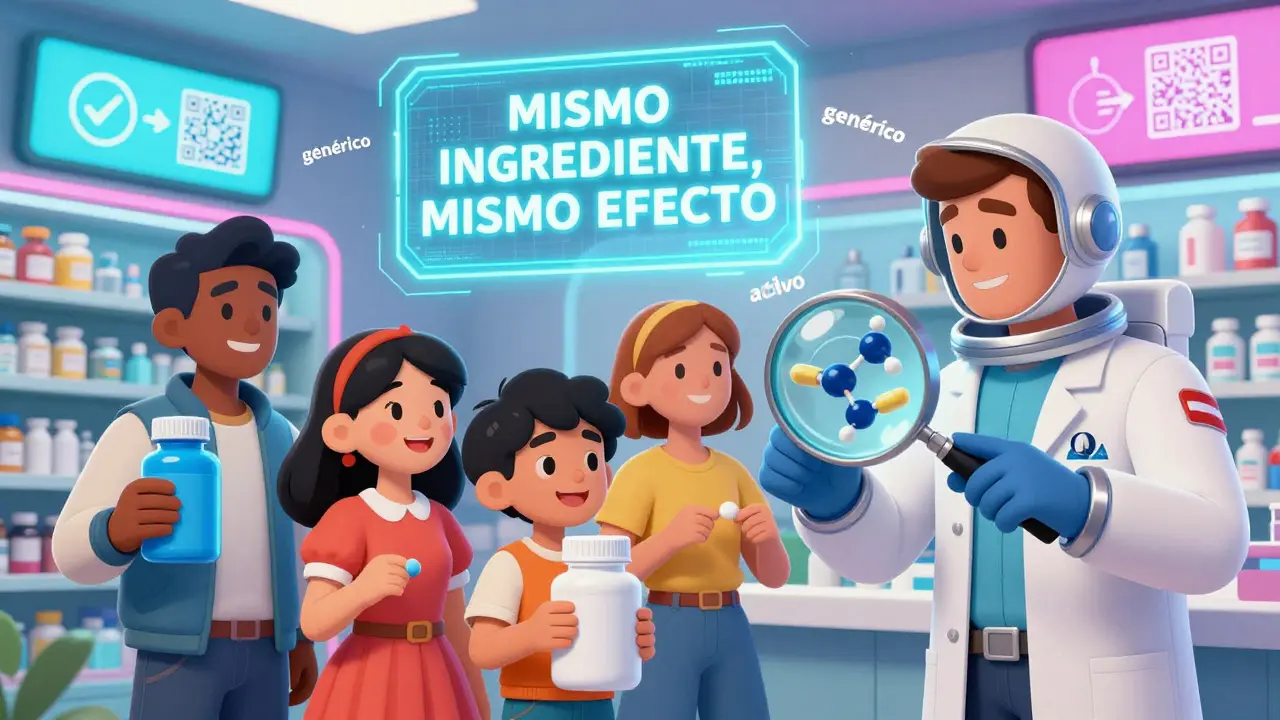
Why Spanish-Speaking Patients Need Clear Information on Generic Medications
Many Spanish-speaking patients in the U.S. avoid generic medications not because they don’t trust them, but because they don’t understand them. They see a pill that looks different from the one they’ve taken before - maybe it’s blue instead of white, or smaller, or has a different marking - and they assume it’s not the same medicine. That’s a dangerous misunderstanding. The truth is, 90% of all prescriptions filled in the U.S. are for generic drugs, and they work exactly the same as brand-name versions. The only difference? Price. Generics cost up to 80% less. But without clear, simple explanations in Spanish, patients often stop taking them - even when they’re life-saving.
What Exactly Is a Generic Medication? (In Spanish)
The term medicamento genérico doesn’t mean "cheap" or "fake." It means the same active ingredient, same dosage, same safety profile - just without the brand name and marketing costs. In Spanish, patients need to hear: "Esta medicina tiene una apariencia diferente, pero es lo mismo" - "This medicine looks different, but it is the same."
That phrase comes from Wake AHEC’s pharmacy translation card, used by clinics across the U.S. to help pharmacists explain the basics. But many patients still don’t get that message. A 2023 survey by the California Health Care Foundation found that 63% of Spanish-speaking patients worried generics weren’t as effective. That fear isn’t based on science - it’s based on silence. If no one explains what a medicamento genérico really is, patients fill the gap with their own assumptions.
Where to Find Reliable Spanish-Language Resources
Not all Spanish materials are created equal. Some are poorly translated, outdated, or use regional terms that confuse patients from different countries. Here are the most trusted sources currently available:
- Agency for Healthcare Research and Quality (AHRQ) - Their "My Medicines List" is available in Spanish and asks patients to write down both the brand and generic name, why they take it, the dose, and how often. It’s simple, practical, and updated through December 2024.
- MedlinePlus.gov - Offers a bilingual PDF comparing brand and generic names side-by-side. It’s updated quarterly and includes links to drug safety alerts in Spanish.
- Spanish Academy’s Pharmacy Vocabulary Guide (July 2023) - Covers 27 essential terms like medicamentos de venta libre (over-the-counter), receta médica (prescription), and efectos secundarios (side effects). It’s designed for patients, not professionals.
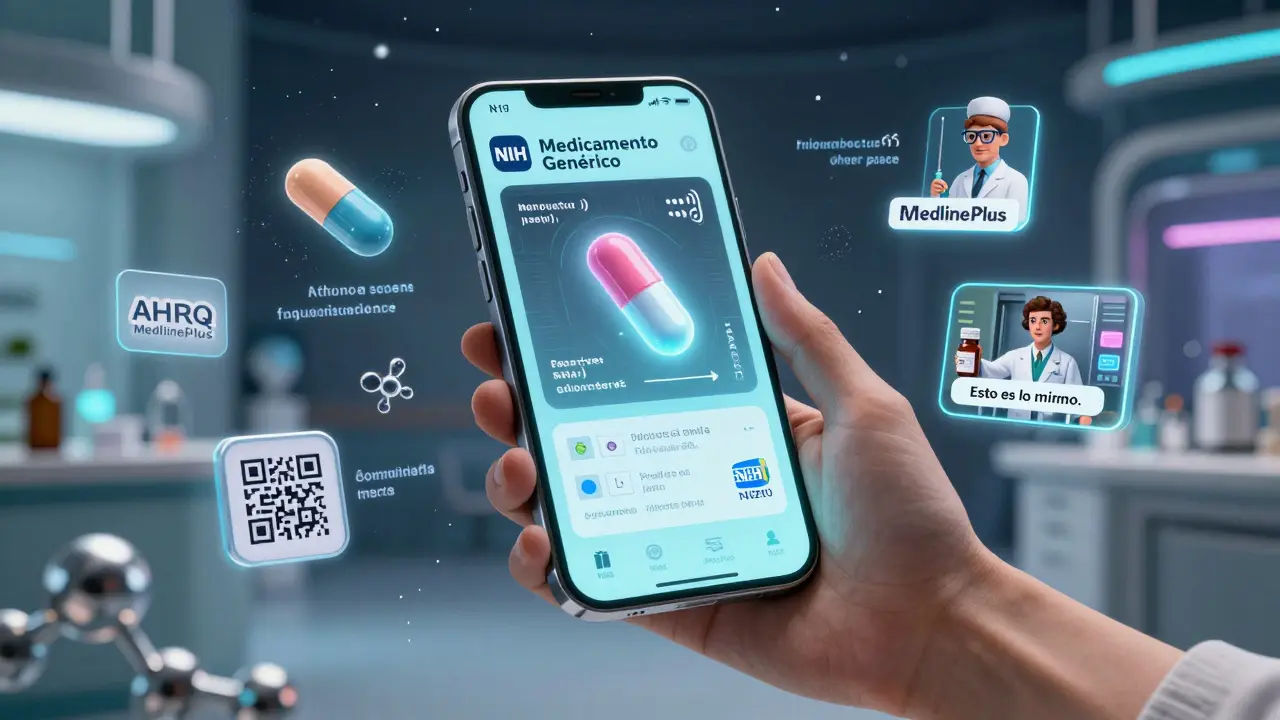
- NIH’s "Medicamento Genérico" App - Launched in September 2023, this free app lets users scan a pill, see its generic name, compare images of brand vs. generic versions, and even hear correct pronunciation of drug names.
These aren’t just translations. They’re tools built with real patient feedback. For example, the NIH app includes photos of actual pills from different manufacturers - something that helped reduce confusion by 37% in a University of Miami study.
The Problem with Regional Differences in Drug Names
One of the biggest hidden gaps in Spanish-language resources? Regional language differences. The same drug can have different names depending on where the patient is from.
Take acetaminophen. In Mexico, Colombia, and most of Latin America, it’s called acetaminofén. In Spain, it’s paracetamol. If a patient from Mexico moves to Texas and hears "paracetamol" at a pharmacy, they might think it’s a different drug - and refuse to take it. That’s not just confusing - it’s risky.
Only a few resources, like the new MedlinePlus database launched in January 2024, now flag these regional variations. Most hospital handouts still use "neutral Spanish," which tries to avoid regional terms but often ends up sounding unnatural or vague. A 2023 American Hospital Association survey found that 68% of U.S. clinics use neutral Spanish - but patients still report confusion.
What Patients Are Saying: Real Stories
On Reddit’s r/MedicalSpanish forum, a user shared how their father stopped taking his blood pressure medication after switching to a generic. "He said the pills looked wrong," the user wrote. "He thought the doctor gave him the wrong medicine. He didn’t know generics could look different."
A bilingual nurse in Los Angeles told a similar story: "I had a patient who refused her asthma inhaler because the new one was red. She said, ‘This isn’t mine.’ She’d been on the brand for years. We showed her the AHRQ guide with pictures - she cried. She said, ‘Why didn’t anyone show me this before?’"
On the flip side, a woman in San Diego said: "My dad used to spend $300 a month on his heart medication. After we used the Spanish version of the AHRQ list, we switched to the generic. Now he pays $80. He said, ‘Why didn’t they tell me this was safe?’"
These aren’t rare cases. The 2023 survey found that 78% of Spanish-speaking patients felt more confident using generics after seeing clear materials - but only if those materials showed them the truth: different look, same medicine.
How Clinics and Pharmacies Can Do Better
Many clinics hand out printed sheets with medical jargon. Terms like "bioequivalence" or "therapeutic equivalence" don’t belong in patient handouts. What works?
- Use visuals. Show side-by-side photos of brand and generic pills. Include the generic name written clearly underneath.
- Add audio. The Kaiser Permanente Spanish portal plays audio pronunciations of drug names. Patients hear "esomeprazol" as "eh-soh-meh-PRAS-ohl," not "ess-o-meh-pra-zole."
- Train staff. Wake AHEC found that pharmacists need 10-15 hours of training to use translation tools effectively. That includes learning phrases like: "El medicamento genérico tiene el mismo ingrediente activo que la marca, pero cuesta menos." (The generic has the same active ingredient as the brand, but costs less.)
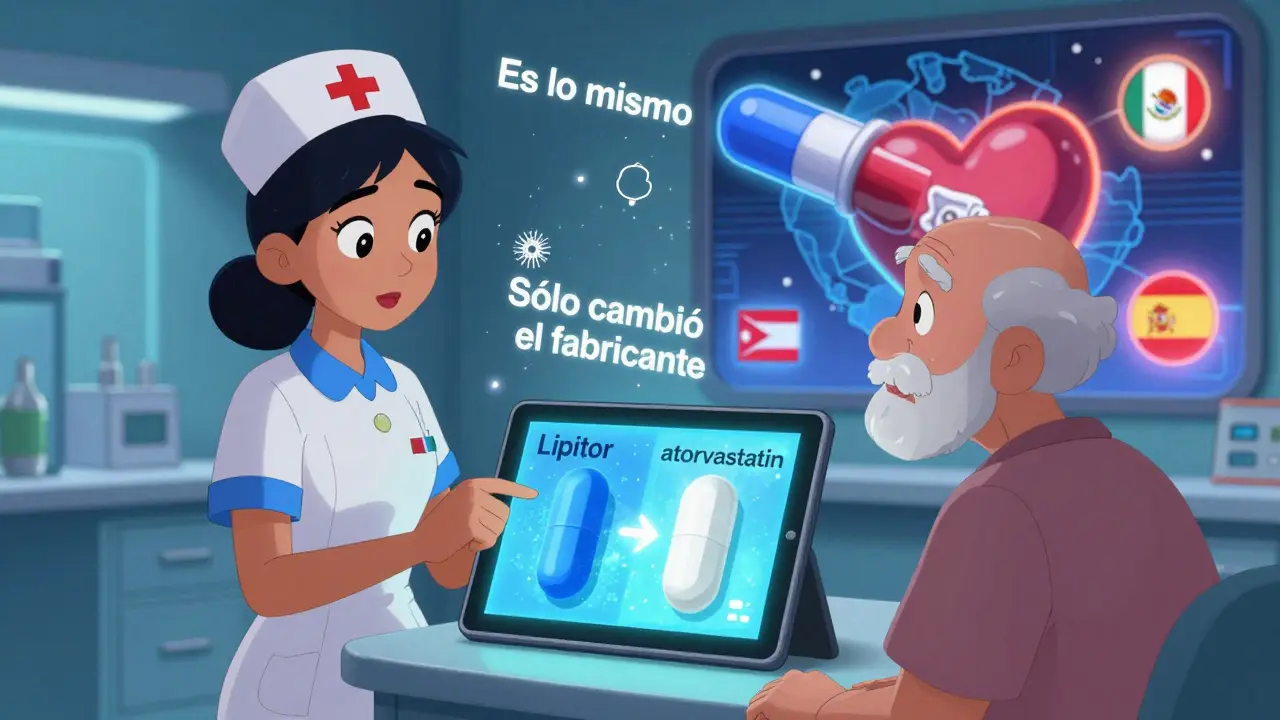
- Use QR codes. AHRQ’s 2024 update added QR codes that link to short videos in Mexican, Puerto Rican, and Colombian Spanish dialects. One video shows a pharmacist opening a pill bottle and saying: "Esto es lo mismo. Solo cambió el fabricante." (This is the same. Only the manufacturer changed.)
The Bigger Picture: Why This Matters
Generic medications save U.S. patients over $300 billion a year. But if Spanish-speaking patients don’t use them because they’re afraid or confused, those savings vanish - and so does their health.
Dr. Maria Hernandez from Harvard Medical School found that bilingual medication resources cut medication errors by 23% since 2015. But generic confusion remains one of the top three reasons patients stop taking their prescriptions. That’s not just a language problem - it’s a health equity problem.
By 2060, nearly 1 in 3 Americans will be Hispanic. If we don’t fix how we explain generics now, we’ll face a wave of preventable hospitalizations, uncontrolled chronic diseases, and wasted healthcare dollars.
What You Can Do Today
If you’re a patient or caregiver:
- Ask your pharmacist: "¿Tiene la versión genérica de esa medicina?" (Do you have the generic version?)
- Request the AHRQ "My Medicines List" in Spanish.
- Download the NIH "Medicamento Genérico" app - it’s free and works offline.
- Take a picture of your pills and compare them to the app’s images.
If you’re a healthcare worker:
- Stop using generic English translations. Use approved Spanish resources - not Google Translate.
- Keep printed AHRQ and MedlinePlus materials in your waiting room.
- Use the visual pill comparison tools in your electronic records. Epic Systems now has this built-in.
- Don’t assume patients understand "generic." Always explain it with words and pictures.
Frequently Asked Questions
What does "medicamento genérico" mean in English?
"Medicamento genérico" means "generic medication" in English. It refers to a drug that contains the same active ingredient, dosage, and safety profile as the brand-name version, but is sold under its chemical name and usually costs much less. It is not a copy, substitute, or lower-quality version - it is the same medicine approved by the FDA.
Why do generic pills look different from brand-name ones?
Generic pills look different because U.S. law requires them to have a different color, shape, or marking than the brand-name version. This is to avoid trademark infringement. But the active ingredient - the part that makes the medicine work - is identical. For example, the generic version of Lipitor (atorvastatin) might be white and oval, while the brand is blue and diamond-shaped. Both lower cholesterol the same way.
Are generic medications safe?
Yes. The FDA requires generic drugs to meet the same strict standards as brand-name drugs for quality, strength, purity, and performance. They must prove they work the same way in the body - a process called bioequivalence. Studies show generics are just as effective and safe. Over 90% of prescriptions in the U.S. are for generics, and they’ve been used safely for decades.
What if I hear different names for the same drug in Spanish?
Some drugs have different names in different Spanish-speaking countries. For example, acetaminophen is called "acetaminofén" in Latin America and "paracetamol" in Spain. Both are the same medicine. The NIH "Medicamento Genérico" app and updated MedlinePlus resources now list both names to avoid confusion. Always check the active ingredient, not just the brand or regional name.
Can I trust Spanish-language resources from the internet?
Only trust resources from official health organizations like AHRQ, MedlinePlus, NIH, or the FDA. Many websites translate content poorly or use outdated information. Avoid blogs, social media posts, or apps that aren’t linked to government or medical institutions. The best resources are updated regularly and include visual aids, audio pronunciations, and clear explanations - not just translations.
Lily Steele
January 30, 2026 AT 17:44Just saw my abuela take her blood pressure med and ask if it was the same because the pill was white instead of blue. She cried when I showed her the NIH app. Why don’t clinics just hand these out at pickup?
Melissa Cogswell
February 1, 2026 AT 11:39The AHRQ 'My Medicines List' is a game-changer. I’ve used it in my clinic for two years. Patients who used to skip doses now bring the list back with notes. Simple tools > complex pamphlets. Also, the QR codes linking to regional dialect videos? Genius. We should be pushing this everywhere.
Beth Beltway
February 3, 2026 AT 02:07Let’s be real - this whole thing is just government overreach disguised as 'health equity.' Why should taxpayers fund apps and videos just because some people can’t read? If you can’t understand basic medical terms, maybe you shouldn’t be taking pills at all. This isn’t a language problem - it’s a responsibility problem.
Marc Bains
February 4, 2026 AT 16:31Actually, Beth, that’s not how medicine works. Health equity isn’t about blame - it’s about access. You think someone who works two jobs and doesn’t speak English fluently should magically understand bioequivalence? We don’t expect non-engineers to read circuit diagrams. Why should we expect patients to decode pharmaceutical jargon? The solution isn’t to shame them - it’s to meet them where they are.
Russ Kelemen
February 5, 2026 AT 21:45I’ve been a bilingual nurse for 18 years. The biggest issue isn’t translation - it’s timing. Patients get handed a sheet in the ER while panicking. No one sits with them. No one shows them the pill pictures. The NIH app? It’s free. It’s offline. It’s real. But if you hand it to someone and walk away? It’s useless. We need to train staff to use it - not just have it on a shelf.
Lisa McCluskey
February 6, 2026 AT 02:23My mom’s from Guatemala and she used to refuse her diabetes meds because the generic looked different. We found the MedlinePlus PDF. Showed her the side-by-side images. She said, 'So it’s not poison?' I cried. We need more of this - not just in clinics, but in churches, community centers, even laundromats.
Diksha Srivastava
February 7, 2026 AT 11:03This is hope. I’m from India and I’ve seen how language gaps hurt patients here too. But seeing this work in the U.S. gives me faith. Change is slow, but tools like the pill scanner? That’s the future. Keep building these. People are listening.
Blair Kelly
February 8, 2026 AT 11:21Let’s not sugarcoat this: the FDA’s 'same active ingredient' line is a legal loophole. The bioequivalence standards are laughably low. Some generics vary by 10-15% in absorption. That’s not 'the same.' That’s a gamble. And now we’re pushing them on elderly patients who can’t afford to gamble? This isn’t equity - it’s cost-cutting disguised as compassion.
owori patrick
February 9, 2026 AT 17:25In Nigeria, we call paracetamol 'paracetamol' - but many don’t know it’s the same as acetaminophen. We have the same problem. The solution isn’t just translation - it’s context. People need to see the pill, hear the name, feel safe. Your NIH app? We’re sharing it in our community groups. Thank you for making this real.
Rohit Kumar
February 10, 2026 AT 16:34There’s a deeper truth here: medicine is not neutral. The color, shape, even the ink on a pill carries cultural meaning. In some Latin American communities, white pills = purity, blue = danger. In Spain, a red pill = emergency. We’re not just translating words - we’re translating trauma. The fact that a 2023 study showed 37% less confusion with visual aids? That’s not data. That’s healing.
Sarah Blevins
February 12, 2026 AT 10:53According to the CDC’s 2023 adverse event database, there’s no statistically significant difference in adverse reactions between brand-name and generic cardiovascular drugs in Spanish-speaking populations. The fear is psychological, not pharmacological. The real issue is the absence of consistent, culturally competent education - not the pills themselves.
Mike Rose
February 12, 2026 AT 20:53bro why do we even have to do all this? like, just give them the same pill. why does it have to be a different color? its dumb. also the app is kinda cringe
Holly Robin
February 13, 2026 AT 03:17THIS IS A BIG PHARMA SCAM. The FDA lets generics in because they’re paid off. The 'same active ingredient' is a lie - they use cheaper fillers that cause inflammation. My cousin got seizures after switching. They don’t want you to know this. The app? It’s tracking you. Don’t download it. Fight back.