
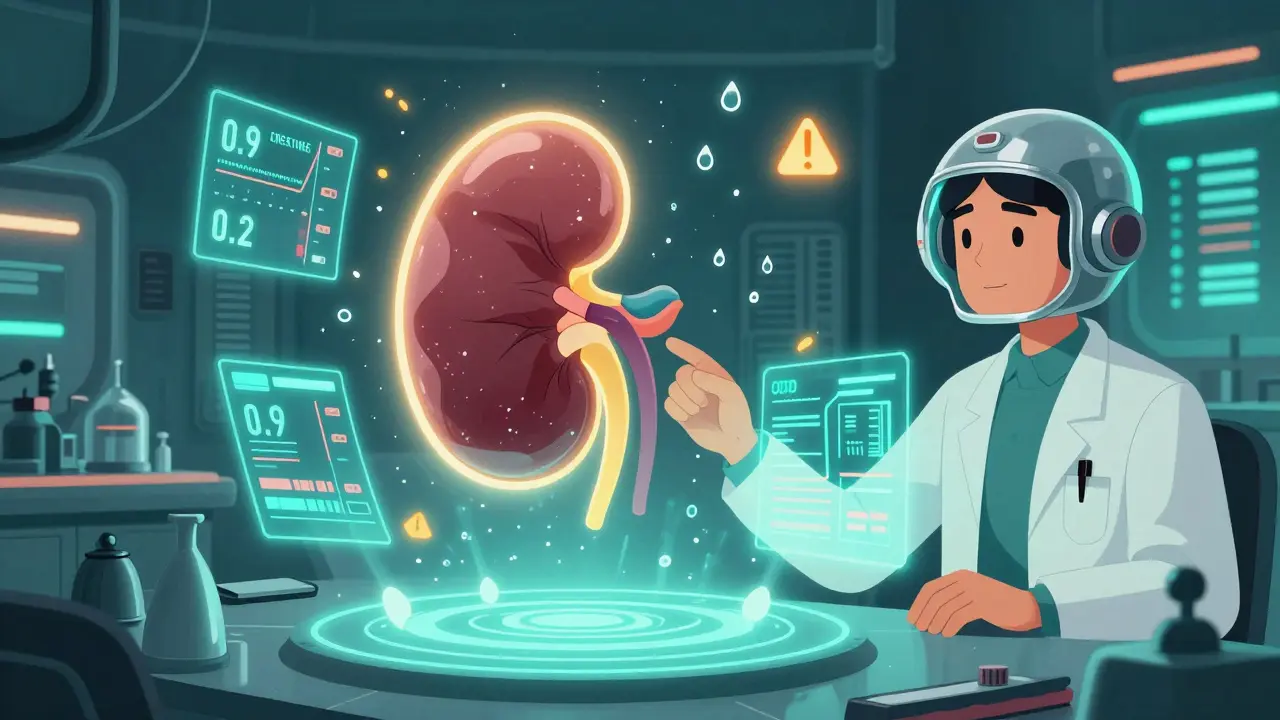
When your kidneys suddenly stop working the way they should, it doesn’t always come with a warning. You might feel fine one day, then wake up exhausted, swollen, or confused the next. This isn’t just fatigue-it could be acute kidney injury (AKI), a rapid drop in kidney function that can turn dangerous within hours. Unlike chronic kidney disease, which creeps in over years, AKI happens fast. And if caught early, it often reverses completely. But if missed? The consequences can be life-altering-or fatal.
What Exactly Is Acute Kidney Injury?
AKI, once called acute renal failure, is now understood as any sudden drop in how well your kidneys filter waste and balance fluids. The change doesn’t have to be huge. Even a small rise in creatinine-a waste product measured in blood tests-can signal trouble. According to the KDIGO guidelines used worldwide, AKI is diagnosed when:
- Serum creatinine increases by 0.3 mg/dL or more within 48 hours, or
- It rises by 50% or more from your baseline over 7 days, or
- You produce less than 0.5 mL of urine per kilogram of body weight per hour for 6 hours straight.
This shift in definition matters. It means even mild kidney stress is taken seriously now. A creatinine jump from 0.9 to 1.2 might seem small, but it can mean your kidneys are struggling to keep up. And that’s enough to trigger serious complications if left alone.
How Do You Know You Have It?
Symptoms vary wildly. Some people feel terrible right away. Others show no signs at all. About 22% of AKI cases are found only during routine blood tests-no symptoms, no warning.
When symptoms do appear, they’re often vague:
- Urine output drops below 400 mL a day (oliguria) or stops completely (anuria)
- Swelling in legs, ankles, or face from fluid buildup (seen in 68% of cases)
- Shortness of breath from fluid in the lungs (42% of hospitalized patients)
- Extreme fatigue (75% of cases)
- Nausea, vomiting, or loss of appetite (58%)
- Confusion or drowsiness (33% of older adults)
- Chest pain from inflammation around the heart (15% in severe cases)
And here’s the catch: if you’ve got a blocked ureter, an enlarged prostate, or kidney stones, you might still pee normally-even while your kidneys are failing. That’s why doctors don’t rely on symptoms alone. Blood tests and ultrasounds are essential.
What Causes It? Three Main Paths
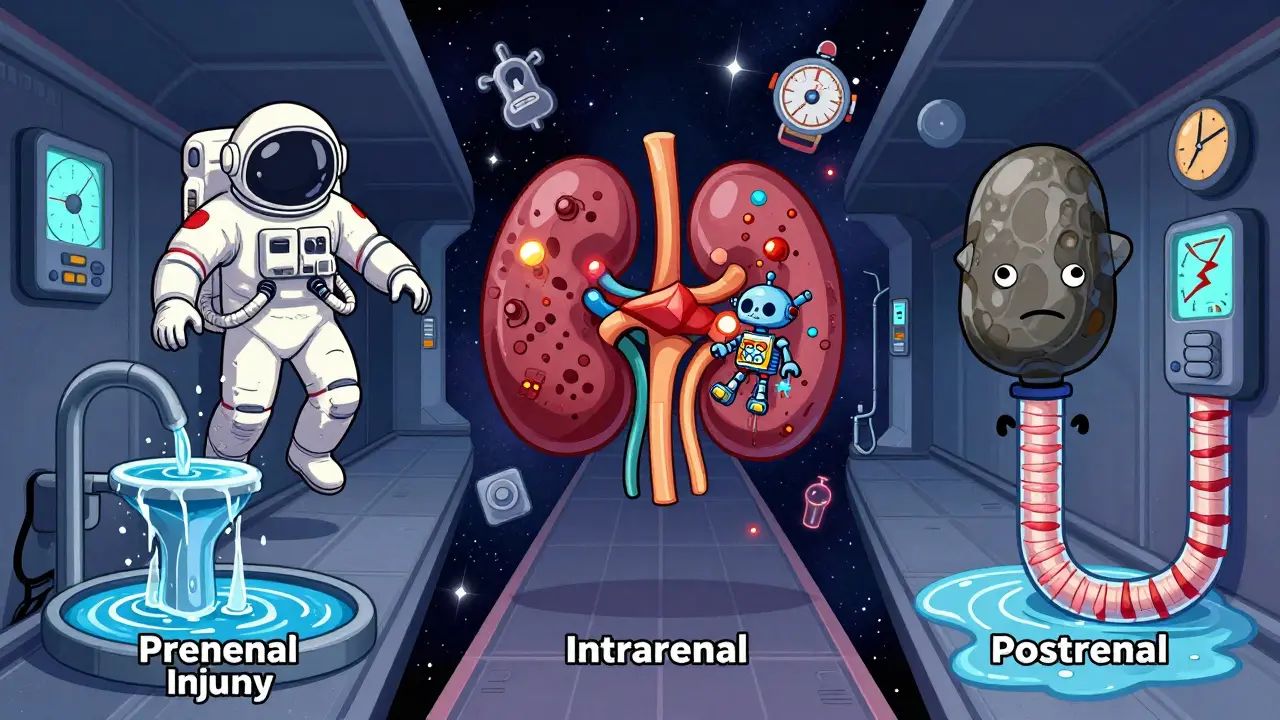
AKI doesn’t happen randomly. It follows three clear patterns, each with its own trigger and treatment.
1. Prerenal (60-70% of cases)
Your kidneys aren’t damaged-they’re just not getting enough blood. This is the most common cause. Think:
- Severe dehydration from vomiting, diarrhea, or not drinking enough (15-20% of community cases)
- Low blood pressure from infection (sepsis), heart failure, or major bleeding
- Medications like NSAIDs (ibuprofen, naproxen) or ACE inhibitors that lower blood pressure too much
Fixing this often means giving fluids-500 to 1000 mL of saline in the ER-and stopping harmful drugs. In 70% of these cases, kidney function returns within 24 to 48 hours.
2. Intrarenal (25-35% of cases)
This is when the kidney tissue itself is damaged. The most common culprit? Acute tubular necrosis (ATN), where the tiny filtering tubes in the kidney die off. It’s often caused by:
- Severe infections or shock
- Nephrotoxic drugs like aminoglycoside antibiotics (10-15% of hospital cases)
- Contrast dye used in CT scans (5-15% risk)
- Autoimmune diseases like lupus (3-5%)
Recovery here is slower. It can take weeks. Some people regain full function. Others are left with lasting damage. The key? Stop the poison-like stopping the antibiotic or avoiding more contrast-and let the kidneys heal. Immunosuppressants can help if lupus or glomerulonephritis is the cause.
3. Postrenal (5-10% of cases)
This is all about blockage. If urine can’t leave the body, pressure builds up and backs up into the kidneys. Common causes:
- Enlarged prostate in men over 60 (65% of obstructive cases)
- Kidney stones blocking both ureters (20%)
- Cancer pressing on the ureters (10-15%)
Relieving the blockage-usually with a stent or catheter-can reverse AKI in 90% of cases. Speed is critical. The longer the blockage lasts, the more damage it does.
What Happens If It’s Not Treated?
Untreated AKI doesn’t just stay stuck-it gets worse. Fluid overload can flood your lungs. Potassium builds up dangerously high (hyperkalemia), which can stop your heart. Acid builds up in your blood. Your heart lining can swell (pericarditis). And in the worst cases, your body just can’t process waste anymore.
Even if you survive, the damage doesn’t always vanish. One in five people who have AKI end up with chronic kidney disease within a year. Each episode increases your risk of needing dialysis later by more than eight times. And if you needed dialysis during your AKI? Only 25% fully recover kidney function after three months.
How Is It Diagnosed?
Doctors don’t guess. They test.
- Serum creatinine and BUN: These rise when kidneys aren’t filtering well. A creatinine over 1.4 mg/dL in men or 1.2 in women is a red flag.
- Urine output: Measured hourly in ICU patients. Less than 0.5 mL/kg/hour for 6 hours = AKI.
- FeNa (fractional excretion of sodium): Under 1% suggests prerenal (kidneys are holding onto sodium). Over 2% suggests intrinsic damage.
- Renal ultrasound: Used in 85% of cases to check kidney size and look for blockages. A swollen kidney? Could be obstruction. A shrunken one? Could be chronic damage.
- CT urography: 95% accurate for spotting kidney stones causing blockage.
New tools are emerging too. Biomarkers like NGAL (neutrophil gelatinase-associated lipocalin) can detect kidney stress 24 to 48 hours before creatinine rises. In trials, using these tests improved early treatment by 30%.
How Is It Treated?
Treatment depends entirely on the cause.
Prerenal AKI
- IV fluids: 500-1000 mL saline bolus. Often works in hours.
- Stop nephrotoxic drugs: NSAIDs, diuretics, ACE inhibitors.
- Treat the root cause: antibiotics for infection, fluids for dehydration, heart support for failure.
Intrarenal AKI
- Stop the toxin: Discontinue the drug causing damage. Recovery begins within 72 hours in 65% of cases.
- Immunosuppressants: Steroids for glomerulonephritis or lupus nephritis. Success rate: 50-70%.
- Plasmapheresis: For conditions like hemolytic uremic syndrome. Works in 80% if started within 24 hours.
Postrenal AKI
- Relieve obstruction: Ureteral stent, catheter, or surgery. 90% improve immediately.
- Remove stones or treat cancer.
For the worst cases-when toxins, fluid, or potassium reach life-threatening levels-dialysis becomes necessary. About 5-10% of hospitalized AKI patients need hemodialysis. In ICU settings, continuous renal replacement therapy (CRRT) is used in 15-20% of cases. Peritoneal dialysis is rare but used if veins are too damaged for IV access.
Can You Recover Fully?
Yes-often. But it’s not guaranteed.
- Prerenal AKI: 70-80% recover fully in 7-10 days if treated early.
- Intrarenal AKI: 40-60% recover partially or fully over 2-6 weeks. ATN with prolonged low urine output? Only 20-30% fully bounce back.
- Postrenal AKI: 90% recover if obstruction is cleared fast.
But some factors make recovery harder:
- Age over 65: 35% lower chance of full recovery
- Pre-existing kidney disease (eGFR under 60): 50% lower recovery odds
- AKI lasting more than 7 days: 2.3x higher risk of incomplete recovery
- Needing dialysis: Only 25% regain full kidney function at 3 months
Even if creatinine levels return to normal, many people feel drained for months. A 2022 survey of over 1,200 AKI survivors found 68% had lasting “kidney fatigue”-a deep exhaustion that made walking short distances exhausting. Nearly half reported anxiety about their kidney health. Recovery isn’t just physical. It’s mental too.
What’s Next? The Future of AKI Care
Doctors aren’t waiting for symptoms anymore. New tech is changing everything.
- AI alerts: Hospitals are using algorithms to scan EHRs and flag patients at risk of AKI 12-24 hours before it happens. Early results show a 20-30% drop in incidence.
- Biomarkers: TIMP-2 and IGFBP7 can predict severe AKI in kids with 85% accuracy before creatinine rises.
- Early dialysis: The STARRT-AKI trial found that starting dialysis sooner in severe cases cut 90-day death rates by 9%.
And the cost? AKI adds $10,000-$15,000 to every hospital stay. In the U.S. alone, it costs $10 billion a year. Preventing it isn’t just better for patients-it’s better for the system.
What Should You Do?
If you’re at risk-elderly, diabetic, on blood pressure meds, recently hospitalized-ask your doctor to check your creatinine every 24-48 hours. If you’re in the ICU, make sure your urine output is tracked hourly. If you’ve had AKI before, get your kidney function checked every 3-6 months.
Hydration matters. Avoid NSAIDs if you’re dehydrated or sick. Don’t ignore swelling, fatigue, or reduced urination. And if you’re ever unsure? Get a blood test. Sometimes, the only sign of AKI is a number on a lab report.
Your kidneys don’t shout. They whisper. Listen before it’s too late.
Can acute kidney injury be reversed?
Yes, in many cases. If caught early and the cause is treated-like dehydration, infection, or a blockage-kidney function often returns to normal within days to weeks. Prerenal and postrenal AKI have the highest recovery rates. Intrarenal cases take longer and may leave some lasting damage, especially if dialysis was needed.
What are the most common causes of acute kidney injury?
The top three causes are: (1) reduced blood flow to the kidneys (prerenal), often from dehydration, heart failure, or sepsis; (2) direct kidney damage from medications, infection, or toxins (intrarenal); and (3) blockage of urine flow (postrenal), usually from an enlarged prostate or kidney stones. Prerenal causes account for 60-70% of cases.
How long does it take to recover from acute kidney injury?
Recovery time varies. Prerenal AKI often improves in 24-48 hours. Intrarenal cases can take 2-6 weeks. If you had severe damage or needed dialysis, recovery may take months-or never fully happen. Age, pre-existing kidney disease, and how long AKI lasted all affect outcomes.
Can you have acute kidney injury without symptoms?
Yes. About 22% of AKI cases show no symptoms at all. They’re found only during routine blood tests. That’s why doctors monitor creatinine and urine output closely in high-risk patients-like those in the hospital or ICU.
Is acute kidney injury the same as chronic kidney disease?
No. AKI is sudden and often reversible. Chronic kidney disease (CKD) develops slowly over months or years and is usually permanent. But AKI can lead to CKD. About 23% of AKI survivors develop stage 3 or higher CKD within one year.
What can I do to prevent acute kidney injury?
Stay hydrated, especially when sick. Avoid NSAIDs like ibuprofen if you’re dehydrated or have kidney issues. Monitor your blood pressure and diabetes. If you’re hospitalized, ask for creatinine checks every 24-48 hours. If you’ve had AKI before, get regular kidney function tests. Prevention is easier than recovery.
Jeff Card
March 2, 2026 AT 18:31I had AKI after a bad bout of the flu last year. Felt fine until I couldn’t get out of bed. Turns out my creatinine was triple what it should’ve been. No swelling, no pain-just exhaustion. They gave me fluids and told me to stop my ibuprofen. Within 36 hours, I was back to normal. Scary how silent it can be.
Now I check my numbers every time I’m sick. Seriously, if you’re over 50 and on blood pressure meds? Ask for a simple blood test. It takes five minutes and could save your kidneys.
Matt Alexander
March 4, 2026 AT 10:50Prerenal is way more common than people think. A lot of folks think their kidneys just ‘gave out’ but it’s usually dehydration or meds. I’ve seen it in the ER a hundred times. Old guy takes his blood pressure pill, skips water for two days, gets dizzy-boom, AKI. Fixing it? Fluids and stopping the NSAIDs. Done. No dialysis needed. Simple as that.
marjorie arsenault
March 4, 2026 AT 21:54My mom had AKI after her hip surgery. She didn’t even know something was wrong. They caught it because they were tracking her urine output hourly. That’s the key-hospitals need to be more proactive. Not everyone gets checked. But if you’re at risk, ask. Don’t wait for symptoms. You’re not being dramatic-you’re being smart.
And if you’re a caregiver? Learn the signs. Fatigue, swelling, less pee. Tiny things. Big consequences.
Deborah Dennis
March 6, 2026 AT 20:40Shivam Pawa
March 8, 2026 AT 04:37Diane Croft
March 8, 2026 AT 13:08It’s not just about the numbers. It’s about how you feel afterward. I recovered physically but felt broken for months. Like my body didn’t trust itself anymore. I’d walk to the mailbox and need to sit down. No one talks about that. The mental toll is real. You’re not ‘fine’ just because your creatinine is normal. Healing takes time. Be kind to yourself.
tatiana verdesoto
March 9, 2026 AT 18:17My cousin is a nurse in Chicago. She told me about a 78-year-old man who came in with ‘just a cough.’ Turned out he had sepsis and AKI. They didn’t test his creatinine until day three. By then, he was in dialysis. He’s still not fully recovered. If they’d checked on day one? He’d be home. This isn’t rocket science. It’s routine. Why isn’t it routine? Because we’re too busy. And that’s dangerous.
Justin Rodriguez
March 10, 2026 AT 06:46Postrenal is underdiagnosed. Men over 60? Get a prostate check. Seriously. If you’re peeing less, or it’s weak, or you feel like you’re never done-go see someone. Don’t wait for swelling or fatigue. That’s too late. A simple catheter can save your kidneys. It’s not embarrassing. It’s smart. And if you’re a woman with kidney stones? Don’t ignore flank pain. It’s not just ‘a bad cramp.’
Raman Kapri
March 10, 2026 AT 18:32RacRac Rachel
March 12, 2026 AT 15:53Just had my third kidney check since last year’s episode. Creatinine back to normal. Feeling 90%. Took 4 months. But I’m alive. And I’m grateful. If you’re reading this and you’re scared? You’re not alone. Recovery is slow, but it’s possible. I walk my dog every morning now. Two blocks. That’s my victory. Small steps. Big wins.
Stay strong.
Jane Ryan Ryder
March 13, 2026 AT 21:09Callum Duffy
March 14, 2026 AT 14:20It is worth noting that the KDIGO guidelines have been instrumental in standardising AKI diagnosis globally. The shift from a binary 'renal failure' model to a graded, biomarker-informed framework represents a significant evolution in clinical practice. That said, resource disparities remain a critical barrier in low-income settings, where even basic serum creatinine testing is not universally accessible. The ethical imperative is clear: equitable access to diagnostics must precede any discussion of recovery rates.
Chris Beckman
March 14, 2026 AT 16:13Levi Viloria
March 15, 2026 AT 08:11My grandfather was from rural India. He never saw a doctor until he couldn’t urinate. Turned out he had a stone blocking both ureters. They put in a catheter. He went home the next day. No fancy tests. No labs. Just a needle and a chance. We don’t need AI or biomarkers to save lives. We need access. We need care. We need to stop treating kidneys like a luxury.
Dean Jones
March 16, 2026 AT 15:44It’s fascinating how we’ve reduced a biological process as complex as renal filtration into a checklist of creatinine thresholds and urine outputs. But what does this really tell us? Are we diagnosing disease-or just statistical deviation? The kidney is not a filter. It’s an organ that maintains homeostasis through intricate hormonal, neural, and vascular feedback loops. We treat it like a clogged pipe, but it’s more like a symphony orchestra-one note out of tune, and the whole piece collapses.
And yet, we don’t ask: Why does this happen? Why now? Why this person? We fix the number, not the person. We treat the lab, not the life. And in doing so, we lose sight of what healing truly means. Recovery isn’t just about creatinine returning to baseline. It’s about restoring dignity. Trust. A sense of bodily autonomy. That’s the part no algorithm can measure. And that’s the part we’re forgetting.