
Bleeding Risk Estimator
This tool calculates your increased bleeding risk when taking SSRIs with anticoagulants based on your HAS-BLED score. According to the article, 33% higher risk means 6 extra bleeds per 1,000 patients.
Your Personalized Risk
Base bleeding risk (anticoagulant alone): 18 per 1,000 patients/year
Increased risk (with SSRI): per 1,000 patients/year
Additional bleeds: per 1,000 patients/year
Alternative Options
For high-risk patients (score ≥3): Consider mirtazapine or bupropion which carry little to no added bleeding risk.
Based on the article: "The American Psychiatric Association says these can be good alternatives, especially for people with high bleeding risk."
Important Warning
The risk is highest in the first 30 days. Watch for:
- Unusual bruising
- Nosebleeds that won't stop
- Dark or bloody stools
- Severe headaches or sudden weakness
Call your doctor immediately if you experience any of these symptoms.
When you’re on blood thinners like warfarin, apixaban, or rivaroxaban, even small changes in your medication routine can have big consequences. Add an SSRI-like sertraline, escitalopram, or fluoxetine-for depression or anxiety, and you’re stepping into a hidden risk zone: increased bleeding. This isn’t theoretical. It’s backed by large, real-world studies showing a 33% higher chance of serious bleeding when these drugs are taken together.
Why SSRIs and Blood Thinners Don’t Play Nice
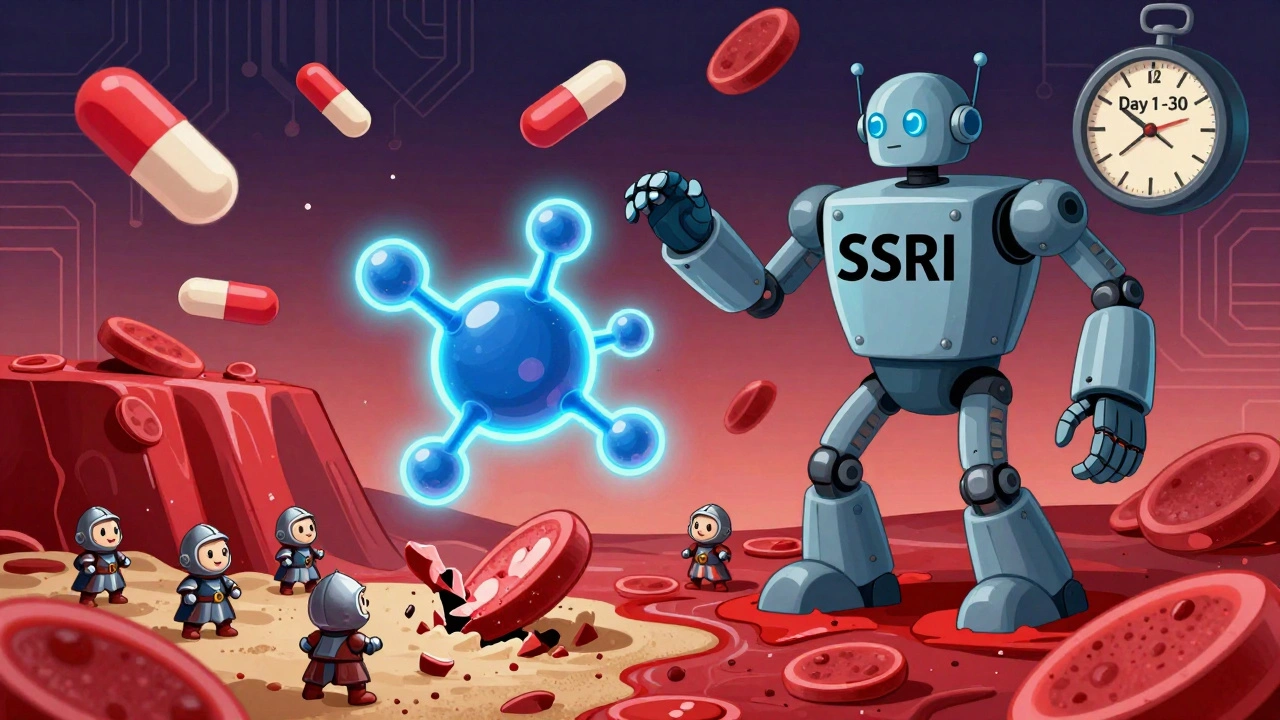
SSRIs work by boosting serotonin in the brain to improve mood. But serotonin isn’t just a brain chemical. It’s also stored inside platelets, the tiny blood cells that help clots form. When you take an SSRI, it blocks the serotonin transporter on platelets. That means platelets can’t take in serotonin from the blood. Over time, their serotonin stores drop by 90% or more. Without enough serotonin, platelets don’t stick together properly. Think of it like trying to build a dam with wet sand instead of dry gravel. The pieces just slide apart. This leads to weaker clots, even when your blood is otherwise normal. That’s why bleeding risk goes up-even if your INR or other clotting tests look fine.The Numbers Don’t Lie
A 2024 study of over 42,000 people on anticoagulants found that those also taking SSRIs had a 33% higher chance of major bleeding. That’s not a small increase. It means for every 1,000 people on an anticoagulant alone, about 18 will have a serious bleed in a year. Add an SSRI, and that number jumps to 24. That’s six extra bleeds per 1,000 patients-enough to fill a small hospital ward over a year. The biggest danger? The first 30 days. Bleeding risk spikes right after you start the SSRI. After six months, the risk drops significantly. That’s why doctors need to watch you closely during the first month. It’s not a lifelong danger-it’s a startup hazard.Where Do the Bleeds Happen?
Not all bleeds are the same. Most are gastrointestinal-about 58% of cases. That means stomach ulcers, bleeding in the intestines, or even bloody stools. These can be silent at first. You might just feel tired or notice dark, tarry stools. Then there’s intracranial bleeding-bleeding in the brain. That’s rare, but deadly. It accounts for 17% of cases. Other major bleeds, like muscle or joint bleeds, make up the rest. The risk isn’t equal across all anticoagulants. Warfarin, the older blood thinner, carries a higher risk when paired with SSRIs than the newer DOACs like apixaban or dabigatran. One study showed a 28% increase with warfarin versus 22% with DOACs. That difference isn’t huge, but every percentage point matters when you’re talking about brain bleeds.Not All SSRIs Are Created Equal
You might think the strongest SSRI-like paroxetine-would be the most dangerous. But that’s not what the data shows. The same 2024 study found no difference in bleeding risk between high-potency SSRIs like paroxetine and lower-potency ones like escitalopram. Even though paroxetine blocks serotonin reuptake more aggressively, it doesn’t cause more bleeding. The same goes for sertraline, fluoxetine, and citalopram. All carry the same level of risk. This contradicts earlier assumptions. Some smaller studies in the past suggested certain SSRIs were safer. But those were based on small groups or flawed methods. The latest, largest analysis clears that up: it’s not about which SSRI you pick-it’s about taking any SSRI with a blood thinner.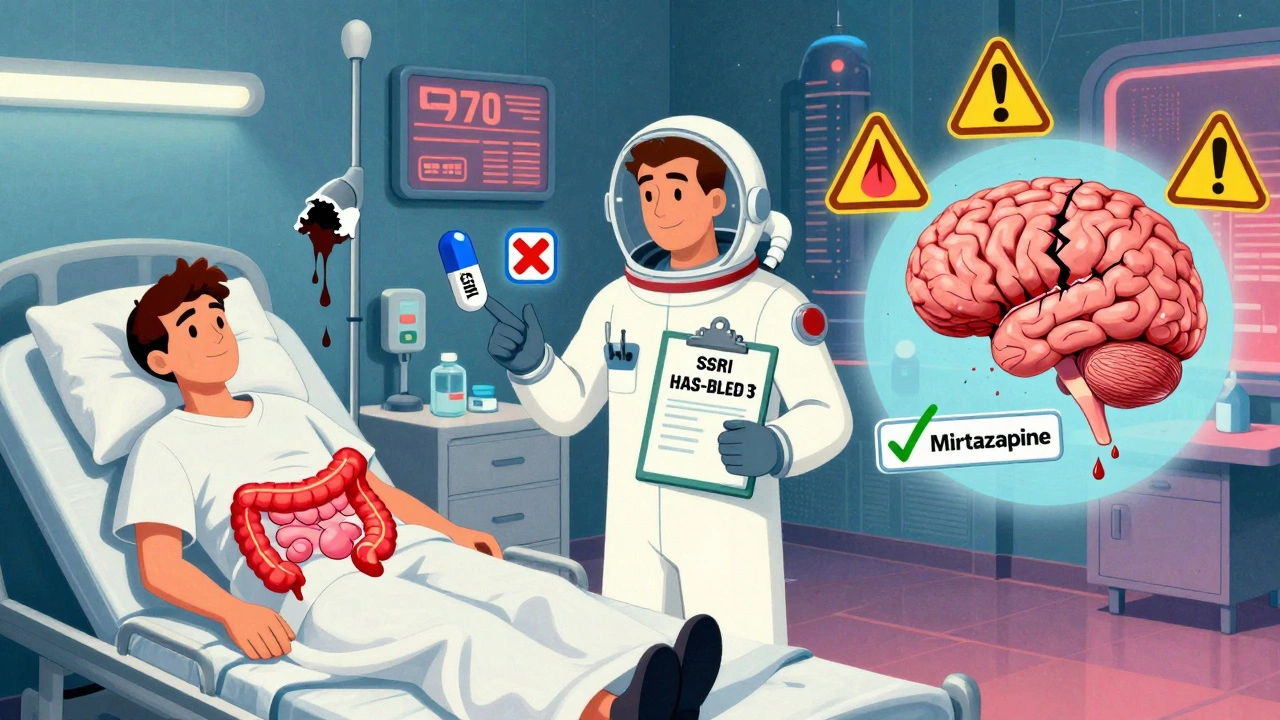
What About Other Antidepressants?
If you’re on a blood thinner and need an antidepressant, SSRIs aren’t your only option. Two alternatives stand out: mirtazapine and bupropion. Mirtazapine doesn’t affect platelet serotonin at all. It works on different brain receptors. Bupropion is a norepinephrine-dopamine reuptake inhibitor-it doesn’t touch serotonin. Both have been shown in studies to carry little to no added bleeding risk when used with anticoagulants. The American Psychiatric Association says these can be good alternatives, especially for people with high bleeding risk. That includes older adults, people with kidney disease, those on aspirin or NSAIDs, or anyone with a history of ulcers or GI bleeds.Who’s at Highest Risk?
Not everyone on this combo will bleed. But some people are far more vulnerable. The HAS-BLED score is the tool doctors use to measure bleeding risk. It looks at things like high blood pressure, kidney or liver disease, previous bleeds, and age over 65. If your HAS-BLED score is 3 or higher, you’re in the high-risk group. For these patients, switching from an SSRI to mirtazapine or bupropion isn’t just a suggestion-it’s often the safer choice. The European Heart Rhythm Association recommends this approach. But here’s the catch: 87% of anticoagulated patients with depression still get SSRIs. Why? Because they work well. And doctors often assume the risk is too small to change course. But with 22% of atrial fibrillation patients also having depression, this combo is everywhere.What Should You Do?
If you’re on an anticoagulant and your doctor wants to start an SSRI, ask these questions:- Is this SSRI absolutely necessary, or could another antidepressant work?
- What’s my HAS-BLED score? Am I high risk?
- Will you monitor me closely in the first 30 days?
- What signs of bleeding should I watch for?
Anna Roh
December 10, 2025 AT 10:08So basically if I’m on blood thinners and my anxiety gets bad, I’m stuck between a rock and a hard place? No wonder I feel like my doctor just shrugs when I ask about meds.
Also why is no one talking about how hard it is to find a psychiatrist who even knows this stuff?
om guru
December 10, 2025 AT 10:14Medical science requires precision and evidence based protocols. SSRIs with anticoagulants present documented risk. Alternative agents such as mirtazapine and bupropion are viable options. Clinical vigilance is mandatory.
Prevention is superior to intervention.
Richard Eite
December 12, 2025 AT 07:39USA still the only country that lets Big Pharma push SSRIs like candy while ignoring the bleeding risk
Europe’s got it right they warn you before you even fill the script
Why are we still playing Russian roulette with our meds
Katherine Chan
December 12, 2025 AT 11:11Hey I’ve been on Eliquis and sertraline for 2 years and I’m still standing
But I also don’t take ibuprofen and I check my stool every week
It’s not scary if you’re paying attention
You got this
Philippa Barraclough
December 12, 2025 AT 15:56The 33% increased risk statistic is compelling but it’s crucial to contextualize this within the baseline incidence of major bleeding among anticoagulated populations. The absolute risk increase translates to approximately six additional events per 1000 patient-years, which, while statistically significant, may not be clinically overwhelming in low-risk individuals. Moreover, the temporal pattern-elevated risk confined to the initial 30 days-suggests a pharmacodynamic adaptation rather than a persistent pharmacokinetic interaction. This has implications for monitoring protocols and patient reassurance. The absence of differential risk among SSRIs also challenges the assumption that serotonergic potency correlates with platelet dysfunction severity, indicating a class effect rather than agent-specific toxicity. Further stratification by renal function, concomitant NSAID use, and HAS-BLED score would enhance clinical utility.
Olivia Portier
December 13, 2025 AT 06:37OMG I just started escitalopram last week and I’m on Xarelto
Thank you for this post I was so scared
Now I know to watch for dark stools and not to take Advil
And that my doc should be checking in more
You’re a lifesaver
Tiffany Sowby
December 14, 2025 AT 18:25Of course the FDA only updated the warnings in 2025
After how many people died?
And yet doctors still prescribe SSRIs like they’re vitamins
It’s not negligence it’s greed
They get kickbacks from pharma
And you’re the one bleeding out in silence
Jennifer Blandford
December 15, 2025 AT 18:48I’m a nurse in rural Maine and I’ve seen this so many times
Old man on warfarin gets depressed
Doc gives him Zoloft
Three weeks later he’s in the ER with a GI bleed
And he’s like ‘I just took my pills like always’
It’s not their fault
We just don’t talk about this enough
Thank you for writing this
Gilbert Lacasandile
December 17, 2025 AT 06:54Just wanted to say I’m on apixaban and bupropion and feel great
No bleeding, no brain fog
And my mood is stable
It took three tries to find the right combo
But it’s possible
Don’t give up
Lola Bchoudi
December 18, 2025 AT 21:07From a clinical pharmacology standpoint, the platelet serotonin reuptake inhibition (SERT) mechanism is well-documented as a class effect among SSRIs, resulting in functional thrombocytopenia despite normal platelet counts. This creates a hypocoagulable state that synergizes with direct oral anticoagulants (DOACs) and vitamin K antagonists (VKAs) by impairing primary hemostasis. The 30-day risk window aligns with the time required for platelet turnover and serotonin depletion. Monitoring should include not only INR and CBC but also fecal immunochemical testing (FIT) and serial hemoglobin trends. Non-SSRI alternatives like mirtazapine (5-HT2/3 antagonist) and bupropion (NDRI) preserve platelet serotonin and are preferred in high HAS-BLED scores (>3). Electronic health record (EHR) alerts are underutilized but critically needed.
Morgan Tait
December 20, 2025 AT 08:40Did you know the FDA’s 2025 update was pushed by a lobbying group funded by a company that makes mirtazapine?
And the PRECISION-AF trial? They’re only recruiting people who already take SSRIs
They’re not even testing the alternatives properly
It’s all a setup to sell more non-SSRI drugs
And they’re using fear to do it
Wake up people
Darcie Streeter-Oxland
December 22, 2025 AT 00:10While the study cited demonstrates a statistically significant increase in bleeding events, the methodology employed fails to adequately control for confounding variables such as concomitant use of antiplatelet agents, alcohol consumption, and underlying gastrointestinal pathology. Furthermore, the generalizability of findings derived from a predominantly North American cohort to other populations remains questionable. The assertion that all SSRIs confer equivalent risk may be premature given pharmacogenetic variability in CYP2D6 and CYP2C19 metabolism. A more granular analysis is warranted.
Kathy Haverly
December 23, 2025 AT 04:30So you’re telling me the entire psychiatric community has been lying to patients for 20 years?
That SSRIs aren’t ‘safe’?
That the ‘gold standard’ treatment is actually a death sentence for people on blood thinners?
And now you want me to trust you because you cited a study?
What’s next? You’ll say aspirin causes cancer?
Suzanne Johnston
December 24, 2025 AT 23:40There’s a deeper question here: why do we treat depression as a biochemical problem that must be fixed with a pill, rather than addressing the root causes-loneliness, trauma, economic insecurity? We’ve turned emotional suffering into a pharmacological puzzle, and now we’re surprised when the solution has unintended consequences. Maybe the real risk isn’t the SSRI-it’s the system that tells us the only way to heal is through chemical intervention.