

Every year, millions of people in the U.S. take their medication wrong-not because they’re careless, but because the instructions they got don’t make sense. You might get a tiny paper slip with tiny print, full of words like “take on an empty stomach” or “avoid concomitant use of CYP3A4 inhibitors”. If you’ve ever stared at that paper and felt confused, you’re not alone. And here’s the truth: you have the right to get instructions you can actually understand.
You Don’t Have to Guess What the Label Means
Pharmacies aren’t required by federal law to give you clear, written instructions with your prescription. That’s not a myth-it’s a fact. The Institute for Safe Medication Practices found that 63% of medication errors happen because patients didn’t understand how to take their drugs. That’s not a failure of willpower. It’s a failure of communication. But here’s the good news: you’re not powerless. You have rights. The American Medical Association says you have the right to ask questions and get answers you understand. The Patient Bill of Rights used by hospitals and pharmacies across the country guarantees you access to information in a language and format you can follow. And if you’re not getting it? You’re not being difficult. You’re being smart.What Clear Instructions Should Look Like
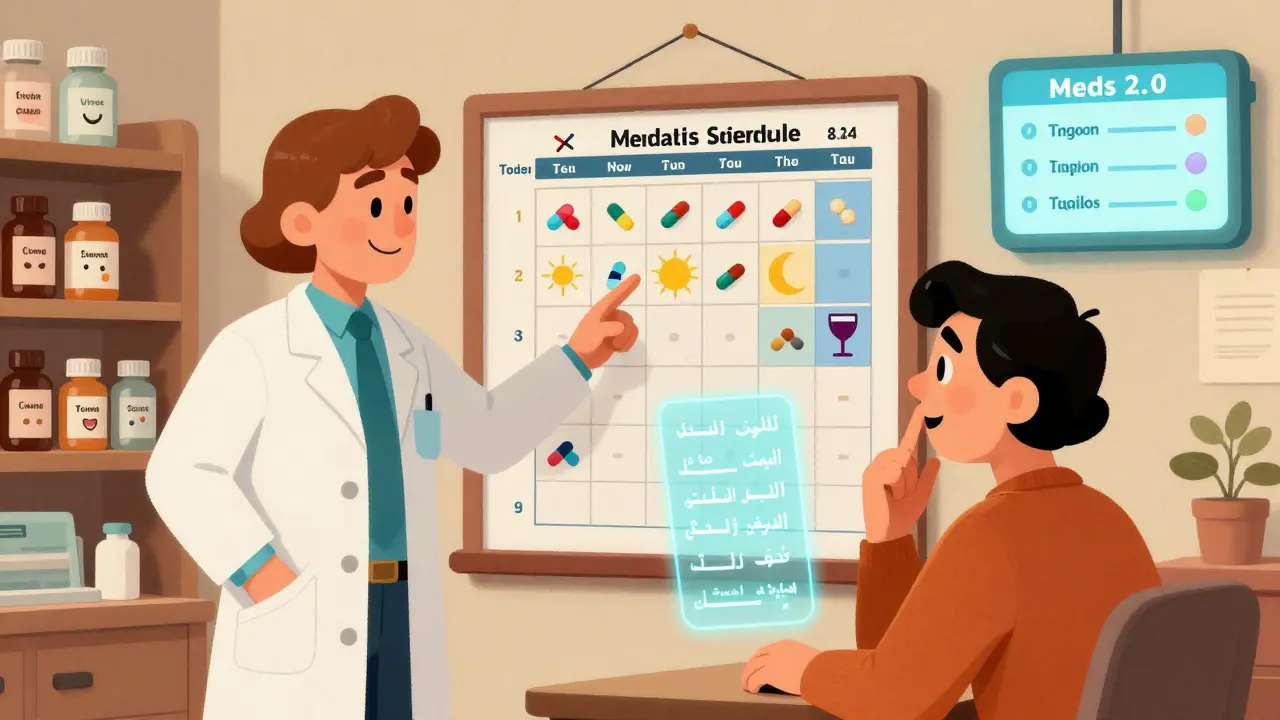
Clear instructions aren’t just about avoiding big words. They’re about structure, visuals, and simplicity. Here’s what you should expect:- A one-page summary, not a 2-page legal document
- Plain language: “Take one pill every morning with breakfast,” not “Administer orally once daily with food”
- Icons or pictures showing when to take it (sunrise for morning, moon for night)
- Warnings in plain terms: “Don’t drink alcohol with this” instead of “Avoid concomitant ethanol ingestion”
- A schedule: a simple chart showing days and times
How to Ask for What You Need
Asking for better instructions isn’t about being pushy. It’s about being specific. Here’s how to do it right:- Ask to speak with the pharmacist-not the technician. Pharmacists are trained to explain meds. Technicians are trained to fill prescriptions. If you ask a tech for help, they’ll often hand you the same confusing paper again.
- Use exact phrases from your rights. Say: “I’m exercising my right under the AmerisourceBergen Patient Rights document to receive education in a language I understand.” Or: “I need this explained in a way I can follow, as stated in the Tennessee Oncology Patient Bill of Rights.” Specific language works better than “Can you make this easier?”
- Request a visual schedule. Say: “Can you give me a chart with pictures showing when to take each pill?” Studies show patients who get visual schedules are 42% more likely to take their meds correctly.
- Ask for a read-back. After they explain, say: “Can I repeat it back to you to make sure I got it right?” Johns Hopkins found this cuts errors by 63%.
- Write it down. Say: “I’m documenting this for my medical records.” Pharmacies are 58% more likely to give you written instructions if they know you’re keeping a copy.
Timing Matters
Don’t wait until your refill to ask. The best time to request clear instructions is when you get a new prescription. Pharmacists have more time then. A 2022 study found 87% of pharmacists feel more comfortable spending time explaining meds during the first fill. By the third refill, they’re rushing. Don’t let them rush you.Language Barriers? You Have Legal Rights
If English isn’t your first language, you’re still entitled to clear instructions. Title VI of the Civil Rights Act says healthcare providers must offer language help. You don’t need to ask nicely. Say: “I need medication instructions in Spanish (or Tagalog, Arabic, etc.) per federal law.” According to a 2023 CMS report, 92% of pharmacies will provide translated instructions when asked this way.What to Do If They Say No
Sometimes, you’ll get pushback. Maybe they say, “That’s all we give.” Or, “We don’t have time.” Here’s what to do:- Ask for a supervisor or pharmacy manager.
- Call the pharmacy’s corporate office. Most chains have patient advocacy lines.
- File a complaint with your state’s board of pharmacy. They track complaints about patient communication.
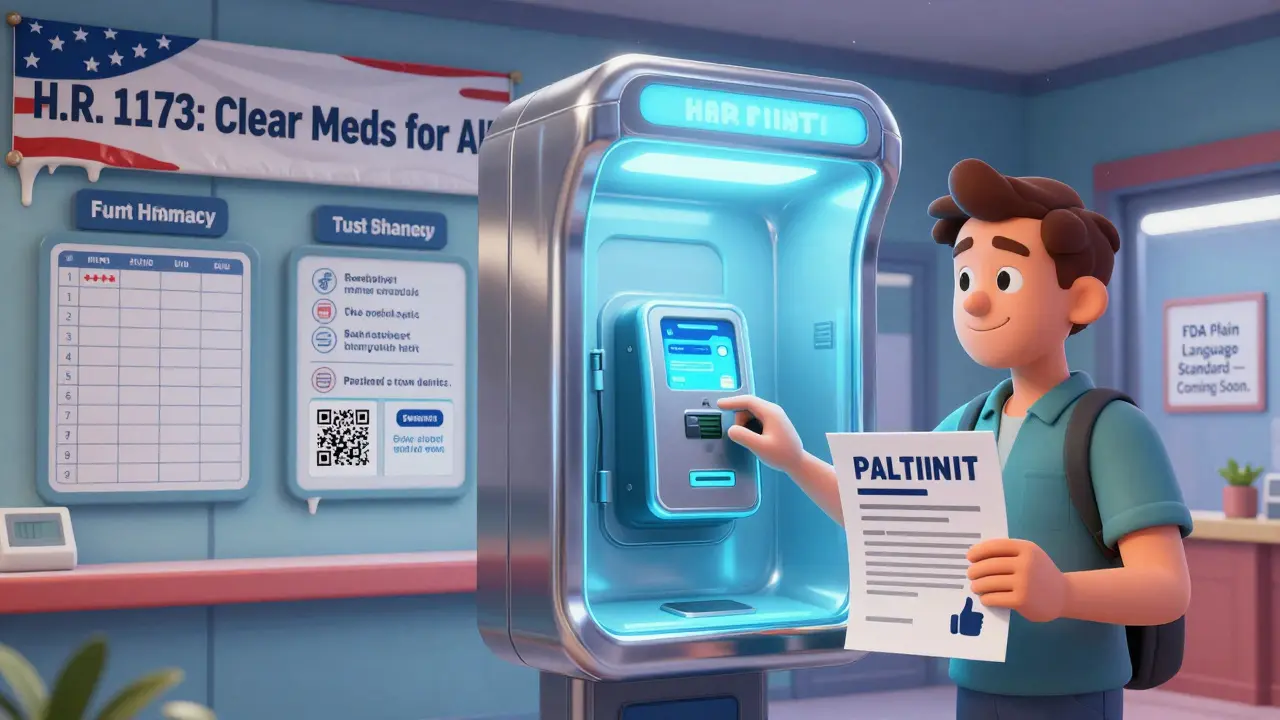
- Use a free tool like Meds 2.0 or MyTherapy to generate your own plain-language guide. Print it and bring it in. Many pharmacists will use it as a reference.
Why This Matters More Than You Think
Taking your meds wrong isn’t just inconvenient. It’s dangerous. Poor understanding leads to hospital visits, emergency rooms, and even death. The U.S. spends $528 billion a year on medication-related hospitalizations-and 30% of that is because patients didn’t understand what to do. But when patients get clear instructions, things change. A 2022 study in the Journal of General Internal Medicine found patients who received instructions at their reading level were 5.3 times more likely to take their meds correctly. That’s not a small difference. That’s life-changing.What’s Changing-And What’s Coming
Change is happening. The FDA is pushing for plain-language labels with icons. Walgreens is rolling out QR codes with video instructions. CVS now uses a system called “Medi-Simplify” that turns complex regimens into picture schedules. In 12 states, laws now require clear instructions. And a federal bill-H.R. 1173-is moving through Congress with bipartisan support. It would make this standard nationwide. You don’t have to wait for the law to catch up. You can demand better today.Start Today: Your Action Plan
Here’s what to do the next time you get a new prescription:- Before you leave the pharmacy, ask to speak with the pharmacist.
- Say: “I need written instructions I can understand. Can you give me a one-page summary with pictures and simple language?”
- Ask for a read-back: “Can I explain it back to you?”
- If they give you a confusing sheet, say: “This still has medical terms I don’t know. Can you rewrite this?”
- Take a photo of the instructions they give you. Save it on your phone. If you forget, you’ll have it.
Can I legally demand written medication instructions I understand?
Yes. While no federal law currently mandates plain-language instructions, your right to understand your care is protected under the American Medical Association’s Code of Medical Ethics, the Patient Bill of Rights adopted by most hospitals and pharmacies, and federal civil rights laws. You can legally request instructions in a language and format you understand. Pharmacists are ethically and professionally obligated to comply.
What if the pharmacy refuses to give me better instructions?
If they refuse, ask to speak with a manager or supervisor. If that doesn’t work, call the pharmacy’s corporate customer service line. Most national chains have patient advocacy teams. You can also file a formal complaint with your state’s board of pharmacy. Document everything: write down the date, time, who you spoke with, and what they said. This creates a paper trail that can lead to change.
Can I get instructions in my native language?
Yes. Under Title VI of the Civil Rights Act of 1964, healthcare providers must offer language assistance services if needed. Say: “I need medication instructions in [language] per federal law.” Most pharmacies will provide translated materials when asked this way. If they don’t, ask for a phone interpreter or written translation.
Do I have to pay for clearer instructions?
No. Clear instructions are part of your care, not a separate service. You should never be charged for plain-language summaries, visual schedules, or translated materials. If a pharmacy tries to charge you, ask to speak with a manager and reference your rights under the Patient Bill of Rights.
Are there apps or tools that can help me understand my meds?
Yes. Apps like MyTherapy, Medisafe, and Meds 2.0 let you input your prescriptions and generate simple, visual schedules you can print or save. Some are even FDA-cleared. You can bring these printouts to your pharmacy-they often use them as templates to create their own clearer instructions.
Stephen Craig
January 5, 2026 AT 08:48They give you a pamphlet that looks like a court summons and expect you to survive. I’ve taken pills for five years and still don’t know what ‘concomitant’ means. Not because I’m dumb-because they don’t care enough to write like a human.
Connor Hale
January 5, 2026 AT 10:27It’s not just about language. It’s about dignity. You’re handed a piece of paper like it’s a parking ticket, then blamed when you mess up. The system treats patients like broken machines that need a manual written in Klingon.
Roshan Aryal
January 6, 2026 AT 20:31Why does America still act like healthcare is a luxury? In India, even village pharmacists draw pictures of pills with suns and moons. We don’t need fancy laws-we need common sense. This is what happens when you outsource empathy to corporate shareholders.
Jack Wernet
January 7, 2026 AT 23:24While the intent behind this post is commendable, it’s worth noting that the legal framework surrounding patient communication varies significantly by state. The AMA’s guidelines are ethical, not enforceable. Federal law does not mandate plain-language labeling, and state boards often lack resources to enforce even existing standards. Real change requires legislative action, not just individual advocacy.
Catherine HARDY
January 8, 2026 AT 19:53Have you noticed how every pharmacy has the same script? ‘We’re sorry, that’s all we can give.’ What if they’re being monitored? What if the FDA secretly approves these confusing labels so they can track who’s ‘non-compliant’? I’ve seen pharmacists glance at a screen before handing me the paper. They’re not stupid-they’re programmed.
Vicki Yuan
January 10, 2026 AT 02:12I printed out the ‘Medi-Simplify’ chart from CVS and brought it to my pharmacy last week. The pharmacist actually smiled and said, ‘We should’ve done this years ago.’ Then she gave me a free sticker with my pill schedule. Small wins matter. You don’t need to fight the system-you just need to show them what it looks like when it works.
Uzoamaka Nwankpa
January 11, 2026 AT 01:22I came to the U.S. for a better life. But every time I go to the pharmacy, I feel like I’m being punished for not speaking their language. They hand me paper. I nod. I leave. I cry in the car. This isn’t healthcare. This is survival with a side of shame.
Chris Cantey
January 12, 2026 AT 09:05They say ‘you have rights.’ But rights don’t fill prescriptions. Rights don’t stop the pharmacist from checking their watch while you’re trying to understand why your blood pressure pill says ‘take with food’ but the bottle says ‘avoid dairy.’ The system isn’t broken-it was designed this way to keep people confused and dependent.
Abhishek Mondal
January 12, 2026 AT 11:18Let’s be clear: this isn’t about ‘accessibility’-it’s about lowering standards. The average American can’t handle basic Latin roots like ‘concomitant.’ Should we ban medical terminology entirely? Should we replace ‘hypertension’ with ‘high blood’? This isn’t patient empowerment-it’s infantilization disguised as compassion.
Oluwapelumi Yakubu
January 12, 2026 AT 21:06Bro, I’m from Lagos and we don’t have fancy apps or QR codes-but we’ve been doing this for decades. Grandma draws pills on a chalkboard with suns and moons. She writes ‘morning’ in marker next to the red one. No one’s suing anyone. No one’s filing complaints. We just make it work. Maybe the answer isn’t more laws-it’s more love.
Akshaya Gandra _ Student - EastCaryMS
January 13, 2026 AT 18:28wait so i can just ask for pics? like actual drawings? i thought that was only for kids?? also i just got a new script and the paper had like 8 different pills and i think i mixed up the blue one with the green one help
Jacob Milano
January 15, 2026 AT 13:22I used to think I was the only one who felt this way. Then I started showing my mom the visual schedules from MyTherapy. She’s 72, speaks mostly Spanish, and now she takes her meds without help. I didn’t change the system-I just gave her a tool. That’s all anyone needs: a little clarity, and someone who won’t let them be silent about it.