
When a medication has a narrow therapeutic index, even a tiny change in its strength can mean the difference between healing and harm. These drugs aren’t like your typical painkiller or antibiotic. With NTI drugs, the line between the right dose and a dangerous one is razor-thin. And when those medications expire? The risks don’t just increase-they become unpredictable, and in some cases, life-threatening.
What Exactly Is a Narrow Therapeutic Index?
A narrow therapeutic index (NTI) means the gap between a drug’s effective dose and its toxic dose is extremely small. For most medications, you might have a 10-fold or even 20-fold safety margin. But with NTI drugs, that margin is often less than twofold. Take warfarin an anticoagulant used to prevent blood clots. The therapeutic range for its effect is measured by the INR (International Normalized Ratio), which should stay between 2.0 and 3.0 for most patients. Go above 4.0? Risk of dangerous bleeding. Drop below 1.5? Risk of stroke or clotting. A 10% drop in potency could push someone out of that range-without them even noticing.
Other common NTI drugs include lithium used for bipolar disorder, where blood levels must stay between 0.6 and 1.2 mmol/L. Exceed 1.5? Toxicity sets in-tremors, confusion, kidney damage. digoxin for heart failure has a therapeutic window of 0.5 to 0.9 ng/mL. Above 1.2 ng/mL? Life-threatening arrhythmias can occur. Even a small loss of potency can cause treatment failure. A rise in toxicity can cause sudden hospitalization.
Why Expiration Dates Matter More for NTI Drugs
Expiration dates aren’t arbitrary. They’re based on rigorous stability testing. Manufacturers test how long a drug retains at least 90% of its labeled potency under proper storage conditions. For most medications, losing 5-10% potency over time isn’t a big deal. But for NTI drugs, that small drop can be catastrophic.
Consider this: The FDA requires generic versions of NTI drugs to meet stricter bioequivalence standards than regular drugs. For most drugs, generics must deliver 80-125% of the brand’s effect. For NTI drugs like phenytoin an antiseizure medication or levothyroxine thyroid hormone replacement, the acceptable range is only 90-111%. That’s a ±11% window, not ±25%. Now imagine an expired NTI drug has degraded by just 5%. That’s nearly half the allowed variation already gone. If the drug was already at the lower end of its therapeutic range, a 5% drop could push it below effectiveness. If it was near the top, degradation might create unpredictable byproducts that increase toxicity.
There’s no data proving exactly how much NTI drugs degrade after expiration. But we know this: carbamazepine an anticonvulsant can form toxic epoxides as it breaks down. theophylline a bronchodilator loses potency quickly if exposed to humidity. And ciclosporin an immunosuppressant is notorious for inconsistent absorption-so if its formulation degrades even slightly, blood levels can swing wildly.
Real-World Consequences of Using Expired NTI Drugs
There are no large-scale studies tracking hospitalizations from expired NTI medications. But we don’t need them to know the danger. Here’s what we do know:
- A 2014 study in the Journal of Clinical Pharmacy and Therapeutics found that NTI drugs were responsible for over 60% of all serious adverse drug events in hospitalized patients-even when given at the right dose.
- Pharmacists report that 67% of warfarin-related errors occur due to subtle changes in formulation, brand, or potency-not just dosing mistakes.
- The American Society of Health-System Pharmacists has issued warnings that NTI drugs require “double-checks” and “independent verification” before dispensing. Expired drugs bypass all safety checks.
- Patients on digoxin who used expired pills have been admitted with heart rhythms so unstable they required emergency pacing.
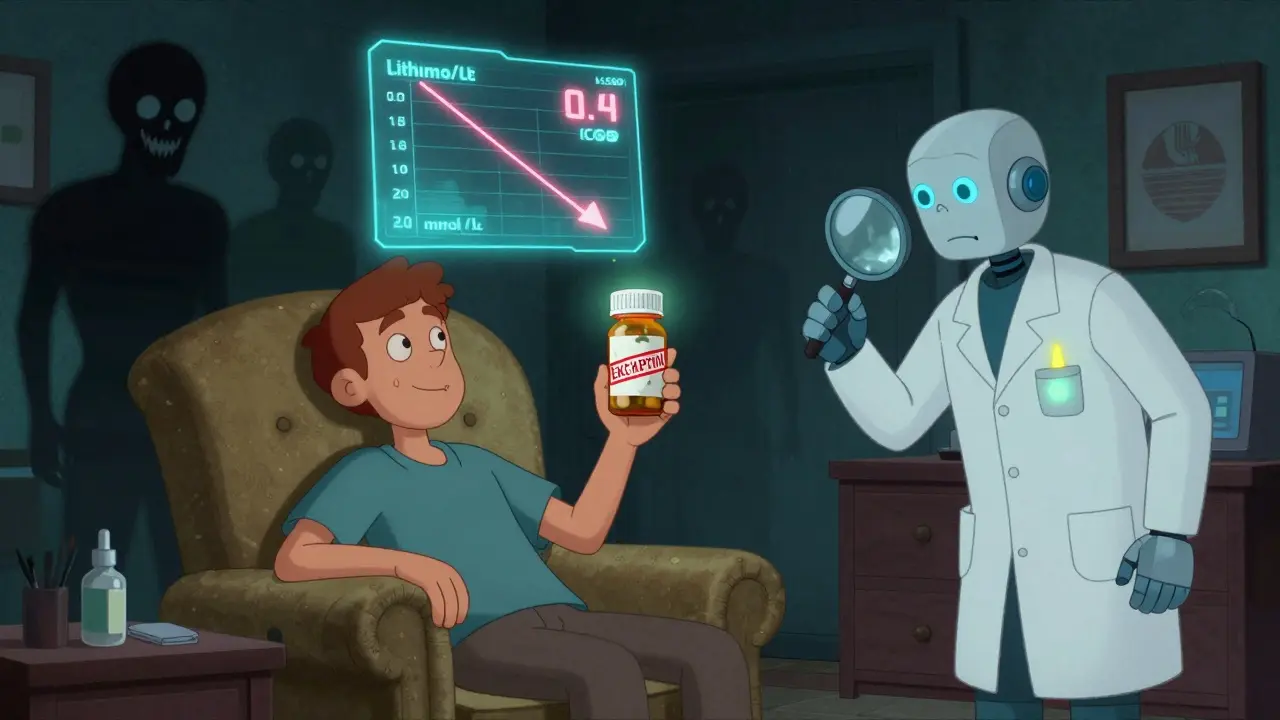
One case from a Sydney hospital in 2023 involved a 72-year-old man on lithium for bipolar disorder. He had been stable for years. His pills had expired six months prior. He didn’t realize. His blood lithium level dropped from 0.8 to 0.4 mmol/L. Within two weeks, he had a severe depressive episode and attempted suicide. He wasn’t noncompliant-he just didn’t know the pills were past their prime.
What You Should Do
If you take any of these drugs, here’s what you need to do:
- Never use expired NTI medications. Even if they look fine. Even if they’re only a few months past the date.
- Store them properly. Keep them in a cool, dry place. Avoid bathrooms. Don’t leave them in hot cars. Humidity and heat speed up degradation.
- Check your prescription labels. Look for NTI drugs. Common ones include warfarin, lithium, digoxin, phenytoin, levothyroxine, carbamazepine, cyclosporine, theophylline, and aminoglycosides.
- Ask your pharmacist. If you’re unsure whether your drug is NTI, ask. Most pharmacists can tell you immediately. They’re trained to spot these.
- Dispose of expired NTI drugs properly. Don’t flush them. Don’t throw them in the trash. Take them to a pharmacy drop-off or a local drug take-back program.
There’s no such thing as “just one more pill” with these medications. One dose too weak-or too strong-can change everything.
What the System Isn’t Telling You
Here’s the uncomfortable truth: No government agency has issued clear guidelines on what to do with expired NTI drugs. The FDA doesn’t say “never use expired NTI drugs.” It doesn’t have to. The science speaks for itself. The FDA’s stricter bioequivalence standards for NTI drugs prove they understand how sensitive these medications are. Yet, most patients aren’t warned.
Pharmacies rarely put warning stickers on NTI prescriptions. Insurance plans don’t cover early refills for these drugs. Patients get a 30-day supply, and if they don’t refill on time, they’re left with expired pills. And because these drugs don’t cause immediate symptoms when they degrade, people don’t realize they’re at risk.
Some manufacturers now test NTI drugs beyond their labeled expiration dates. One 2022 survey found that 78% of major pharmaceutical companies run extended stability studies on NTI products. But that doesn’t change the expiration date on your bottle. The date you see? It’s the date the manufacturer guarantees safety and potency-not when the drug stops working entirely.
Bottom Line
NTI drugs aren’t like other medications. Their safety depends on precision. Expired NTI drugs aren’t just less effective-they’re unpredictable. A pill that’s 5% weaker might cause a clot. One that’s 5% stronger might cause a seizure, a stroke, or cardiac arrest. There’s no middle ground.
If you’re on one of these drugs, treat every pill like it’s a loaded syringe. If the expiration date has passed, get a new prescription. Don’t wait. Don’t guess. Don’t hope. Your life isn’t worth the risk.
Can I still take an NTI medication if it’s only a month past its expiration date?
No. Even a small loss of potency in an NTI drug can push your blood levels outside the safe range. For drugs like warfarin, lithium, or digoxin, a 5% drop in strength can mean the difference between control and crisis. There’s no safe grace period.
Are generic versions of NTI drugs safe to use?
Yes-but only if they’re FDA-approved under strict bioequivalence standards. Generic versions of NTI drugs must deliver between 90% and 111% of the brand’s effect, compared to 80-125% for most drugs. Even then, switching between brands or generics can require dose adjustments. Never switch without consulting your doctor or pharmacist.
How do I know if my medication has a narrow therapeutic index?
Common NTI drugs include warfarin, lithium, digoxin, phenytoin, levothyroxine, carbamazepine, cyclosporine, theophylline, and aminoglycosides. If you’re unsure, ask your pharmacist or check your prescription label. Some pharmacies now flag NTI drugs with special stickers. If you’re on one, your doctor should have discussed the risks with you.
What happens if I accidentally take an expired NTI drug?
If you took one dose, monitor yourself closely. For warfarin, watch for signs of bleeding (bruising, nosebleeds, dark stools). For lithium, look for tremors, confusion, or nausea. For digoxin, note irregular heartbeat or dizziness. Call your doctor immediately. Don’t wait for symptoms. Blood tests may be needed to check your drug levels.
Is it okay to keep expired NTI drugs as a backup?
Absolutely not. NTI drugs require precise dosing. A backup pill that’s degraded could cause serious harm. If you’re worried about running out, talk to your doctor about getting a slightly larger supply or setting up automatic refills. There’s no safe way to store expired NTI drugs for later use.
Chris Bird
March 11, 2026 AT 01:52Miranda Varn-Harper
March 11, 2026 AT 07:52Bridgette Pulliam
March 11, 2026 AT 21:56Mike Winter
March 13, 2026 AT 19:39Randall Walker
March 14, 2026 AT 13:02Shourya Tanay
March 16, 2026 AT 12:38LiV Beau
March 17, 2026 AT 07:02Adam Kleinberg
March 18, 2026 AT 17:32Denise Jordan
March 20, 2026 AT 03:55Gene Forte
March 21, 2026 AT 06:28Kenneth Zieden-Weber
March 21, 2026 AT 13:09