
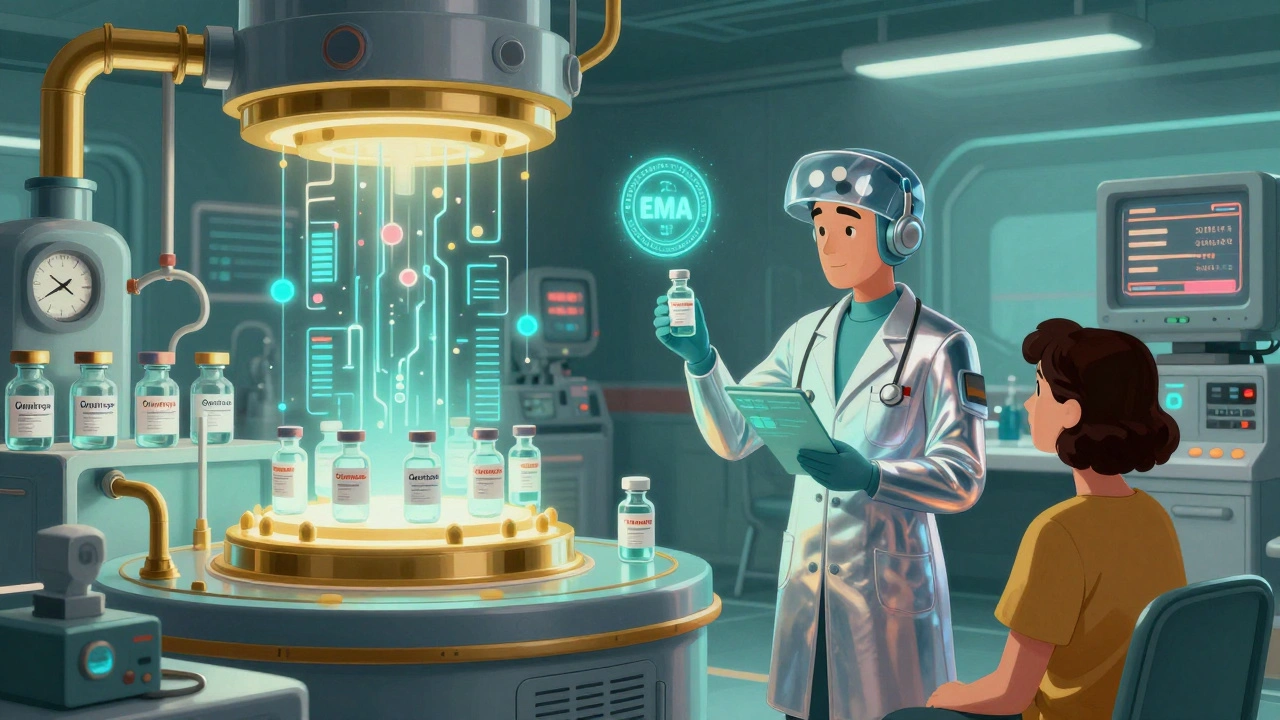
When you hear the word biosimilar, you might think it’s just another generic drug. But it’s not. Biosimilars are complex, life-saving medicines that copy highly sophisticated biologic drugs-like those used for cancer, rheumatoid arthritis, and diabetes. These aren’t pills you can easily replicate. They’re made from living cells, which means even tiny changes in manufacturing can affect how they work. That’s why getting them approved isn’t as simple as copying a chemical formula. And when it comes to how fast and how well these drugs reach patients, Europe and the United States are playing two very different games.
Europe Got There First-and Built a System
Europe didn’t just jump into biosimilars. It planned for them. In 2006, the European Medicines Agency (EMA) approved the world’s first biosimilar, Omnitrope, a copy of the growth hormone somatropin. That wasn’t a lucky accident. It was the result of a clear, science-based regulatory framework built from the ground up. The EMA didn’t demand endless new clinical trials. Instead, it used a "totality-of-evidence" approach: deep lab analysis, animal studies, and a few targeted human trials to prove similarity. That kept costs down and speed up approval.
By 2024, Europe had approved over 100 biosimilars. Germany, France, and the UK led the charge, not just as users but as manufacturers. German companies became global hubs for biosimilar production, attracting big names like Sandoz and Fresenius Kabi. Hospitals there didn’t wait for doctors to push biosimilars-they used tender systems to automatically pick the cheapest, most effective option. In oncology and rheumatology, biosimilars now make up more than 80% of prescriptions in some countries. That’s not just adoption. That’s dominance.
Payers-governments and insurers-knew they were saving money. A biosimilar typically launches at 15-30% cheaper than the original biologic. In a region with tight public health budgets, that’s not a nice-to-have. It’s essential. And because the EMA’s approval was trusted across all EU countries, once a biosimilar got the green light, it could roll out fast. No patchwork of state-by-state rules. No confusing insurance battles. Just science, price, and scale.
The US Started Late-and Got Stuck
The United States passed the Biologics Price Competition and Innovation Act (BPCIA) in 2009, giving the FDA the legal power to approve biosimilars. But it took six years for the first one, Zarxio, to actually hit the market in 2015. Why the delay? It wasn’t science. It was lawsuits.
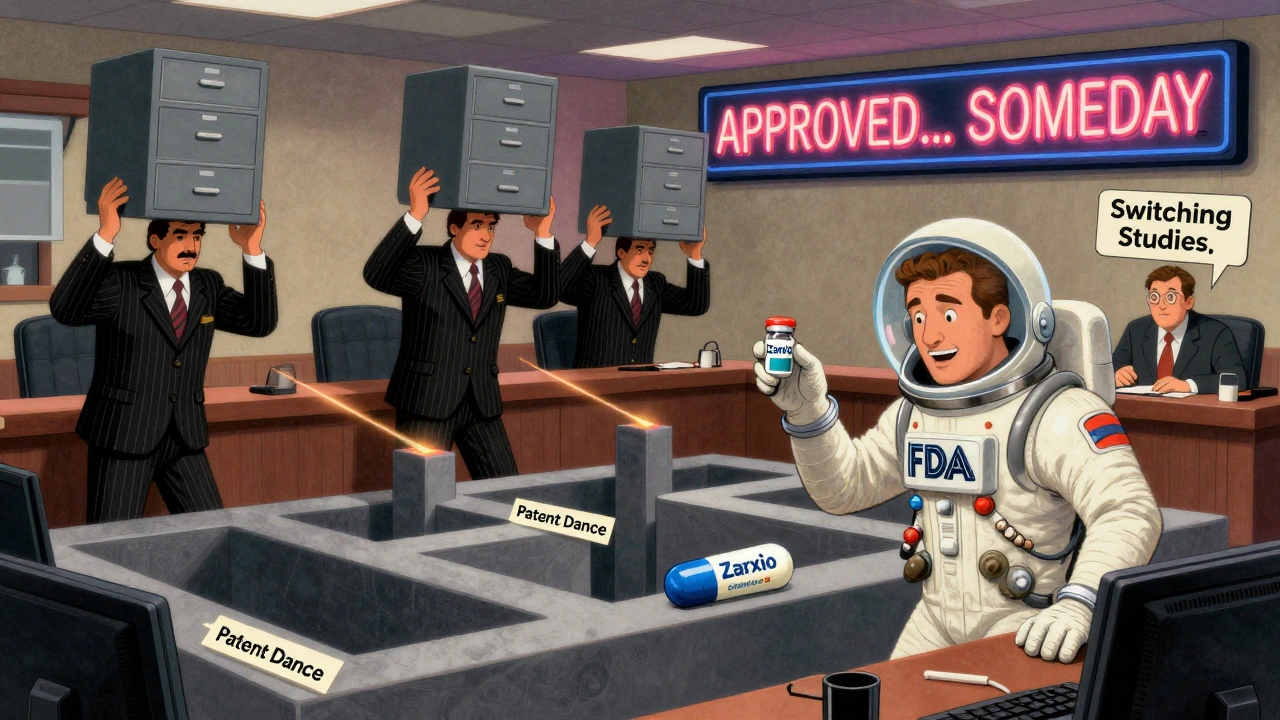
Big pharma companies didn’t want to lose their billion-dollar monopolies. They used patent thickets-layer after layer of overlapping patents-to block competitors. The "patent dance," a legal process meant to resolve disputes before a biosimilar launched, became a tool for delay. Companies dragged out court cases for years. By 2024, the US had approved only about 20 biosimilars, compared to Europe’s 100+. And even when approved, many never made it to pharmacies because of settlement deals that delayed market entry.
Another roadblock? Interchangeability. The FDA required biosimilars to prove they could be switched with the original drug without risk-through extra clinical trials called "switching studies." These studies were expensive, time-consuming, and often unnecessary. Doctors didn’t need them to trust the science. Patients didn’t need them to get better. But the FDA made them mandatory. So even when a biosimilar was proven safe and effective, it couldn’t be automatically substituted at the pharmacy like a generic pill.
The result? A market that was slow to grow. In 2024, the US biosimilar market was worth about $10.9 billion. Sounds big? It is. But it’s still a fraction of what it could be. Europe’s market was already $13.16 billion, and it had been doing this for nearly two decades. The US had the bigger biologics market, the deeper pockets, and the most patients. But it was stuck in legal and regulatory quicksand.
The Turning Point: June 2024
Everything changed in June 2024. The FDA proposed new rules that eliminated the requirement for switching studies to get interchangeable status. That was a game-changer.
For the first time, the US was moving toward the European model: trust the science, not the lawsuits. If a biosimilar is shown to be highly similar to the original through analytical, non-clinical, and limited clinical data, it should be interchangeable. No extra trials. No extra cost. No extra delay.
That single move unlocked potential. Companies that had been sitting on the sidelines started preparing to launch. By 2025, more than 14 biosimilars for Humira (adalimumab)-one of the most expensive drugs in the world-had been approved. Only six were available, thanks to patent deals. But with the new rules, that number is expected to jump. Analysts now project the US market will grow at 18.5% per year through 2033. Europe’s growth is strong too-around 17.3%-but the US is catching up fast.
And then there’s the Inflation Reduction Act of 2022. It didn’t just lower drug prices for seniors. It eliminated the Medicare Part D coverage gap-the "donut hole"-and gave pharmacies and insurers real financial reasons to choose biosimilars. Suddenly, switching wasn’t just about ethics or savings. It was about revenue.
Who’s Winning? Europe Still Leads, But the US Is Closing In
As of 2024, Europe still has the larger biosimilar market by revenue. But the US is gaining ground fast. North America as a whole (mostly the US) is projected to overtake Europe in market size by 2027. Why? Because the US has more high-value biologics coming off patent. Between 2025 and 2034, 118 biologics will lose exclusivity-worth $232 billion in sales. That’s a tidal wave of opportunity.
Europe’s advantage is maturity. Its systems are built. Doctors know biosimilars. Pharmacists can substitute them. Patients trust them. The US is still building that trust. But now it has the tools: better regulation, financial incentives, and a growing list of approved products.
Therapeutic areas tell the story too. Europe led in autoimmune diseases-drugs for rheumatoid arthritis and Crohn’s disease. The US started with supportive care: drugs like filgrastim for low white blood cell counts after chemotherapy. Now, it’s catching up. Biosimilars for insulin, monoclonal antibodies, and even complex cancer treatments are entering the pipeline.
The Future: Convergence, Not Competition
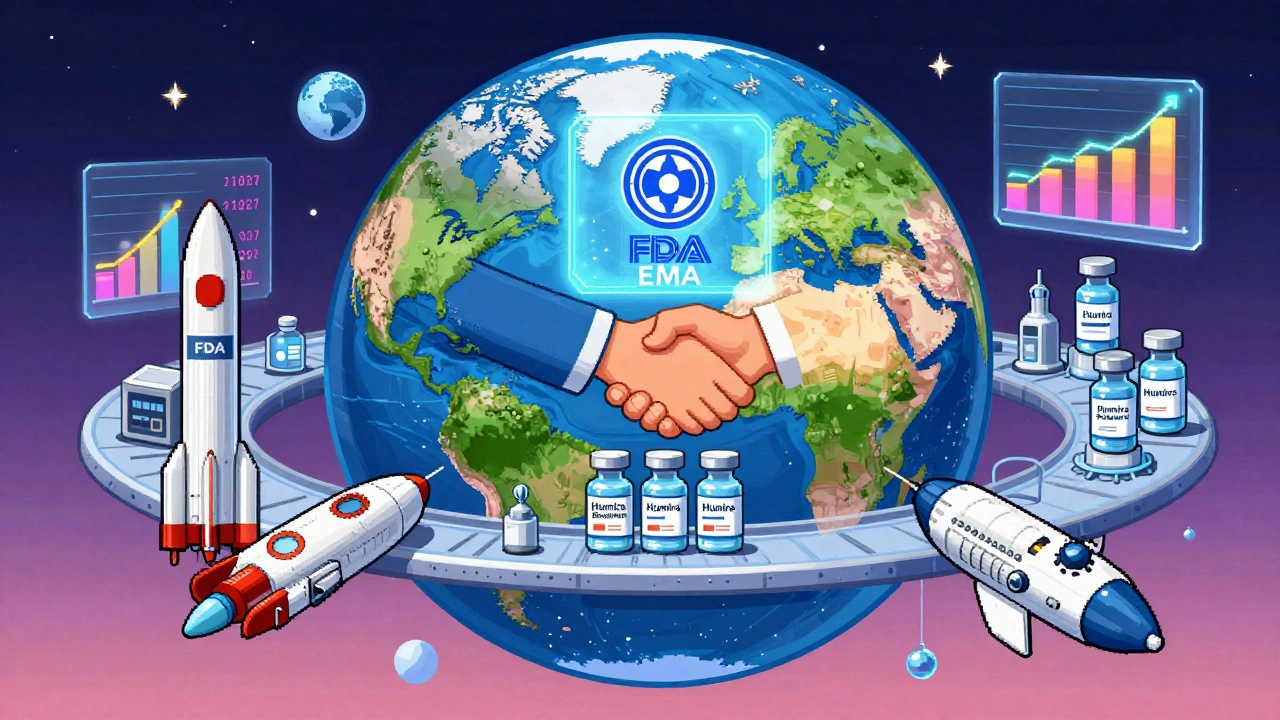
Europe and the US aren’t rivals anymore. They’re learning from each other. The FDA is copying EMA’s science-first approach. Europe is watching how the US uses market forces and pricing pressure to drive adoption. Both regions now accept similar data packages for approval. The gap is closing.
Manufacturing is another story. Europe still leads in production capacity, especially in Germany. But US companies like Pfizer, Merck, and Samsung Bioepis are investing billions to scale up. The next decade will see biosimilars made in both continents, shipped globally, and used everywhere.
The real winner? Patients. And the healthcare system. Biosimilars are saving billions. In Europe, they’ve cut biologic spending by tens of billions since 2006. In the US, those savings are just starting. By 2034, the global biosimilar market could be worth over $175 billion. That’s money that can fund new research, expand access, and lower premiums.
It’s not about which region is better. It’s about what happens when science meets smart policy. Europe showed it could be done. The US is proving it can be done faster-with bigger stakes.
Are biosimilars the same as generics?
No. Generics are exact copies of small-molecule drugs made from chemicals. Biosimilars are copies of large, complex biologic drugs made from living cells. Even small changes in how they’re made can affect how they work. That’s why biosimilars need more testing than generics-but not as much as brand-new biologics.
Why are biosimilars cheaper than the original biologics?
They don’t need to repeat all the early-stage research. The original drug already proved safety and effectiveness. Biosimilar makers only need to show they’re highly similar-through lab tests, animal studies, and a few focused human trials. That cuts development costs by 50-70%, which lets them price lower-usually 15-30% below the original.
Can a pharmacist switch me from a biologic to a biosimilar without asking my doctor?
In Europe, yes-in many countries, substitution is automatic. In the US, it depends. Only biosimilars with "interchangeable" status can be substituted without a doctor’s permission. Until mid-2024, very few had that status. Now, with new FDA rules, more are expected to qualify. Check with your pharmacist or insurer to see what’s allowed in your state.
Are biosimilars safe?
Yes. Every biosimilar approved by the EMA or FDA has been rigorously tested. They must show no clinically meaningful differences in safety, purity, or potency compared to the original. Millions of patients worldwide have used them for over 15 years with no new safety concerns. The FDA and EMA monitor them just like any other drug.
What’s stopping biosimilars from being used more in the US?
Three things: patent lawsuits, lack of interchangeable status, and slow payer adoption. Even when a biosimilar is approved, originator companies can delay it with legal battles. Without interchangeable status, pharmacists can’t substitute it automatically. And some insurers still prefer the original drug due to rebates or contracts. But the 2024 FDA changes and the Inflation Reduction Act are starting to break those barriers.
Which countries in Europe lead in biosimilar use?
Germany, France, and the UK are the top adopters. Germany also leads in manufacturing, with several local companies producing biosimilars for global markets. These countries use hospital tenders and mandatory substitution policies to drive uptake, especially in high-cost areas like oncology and autoimmune diseases.
What Comes Next?
The next wave of biosimilars will target even more complex drugs-like cell and gene therapies. That’s harder. But the lessons from Europe and the US are clear: regulation matters. Speed matters. And trust matters more than anything.
Patients don’t care if a drug was made in Basel or Boston. They care if it works. If it’s safe. If they can afford it. That’s the real goal-and both regions are finally moving toward it together.
Wesley Phillips
December 7, 2025 AT 20:51Let’s be real-Europe’s system is basically a bureaucratic utopia where regulators actually trust science. Meanwhile, the US spends more time in courtrooms than labs. Pathetic. 🤷♂️
Kyle Oksten
December 8, 2025 AT 05:44The real issue isn’t who’s faster-it’s who’s willing to prioritize patient access over corporate profits. Europe didn’t just make policy; they made a moral choice. The US is only now catching up because the financial stakes got too high to ignore. Science doesn’t care about patents. People do.
Nancy Carlsen
December 8, 2025 AT 07:39This is actually so hopeful!! 💪 The fact that the US is finally listening to the science and dropping those ridiculous switching studies? HUGE win for patients. 🌍❤️ We’re not behind-we’re just waking up. And when we wake up, we go ALL IN.
Ted Rosenwasser
December 8, 2025 AT 14:18You’re all missing the elephant in the room. The FDA’s new rules? A tactical surrender to EU pressure. Don’t pretend this is about patient care-it’s about global competitiveness. The US doesn’t lead because it’s smarter. It leads because it’s forced to. And now it’s playing catch-up with a corporate playbook, not a public health one.
Helen Maples
December 10, 2025 AT 13:53Let me correct a few things. The FDA didn’t 'copy' the EMA. They adapted. There’s a difference. And interchangeability wasn’t 'unnecessary'-it was poorly implemented. The burden of proof was misplaced, not the principle. Also, 'patent thickets' aren’t just legal maneuvers-they’re economic weapons. And the Inflation Reduction Act? That’s the real catalyst. Not regulation. Money.
Ashley Farmer
December 11, 2025 AT 11:10I’ve been on biosimilars for my rheumatoid arthritis since 2020. They saved my life. No difference in how I feel. No flare-ups. My insurance pays less. My co-pay dropped by 70%. I don’t care where it was made. I just care that it works. So please-stop talking about markets and start talking about people.
Jennifer Anderson
December 13, 2025 AT 01:48fr fr europe was just lucky they had the time to figure it out. us had to deal with big pharma lobbying from day one. now that the money’s on the table, everyone’s like 'oh wait we can do this too?' lol. also biosimilars r life changing, why is this even a debate??
Nicholas Heer
December 14, 2025 AT 03:30THEY’RE HIDING SOMETHING. WHY DID THE FDA CHANGE RULES JUST AFTER THE IRA? WHY NOW? THIS ISN’T SCIENCE-IT’S A COORDINATED MOVE TO DESTROY AMERICAN PHARMA AND HAND CONTROL TO EUROPEAN COMPANIES. THEY WANT US DEPENDENT ON FOREIGN MEDS. THEY’RE USING 'COST SAVINGS' AS A COVER. DON’T BE FOOLED. THIS IS A GEO-POLITICAL POWER PLAY. AND WE’RE THE ONES PAYING FOR IT.