
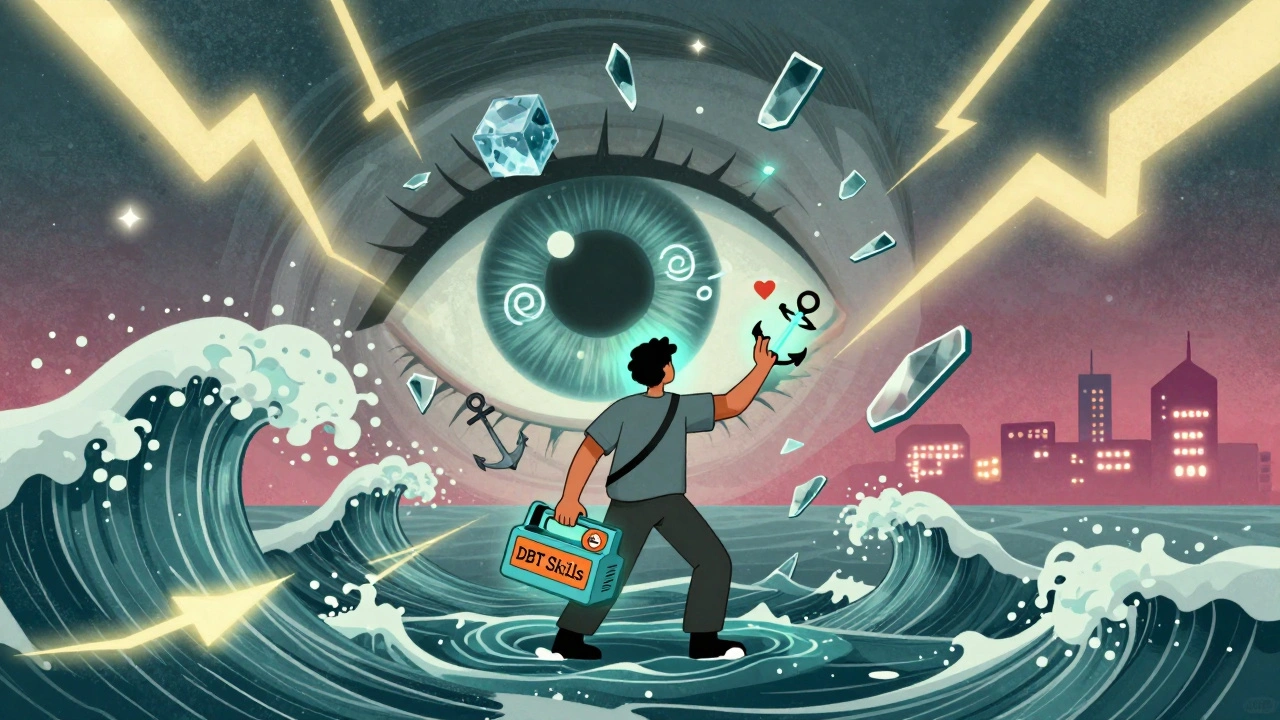
Living with borderline personality disorder (BPD) often feels like being caught in a storm with no shelter. Emotions hit hard and fast. Relationships burn out quickly. One moment you're fine, the next you're drowning in shame, rage, or despair. And when the pain becomes unbearable, self-harm or suicidal thoughts can feel like the only way out. But there’s a proven path forward - one built not on vague advice, but on concrete, usable skills. DBT - Dialectical Behavior Therapy - isn’t just another therapy. It’s a toolkit designed for people who feel too much, react too intensely, and struggle to survive their own emotions.
What Makes DBT Different?
Most therapies focus on understanding why you feel the way you do. DBT skips the endless analysis and gets straight to what works: teaching you how to handle intense emotions before they destroy your day, your relationships, or your safety. Developed by Dr. Marsha Linehan in the late 1980s, DBT was created because traditional talk therapy wasn’t enough for people with BPD who were constantly in crisis. It combines acceptance - “It’s okay that you feel this way” - with change - “Here’s how to get through it without hurting yourself.”
Unlike other treatments, DBT doesn’t ask you to just talk about your pain. It gives you real skills you can use while you’re in the middle of a meltdown. And it’s not theoretical. Research shows DBT cuts self-harm by nearly half and reduces suicide attempts by 50% within the first year. The National Institute for Health and Care Excellence (NICE) and the American Psychological Association both list it as a top-tier, evidence-based treatment for BPD.
The Four Core Skill Modules
DBT is built on four skill sets, each targeting a different part of the BPD experience. You don’t need to master them all at once. Start with one. Build from there.
Mindfulness: Ground Yourself in the Now
If your mind is racing, your body is tense, and you’re spiraling, mindfulness is your anchor. It’s not about emptying your thoughts. It’s about noticing them without getting swept away. The core skills are simple: observe what’s happening inside you, describe it without judgment, and participate fully in the moment.
Think of it like this: instead of yelling at yourself for feeling angry, you pause and say, “I notice my chest is tight. My hands are clenched. I’m thinking I want to smash something.” Just naming it reduces its power. Studies show just eight weeks of daily mindfulness practice boosts emotional regulation by 32% in people with BPD.
Distress Tolerance: Survive the Unbearable
Some crises can’t be fixed right away. You can’t talk your way out of a panic attack. You can’t reason with a wave of suicidal thoughts. That’s where distress tolerance comes in. These are your emergency skills - the ones you use when you’re about to lose control.
The TIPP skill is your fastest reset button:
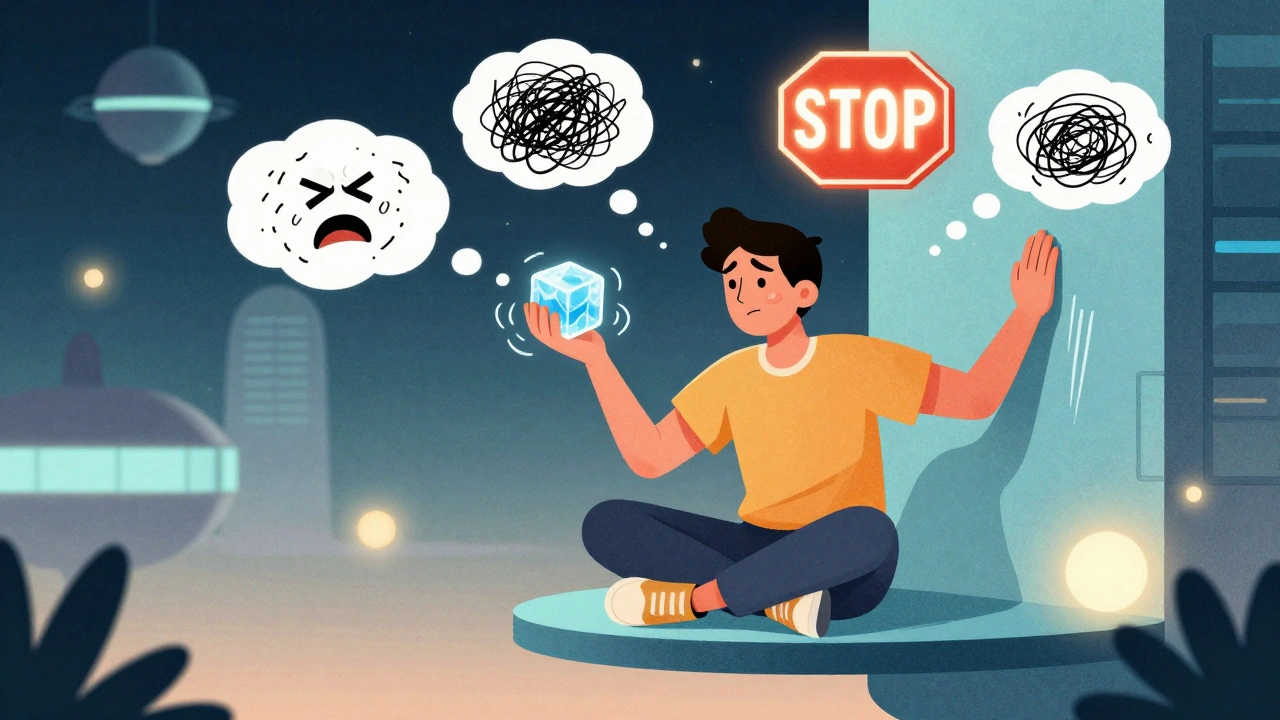
- Temperature: Splash ice water on your face or hold an ice cube. This triggers your body’s dive reflex, slowing your heart rate instantly.
- Intense exercise: Run in place, jump jacks, or push against a wall for 30 seconds. Burn off the adrenaline.
- Paced breathing: Breathe in for 4 seconds, hold for 4, out for 6. Repeat. Slows your nervous system.
- Paired muscle relaxation: Tense your fists for 5 seconds, then release. Move up your body - shoulders, jaw, feet. Release tension with each exhale.
Another powerful tool is STOP:
- Stop - freeze. Don’t act.
- Take a step back - create space between you and the impulse.
- Observe - what’s happening in your body? Your thoughts? Your surroundings?
- Proceed mindfully - choose your next move, don’t react.
And then there’s IMPROVE - a mental escape hatch:
- Imagine a calming place
- Meaning - find purpose even in pain
- Pray - if it helps, even if you’re not religious
- Relaxation - breathe, stretch, hum
- One thing in the moment - focus on one sense: the sound of rain, the texture of your blanket
- Vacation - mentally step away from the crisis
- Encouragement - talk to yourself like you would to a friend
People who use these skills regularly report a 57% drop in emergency room visits for self-harm in just four months.
Emotion Regulation: Stop Being Controlled by Your Feelings
Emotions aren’t the enemy. But when they’re this intense, they hijack your brain. Emotion regulation teaches you how to understand, name, and reduce the power of overwhelming feelings.
The PLEASE skill is your foundation:
- Physical illness - treat any medical issue
- Level of eating - don’t skip meals
- Evoid mood-altering drugs - alcohol, weed, stimulants make emotions worse
- Abalanced sleep - aim for 7-8 hours
- Sexercise - even a 10-minute walk helps
When you’re physically stable, your emotions have less fuel to burn. Then there’s opposite action: if you feel like isolating, reach out. If you feel like lashing out, speak gently. Do the opposite of what your emotion demands. It rewires your brain over time. Six months of consistent practice reduces emotional reactivity by 40%.
Interpersonal Effectiveness: Keep Relationships From Burning Down
People with BPD often fear abandonment - and then push people away in the same moment. The DEAR MAN skill helps you ask for what you need without destroying the relationship:
- Describe the situation - stick to facts
- Express your feelings - “I feel scared when you don’t reply”
- Assert your request - “Can you text me when you’ll be late?”
- Reinforce - “It would mean a lot to me”
- Mindful - stay on topic
- Appear confident - even if you’re not
- Negotiate - be willing to compromise
There’s also GIVE to keep things calm:
- Gentle - no attacking, no blaming
- Interested - listen more than you speak
- Validate - “I get why you’d feel that way”
- Easy manner - smile, relax your shoulders
And FAST to protect your self-respect:
- Fair - be fair to yourself and others
- Appologies - don’t over-apologize
- Stick to values - don’t say yes to please others
- Truthful - don’t lie to avoid conflict
People who use these skills regularly report a 28% increase in relationship satisfaction within six months.
Crisis Planning: Your Personal Survival Kit
DBT isn’t just about learning skills - it’s about having a plan when you’re too overwhelmed to think. A crisis plan isn’t a luxury. It’s a lifeline.
Start simple:
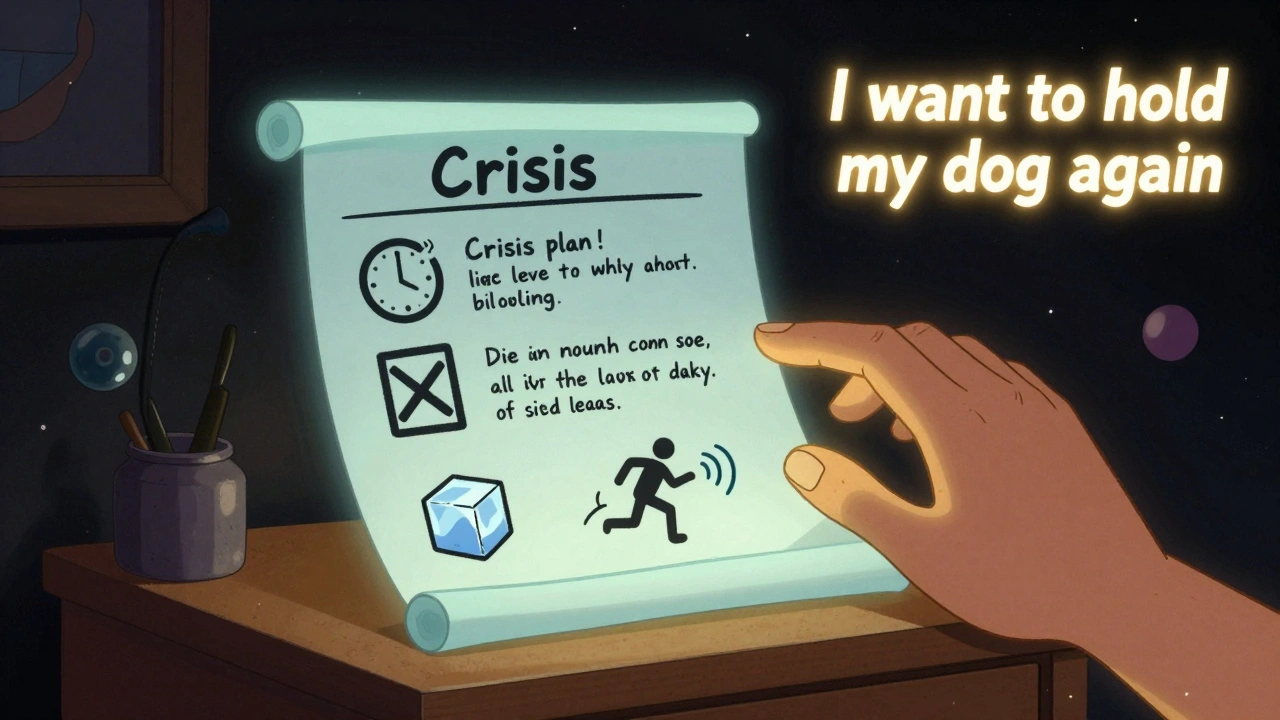
- Write down your top three warning signs: “I stop sleeping,” “I delete all my photos,” “I can’t answer texts.”
- List your top three distress tolerance skills that work for you - TIPP? IMPROVE? Ice water? Running? Write them down.
- Keep a list of 3 people you can call - even if you’re scared to. Include their numbers.
- Write one reason you want to live - something specific: “I want to see my niece graduate,” “I want to hold my dog again,” “I want to feel peace.”
Keep this plan on your phone, taped to your mirror, or in your wallet. When the crisis hits, you won’t have to think. You’ll just follow the steps.
Phone coaching is part of full DBT programs - you can call your therapist during a crisis for real-time support. If you don’t have access to that, use your plan. Call a friend. Go for a walk. Use TIPP. Do something - anything - to delay the impulse.
How Long Does It Take?
DBT isn’t quick. Most full programs last 6 to 12 months. You’ll attend weekly individual therapy, a 2-hour skills group, and have access to phone coaching. It’s intense. But you don’t need to do it all at once.
Many people start with one skill - say, TIPP - and use it for weeks until it becomes automatic. Then they add another. The Cleveland Clinic reports that most people grasp the basics in 2-4 weeks, but real change takes 6-8 months of consistent practice.
Don’t get discouraged if you forget to use your skills during a meltdown. That’s normal. The goal isn’t perfection. It’s progress. One time you used STOP instead of cutting? That’s a win. One day you ate and slept? That’s progress.
What If DBT Doesn’t Work for Me?
DBT works best for people whose main struggles are emotional overwhelm, self-harm, and unstable relationships. If your biggest issue is identity confusion without intense emotional swings, other therapies like Schema Therapy or Mentalization-Based Therapy (MBT) might fit better.
Some people find DBT too structured. The worksheets feel overwhelming. The homework feels like another burden. That’s valid. But don’t quit because it’s hard. Talk to your therapist. Adapt it. Use your phone to record your TIPP steps. Skip the worksheets and just write one skill on a sticky note.
And if you can’t find a DBT therapist? There are apps like DBT Coach and online workbooks. The skills are free. You can learn them on your own. Start with mindfulness. Then try TIPP. You don’t need a clinic to survive your next crisis.
Real People, Real Results
One Reddit user wrote: “I used DEAR MAN during an argument with my partner. I didn’t scream. I didn’t leave. I said, ‘I feel scared when you don’t reply. Can you text me if you’ll be late?’ He did. We didn’t fight. That was the first time in years.”
Another said: “Last month, I felt suicidal. I used IMPROVE. I imagined my dog sleeping on the porch. I listened to my favorite song. I held a cold bottle of water. I didn’t hurt myself. For the first time in 10 years.”
These aren’t miracles. They’re skills. And they’re learnable.
Where to Start Today
You don’t need to wait for therapy to begin. Right now:
- Write down your top three crisis warning signs.
- Practice TIPP - ice water, jump jacks, paced breathing - for five minutes today.
- Write one reason you want to live. Keep it where you’ll see it.
- Find one person you can call. Save their number.
DBT doesn’t promise to fix everything. But it gives you something no therapy alone can: tools you can use when you’re alone, scared, and in pain. And sometimes, that’s enough to keep you alive until the next day.
nina nakamura
December 14, 2025 AT 06:45DBT is overhyped. People don't need skills they need to stop being dramatic. If you can't handle your emotions, maybe you should just grow up. This post reads like a self-help cult manual. No one needs to write down 'reasons to live' like it's a grocery list. Just be responsible for your actions.
Constantine Vigderman
December 14, 2025 AT 10:41OMG this is LIFE CHANGING!! I tried TIPP yesterday with ice water and like??? my panic just vanished 😭🙏 I used to cut myself every week now it's been 3 weeks!! I'm crying typing this thank you thank you thank you 🥹💙
Cole Newman
December 15, 2025 AT 21:31Yo I've been doing DBT for 3 years and honestly half this stuff is just common sense. Like 'don't use drugs to regulate emotions'? Duh. And 'breathe'? Bro I learned that in kindergarten. But I'll give you this - TIPP actually works if you're not too lazy to try it. Also your post is kinda long but I get it. You're trying to help. Respect.
Alvin Montanez
December 17, 2025 AT 21:30Let's be clear: this isn't therapy. This is behavioral conditioning disguised as emotional intelligence. The entire premise assumes that human suffering can be reduced to a checklist, as if trauma is a software bug you can patch with paced breathing. You're teaching people to manage symptoms while ignoring root causes - abandonment trauma, childhood neglect, attachment wounds. DBT doesn't heal; it suppresses. And calling it 'evidence-based' ignores the fact that most studies are funded by institutions with a vested interest in maintaining the status quo of psychiatric care. You're not giving people tools - you're giving them handcuffs with a smiley face.
Lara Tobin
December 19, 2025 AT 08:59Thank you for writing this. I’ve been struggling for years and I didn’t know any of these skills existed. I’ve been using IMPROVE since last week and it’s the first time I’ve felt like I have any control. I’m not fixed, but I’m not drowning anymore. 💛
Jamie Clark
December 20, 2025 AT 19:59You're all missing the point. This isn't about skills. It's about power. The system doesn't want you healed - it wants you manageable. DBT turns emotional pain into a productivity metric. 'Did you use TIPP today? Good job.' What about the people who were abused? Who were gaslit? Who were told their pain was too much? You're not teaching them to survive - you're teaching them to comply. And if you're still using your phone to record TIPP steps instead of demanding better care? You're being exploited.
Sheldon Bird
December 21, 2025 AT 06:44Hey I just wanted to say - if you're reading this and you're hurting, you're not broken. You're not weak. You're not too much. You're human. And if you used one skill today - even if you forgot the rest - that's enough. Keep going. I believe in you. 🤍
Karen Mccullouch
December 22, 2025 AT 08:23USA has the best mental health resources in the world and you people still whine? Go to a real therapist. Stop relying on Reddit hacks. This post is just another way to make people feel special for being broken. We don't need more validation. We need discipline. And if you're too lazy to get off your couch and get real help, then stop posting this crap.