
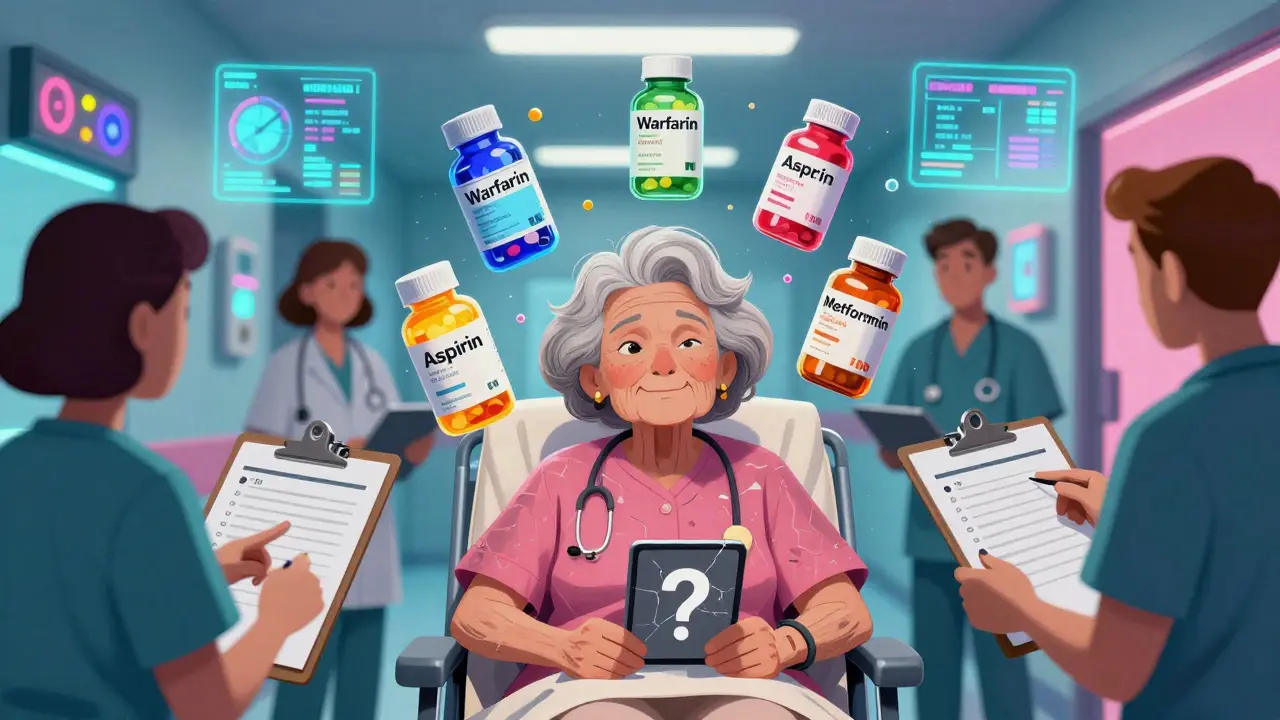
Every year, hundreds of thousands of patients are harmed because their medications get lost in the shuffle between hospitals, clinics, nursing homes, and home care. It’s not a rare mistake-it’s a systemic failure. Medication errors during care transitions are one of the most common-and preventable-causes of avoidable harm in healthcare. When a patient moves from one setting to another, their medication list often gets copied, pasted, or guessed at. That’s how a blood thinner gets doubled up, or a diabetes drug gets dropped entirely. And it happens more often than you think: 60% of all medication errors occur during these handoffs.
Why Medication Errors Happen During Transitions
Think about this: a 72-year-old woman is discharged from the hospital after a heart attack. She’s on eight different medications. The hospital team writes down what they think she’s on. The pharmacist at the community pharmacy calls to confirm. The home nurse visits and asks her what she’s taking. Each person hears something slightly different. One says she takes warfarin. Another says she stopped it. The discharge summary says she’s on aspirin, but she never took it before. Who’s right? This isn’t an isolated case. Studies show that when patients leave the hospital, nearly half of them go home with at least one medication error. Some are minor. Others lead to falls, bleeding, kidney failure, or death. The biggest culprits? Incomplete lists, unclear communication, and systems that don’t talk to each other. The World Health Organization calls this a global crisis. Their Medication Without Harm campaign, launched in 2017, set a target to cut severe, avoidable harm by 50% within five years. That goal is still out of reach-not because we don’t know how to fix it, but because we don’t consistently do the basics right.The Core Solution: Medication Reconciliation
The single most powerful tool we have is called medication reconciliation. It’s not fancy. It’s not new. It’s been required by The Joint Commission since 2005. But it’s still done poorly in most places. Medication reconciliation is a simple four-step process:- Get the most accurate list possible of what the patient is actually taking right now.
- Write down what medications should be prescribed during this transition.
- Compare the two lists side by side.
- Make clinical decisions-stop, start, change, or continue each drug based on the comparison.
Where Systems Fail-And How to Fix Them
Many hospitals use electronic health records (EHRs) to automate reconciliation. Sounds smart, right? But here’s the catch: EHRs can make things worse. A 2021 study in JAMA Internal Medicine found that when hospitals first switched to digital systems, medication discrepancies actually went up by 18%. Why? Because the system auto-filled old lists without checking. Or because the nurse didn’t know how to use it properly. The real game-changer isn’t the software-it’s the workflow. The AHRQ’s Medication at Transitions and Clinical Handoffs (MATCH) toolkit, updated in 2023, breaks down the process into 159 specific steps across 11 phases. Organizations that followed all the recommendations saw a 63% reduction in errors. Those that just installed an EHR? Only a 41% drop. One key insight? Role clarity matters. A 2022 MARQUIS study found that when staff were trained to take medication histories but weren’t clearly assigned responsibility, harmful errors went up by 15%. That’s not a technology problem. That’s a leadership problem.
The Human Factor: Patients and Providers
Patients aren’t just passive recipients of care-they’re critical partners. Yet only 28% of healthcare facilities consistently involve them in the reconciliation process. That’s a missed opportunity. A 2024 Kaiser Family Foundation survey showed that 72% of patients don’t understand why their medication list matters during transitions. But among those who did participate-like being asked to bring all their pills to the hospital or review the list with a pharmacist-85% felt more confident about their treatment. And what about the providers? A resident at Massachusetts General Hospital told the American College of Physicians forum that her hospital’s EHR reconciliation module adds 12-15 minutes per patient. That’s time she doesn’t have. So she skips steps. Or relies on memory. Or asks the patient to repeat their list-again-during discharge. The fix? Embed reconciliation into existing workflows. Don’t make it an extra task. Make it part of admission, discharge, and transfer checklists. Give pharmacists dedicated time. Train nurses to ask, “Can you show me what you take at home?” not “Do you take any medications?”Technology: Helpful, But Not a Cure-All
Technology has its place. Computerized Physician Order Entry (CPOE), barcode scanning, and clinical decision support tools have cut medication errors by 48% in hospitals, according to a 2022 Cochrane review. But these tools only work if they’re connected. Here’s the ugly truth: only 37% of U.S. hospitals can electronically share medication data with community pharmacies. That means pharmacists are still calling hospitals, leaving voicemails, and waiting hours for a callback. One pharmacist on Reddit said they spend 40% of their day just trying to verify medication lists. New tools are emerging. In August 2024, the FDA cleared MedWise Transition, an AI-powered tool that analyzes medication lists across systems and flags potential interactions or duplications. In a pilot with 12 hospitals, it reduced discrepancies by 41%. But even the best AI can’t replace a pharmacist who knows the patient’s history, or a nurse who asks the right question.
What Success Looks Like
Successful programs don’t rely on one tool or one person. They build a system:- Pharmacists are embedded in discharge teams-no exceptions.
- Every patient gets a printed, up-to-date medication list before leaving, written in plain language.
- Discharge instructions include a clear plan: “Take this drug at 8 a.m. daily. Call your doctor if you feel dizzy.”
- Community pharmacies are contacted electronically, not by phone.
- Patients are asked to bring all their pills to every appointment.
What You Can Do-Even If You’re Not a Doctor
You don’t need to be a clinician to help prevent these errors. If you’re caring for someone:- Always bring a written list of medications-include dosages, times, and why they’re taken.
- Ask: “Is anything being stopped or changed today?”
- Verify discharge instructions with the pharmacist before leaving the hospital.
- Call your pharmacy a day after discharge to confirm what was sent.
- Keep a physical copy of the updated list at home, and update it every time something changes.
The Bottom Line
Medication errors during transitions aren’t accidents. They’re system failures. And they’re entirely preventable. The tools exist. The evidence is clear. The cost of doing nothing is measured in lives lost, hospital stays extended, and billions wasted. The fix isn’t about buying better software. It’s about doing the basics-consistently, thoroughly, and with the patient at the center. Every time a patient leaves a hospital, clinic, or nursing home, their medication list should be accurate, complete, and understood. Not because it’s a checklist item. But because it’s the difference between safety and harm.What is medication reconciliation?
Medication reconciliation is the process of creating the most accurate list possible of a patient’s current medications and comparing it to new orders during transitions-like admission, transfer, or discharge. It involves four steps: getting the current list, creating the new list, comparing them, and making clinical decisions based on the differences. This prevents errors like duplications, omissions, or incorrect dosages.
Why do medication errors happen during discharge?
Errors happen because communication breaks down between providers, systems don’t share data, and patient information is incomplete or outdated. A patient might be on 10+ medications, and different teams may rely on memory, outdated records, or incomplete forms. Only 28% of facilities consistently involve patients in the process, and only 37% of U.S. hospitals can electronically share medication data with pharmacies.
Can electronic health records (EHRs) prevent medication errors?
EHRs can help-when used correctly. They’ve been shown to reduce errors by 32% overall. But during initial implementation, they can increase discrepancies by 18% if staff aren’t trained or if systems auto-fill inaccurate data. The real benefit comes when EHRs are combined with clear workflows, pharmacist involvement, and patient engagement. Standalone EHRs without process changes aren’t enough.
How much time should be spent on medication reconciliation?
Experts recommend 15-20 minutes per patient for a thorough reconciliation. But in practice, many facilities only allow 8-10 minutes due to time pressures. This leads to shortcuts and errors. The most successful programs prioritize this step by assigning dedicated staff, like pharmacists, and building it into standard workflows instead of treating it as an extra task.
What role do pharmacists play in preventing errors?
Pharmacists are the most effective frontline defense. Studies show that pharmacist-led reconciliation reduces post-discharge medication errors by 57% and hospital readmissions by 38%. They have the training to detect drug interactions, duplications, and inappropriate dosages. Facilities with dedicated transition pharmacists see 53% fewer adverse drug events. Their involvement is now a core recommendation in ASHP and ISMP guidelines.
What can patients do to help prevent medication errors?
Patients can keep a written list of all medications-including dosages, times, and reasons for taking them-and bring it to every appointment. They should ask, “Is anything being changed today?” and confirm discharge instructions with a pharmacist before leaving. Calling their pharmacy after discharge to verify what was sent can catch mistakes early. Patients who participate in the process report 85% higher confidence in their care.
Jonathan Noe
February 11, 2026 AT 03:49Let me tell you something - I’ve seen this play out in three different hospitals. The EHR auto-fills the med list from last admission, and boom, patient gets doubled up on warfarin because no one checked. It’s not a tech issue. It’s a culture issue. Staff are overworked, undertrained, and nobody owns the reconciliation process. Pharmacists? They’re stuck in the back room like librarians. We need them at the bedside, not behind a screen.
And don’t get me started on discharge papers. I had a cousin get sent home with a script for a drug she was allergic to. The nurse said, ‘We thought she stopped it.’ Thought? Thought?! That’s not clinical judgment - that’s gambling with someone’s kidneys.
Jim Johnson
February 11, 2026 AT 15:06you guys are overcomplicating this. just make every patient bring their meds in a ziplock bag when they come in. simple. no guesswork. no ehr glitches. no ‘we thought’ nonsense. i’ve done it at my mom’s hospital and it cut errors by like 70%. pharmacists can just look at the bag, check it against the list, and boom - done. also, give them a printed list in big font with emojis for times (💊 8am 🌞). people remember pictures better than paragraphs.
Vamsi Krishna
February 12, 2026 AT 19:29you americans always think technology will fix everything. in india we just ask the patient, ‘what are you taking?’ and if they say ‘i don’t know,’ we call the family. no ehr. no ai. no 159-step toolkit. just human conversation. you think a 72-year-old woman remembers eight drugs? she remembers her granddaughter’s birthday. that’s what you need to connect to. the system isn’t broken - your arrogance is. you treat patients like data points. we treat them like people. that’s why our mortality rate from med errors is lower than yours. and yes, i’ve worked in both systems.
Brad Ralph
February 13, 2026 AT 12:06so we built a $20M EHR system… to make a nurse spend 12 minutes asking a patient ‘what meds do you take?’ 🤦♂️
the real innovation? a nurse with coffee in one hand and a patient’s pill bottle in the other. 🤖➡️☕
Steve DESTIVELLE
February 14, 2026 AT 05:22the entire healthcare system is built on the illusion of control we dont really know what anyone is taking or why they are taking it and the idea that we can standardize something as chaotic as human biology and memory and emotion and fear and grief and hope and the way a grandmother forgets her pills because she is lonely and the way a son lies to his mother to avoid conflict about her pills because he is scared of losing her and the way a pharmacist in rural ohio gets 17 voicemails a day and none of them are returned and we call this a crisis when really it is just the natural consequence of a civilization that treats the body like a machine and the soul like a billing code
we dont need more steps we need more presence
the patient is not a problem to be solved they are a person to be held
Stephon Devereux
February 15, 2026 AT 07:14look - this isn’t rocket science. if you embed a pharmacist in every discharge team, train nurses to say ‘show me your pills’ instead of ‘do you take meds?’, and give patients a printed list with pictures - you cut errors by half. easy. the problem isn’t the lack of knowledge - it’s the lack of will. hospitals don’t prioritize this because it doesn’t make money. but guess what? preventing a readmission saves $15k. that’s not a cost - that’s profit. we just need leaders who care more about people than profit margins. and yes - it’s possible. i’ve seen it. we can do better. we just have to choose to.
steve sunio
February 15, 2026 AT 18:24so the solution is to make nurses do more work? wow. real genius. why dont we just make the patients pay for their own errors? they dont even know what theyre taking so why should we? also ehrs are a joke. my cousin got prescribed a drug that was banned in 2012. the system auto filled it. no one checked. now the hospital is suing her for the cost of her hospital stay. this system is a scam. we need to burn it all down
Neha Motiwala
February 16, 2026 AT 20:09HOW DO WE KNOW THIS ISN’T ALL A PHARMA COVER-UP?! I’ve read things - the EHRs? They’re coded to push certain drugs. The ‘reconciliation’ forms? They’re designed to make you miss the dangerous combinations. I know a nurse who got fired for reporting a pattern - she said 7 patients got the same wrong med after discharge. They said she was ‘paranoid.’ But now three of them are in comas. And the hospital? They just changed the software. Again. Why? Because they’re hiding something. I’m not crazy - I’m the only one paying attention.
athmaja biju
February 17, 2026 AT 14:55in india we do not have this problem because we do not rely on machines. we rely on family. when a patient is discharged, the son or daughter brings the pills to the doctor. the doctor holds them. looks at them. asks questions. no ehr. no computer. no 159 steps. just a man with pills in his hand and a family who cares. this is why our mortality rate is lower. we do not have the luxury of technology so we have the wisdom of humanity. america has technology but no soul. that is your problem.
Robert Petersen
February 18, 2026 AT 14:14biggest takeaway for me? Patients aren’t the problem - the system is. And the good news? We can fix it. I work in a clinic where we started giving patients a laminated card with their meds, times, and a QR code that links to a video of their pharmacist explaining why each one matters. Guess what? Adherence went up 60%. Readmissions dropped. Staff morale improved. It’s not about adding work - it’s about adding care. Small changes. Big impact. We’re proof it works. You can too.
Craig Staszak
February 18, 2026 AT 23:47the fact that we need a 159-step toolkit to do something this basic says everything. we’ve over-engineered care. just ask the patient. show them the list. have them sign it. call the pharmacy. done. no AI. no EHR. no consultants. just humans talking. the data exists. the solution is simple. we just refuse to do it because we’re too busy measuring outcomes instead of saving lives
alex clo
February 20, 2026 AT 15:00the literature is clear: pharmacist-led reconciliation reduces errors by over 50%. yet only 12% of U.S. hospitals have pharmacists embedded in discharge teams. this is not a technical challenge - it is a prioritization failure. institutional inertia, reimbursement structures, and siloed workflows are the true barriers. evidence-based practice is not optional. it is the standard of care. compliance is not negotiable. the cost of inaction is measured in preventable death.
Ernie Simsek
February 21, 2026 AT 01:40my aunt died because they gave her a drug she’d been off for 3 years. the EHR said ‘continue.’ no one checked. the nurse said ‘she looked fine.’ she was dead by midnight. now my family is suing. but honestly? the hospital’s defense? ‘We followed protocol.’
protocol killed her.
😭
Joanne Tan
February 21, 2026 AT 15:05just started doing this at my mom’s rehab center - we give every patient a little notebook to write down their meds. we take a pic of it. then we print it out, sign it, and hand them a copy. they love it. one guy said ‘i finally feel like someone cares.’ turns out, people just want to be heard. and maybe… just maybe… that’s the real reconciliation.