
How Patents Keep New Drugs Coming
Imagine spending 12 years and $2.6 billion to create a drug that could save lives. Now imagine someone copying it the moment it hits the market and selling it for 10% of the price. That’s the problem patent law was built to solve - not to block competition, but to make sure the companies taking huge risks can actually get paid back.
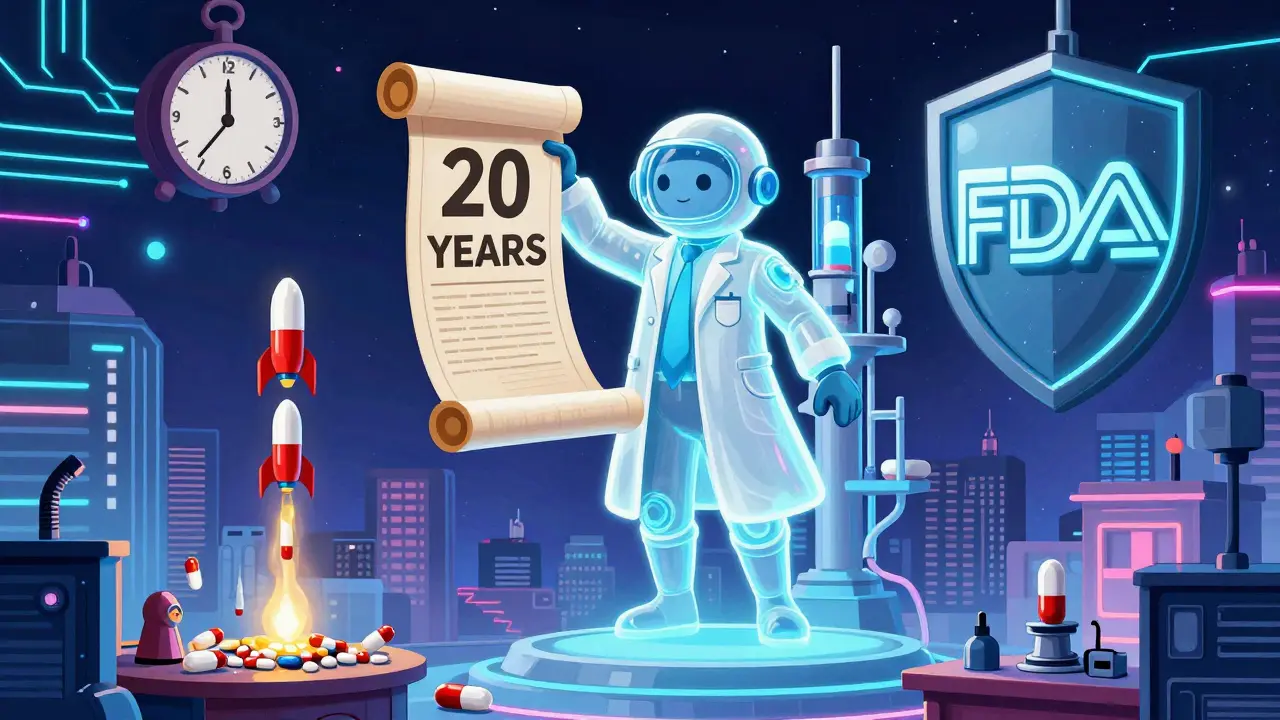
In the U.S., pharmaceutical patents give a company exclusive rights to make and sell a new drug for 20 years from the day the patent is filed. But here’s the catch: by the time a drug gets approved by the FDA, it’s often already five or six years into that 20-year window. That leaves just 12 to 14 years of real market exclusivity. Without that window, no company would risk billions on a drug that might fail in clinical trials.
The Hatch-Waxman Act: The Balancing Act
In 1984, Congress passed the Hatch-Waxman Act - named after Senator Orrin Hatch and Representative Henry Waxman - to fix a broken system. Before this law, brand-name drugmakers could delay generics indefinitely by suing them the moment they tried to enter the market. Generic companies had no legal path to follow. The law changed everything.
It created a two-track system: one for innovators, one for generics. Brand companies still get their 20-year patent protection, but now generic manufacturers can start developing copies while the patent is still active. They just can’t sell them until the patent expires - or until they successfully challenge it in court.
Here’s how it works: a generic company files an application with the FDA saying, “We’re making this drug, and we believe the patent is invalid or won’t be enforced.” That’s called a Paragraph IV certification. When they do that, the brand company has 45 days to sue for patent infringement. If they do, the FDA is legally required to delay approval of the generic for up to 30 months - even if the patent is weak or clearly invalid. That’s not a victory for the brand; it’s a legal timeout that gives them more time to protect their revenue.
The First-Mover Advantage: Why Generics Fight So Hard
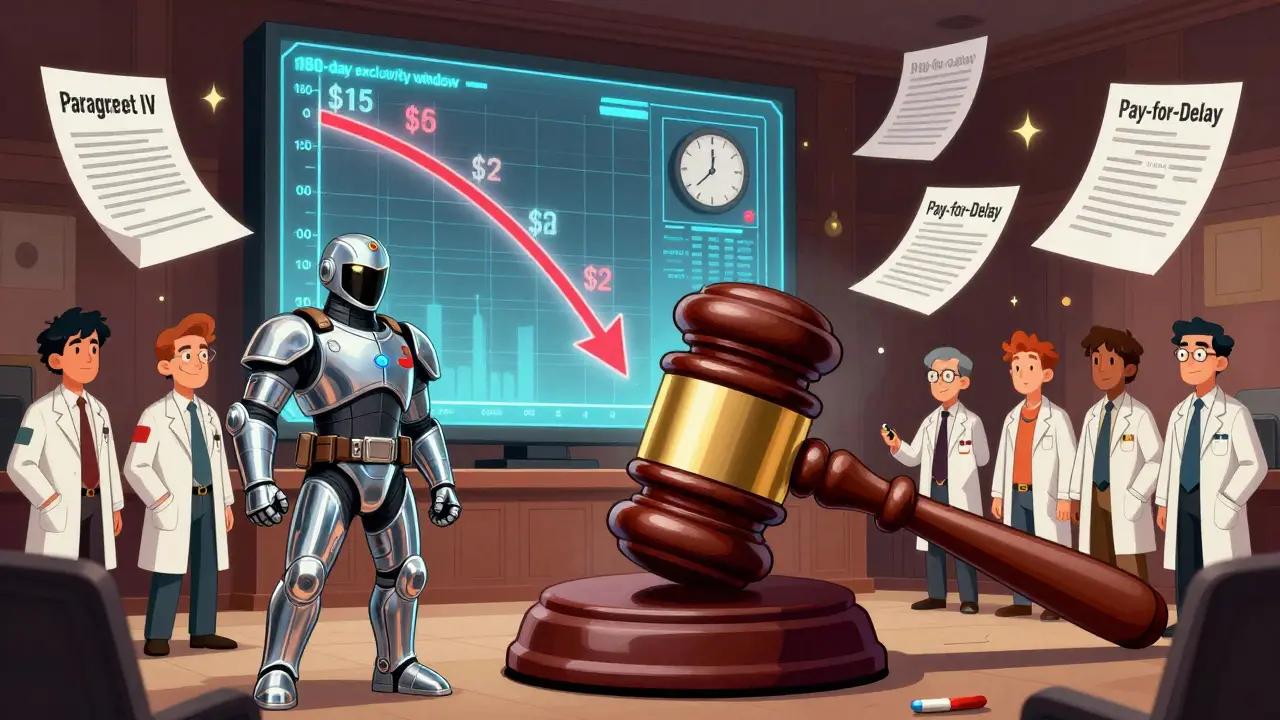
The real game-changer in Hatch-Waxman is the 180-day exclusivity period for the first generic company that successfully challenges a patent. Once they get FDA approval, they’re the only generic on the market for six months. During that time, they can charge a price somewhere between the brand drug and the eventual low-cost generics. That’s often worth hundreds of millions in profit.
That’s why generic companies spend millions on lawyers and scientists just to be first. They know that once the 180 days are up, prices will crash. And they’re right. When the first generic version of Prozac hit the market in 2001, Eli Lilly lost 70% of its U.S. sales within a year. Within six months, prices dropped 70%. By the time five generics were on the shelf, the price had fallen 90%.
How Generics Save Billions - Without Cutting Corners
Generics aren’t knockoffs. They’re chemically identical to the brand-name drug. The FDA requires them to prove they work the same way, in the same amount of time, in the same part of the body. No shortcuts. No cheaper ingredients. Just the same active molecule.
That’s why generics now make up 91% of all prescriptions in the U.S. But they cost only 24% of what brand drugs do. In 2022, they saved patients and insurers $373 billion. A bottle of ibuprofen that once cost $15 under the brand name Brufen? Now it’s $2. That’s not inflation - that’s competition.
The Dark Side: Evergreening and Patent Thickets
But the system isn’t perfect. Some companies use tricks to stretch their monopoly beyond the original patent. This is called “evergreening.” Instead of inventing new drugs, they file patents on tiny changes: a new pill coating, a slightly different dose schedule, or a new way to manufacture the same molecule.
Take Humira. The original patent expired in 2016. But the manufacturer, AbbVie, filed over 240 patents covering everything from how the drug is stored to how it’s injected. These weren’t new inventions - they were legal barriers. The result? No biosimilar (the biologic version of a generic) entered the U.S. market until 2023 - seven years after Europe got them.
These patent thickets make it expensive and risky for generics to enter. Sometimes, they just give up. That’s why the average time from patent expiration to generic entry has grown from 2.1 years in 2005 to 3.6 years in 2020.
Pay-for-Delay: When Generics Get Paid to Wait
Even worse is “pay-for-delay.” That’s when a brand company pays a generic company to delay launching its cheaper version. The FTC estimates these deals cost consumers $3.5 billion a year.
Here’s how it works: the brand offers the generic a cut of the profits - say, $100 million - if they agree not to sell their version for another two years. The generic takes the money. The brand keeps its monopoly. The patient pays more. The system breaks down.
Congress has tried to ban these deals with bills like the Preserve Access to Affordable Generics Act. But they keep slipping through loopholes. Courts have allowed them if they’re “not obviously anti-competitive.” That’s not a high bar.
What’s Next? The Fight Over Biologics and IPR
Biologics - drugs made from living cells, like insulin or cancer treatments - are the new frontier. They’re more complex than traditional pills, so generics are called biosimilars. The law that governs them, the BPCIA, was supposed to create a clear path. But in 2017, a federal court decision in Amgen v. Sandoz threw it into chaos.
The court ruled that brand companies don’t have to share their manufacturing secrets with biosimilar makers. That made it harder for generics to prove their product matches. As a result, biosimilar entry has been slow. Only a handful have made it to market in the U.S., even though they’re approved in Europe.
Another big issue: inter partes review (IPR). This is a fast, cheap way for generics to challenge patents at the Patent Office instead of in court. But some drugmakers argue IPR is unconstitutional. The Supreme Court hasn’t ruled yet. If IPR gets shut down, generic companies will have to go back to expensive, slow court battles - and fewer will bother.
The Bottom Line: Innovation Needs Protection - But Not Forever
Patents aren’t about stopping generics. They’re about giving innovators a fair shot to recover their investment. Without them, we wouldn’t have new cancer drugs, rare disease treatments, or breakthrough vaccines.
But patents shouldn’t be used as weapons to delay competition. The Hatch-Waxman Act was designed to strike a balance. Today, that balance is tipping. Evergreening, pay-for-delay, and patent thickets are undermining the system’s original purpose.
The solution isn’t to weaken patents. It’s to enforce them fairly. Stop letting companies game the system. Let generics enter faster when patents are weak. Ban pay-for-delay deals. Require transparency in patent listings. And make sure the FDA has the tools to approve generics without unnecessary delays.
Because in the end, it’s not about big pharma vs. big generics. It’s about patients who need affordable medicine - and the innovators who still need a reason to keep trying.
How long does a pharmaceutical patent last?
A pharmaceutical patent lasts 20 years from the date it’s filed. But because it takes 5-10 years to get FDA approval, the actual time a company has to sell the drug without competition is usually only 12-14 years.
What is the Hatch-Waxman Act?
The Hatch-Waxman Act of 1984 is the U.S. law that created the modern system for generic drugs. It lets generic companies start developing copies while brand patents are still active, gives them a 180-day exclusivity period if they challenge a patent, and allows brand companies to get a 30-month delay in generic approval if they sue for infringement.
Why do generic drugs cost so much less?
Generic drugs cost 80-85% less because they don’t have to repeat expensive clinical trials. They only need to prove they’re bioequivalent to the brand drug - meaning they work the same way in the body. Their savings come from skipping R&D and marketing costs.
What is ‘evergreening’ in drug patents?
Evergreening is when a drug company files new patents on minor changes - like a new pill shape, dosage, or delivery method - to extend their monopoly after the original patent expires. This delays generics without adding real innovation.
Can generic drugs be unsafe?
No. The FDA requires generic drugs to have the same active ingredient, strength, dosage form, and route of administration as the brand drug. They must also prove they’re absorbed the same way in the body. Thousands of generics are approved each year - and they’re just as safe and effective.
What’s the difference between a generic and a biosimilar?
Generics are exact copies of small-molecule drugs made with chemicals. Biosimilars are highly similar versions of complex biologic drugs made from living cells. Because biologics are harder to copy exactly, biosimilars aren’t identical - but they must be proven to work the same way in patients.
Why do some generics take years to appear after a patent expires?
Brand companies often file dozens of patents to create legal barriers. Generic makers must challenge each one in court, which can take years. Pay-for-delay deals and complex litigation also slow down entry. The average delay is now 3.6 years after patent expiration.
Do patents discourage innovation?
Not when they’re used properly. Patents incentivize companies to invest in risky R&D. But when patents are used to block competition without real innovation - like through evergreening or pay-for-delay - they actually reduce innovation by protecting old drugs instead of encouraging new ones.
Matt W
February 2, 2026 AT 11:47Solomon Ahonsi
February 3, 2026 AT 17:35Anthony Massirman
February 4, 2026 AT 00:15larry keenan
February 4, 2026 AT 03:18Brett MacDonald
February 5, 2026 AT 05:47Vatsal Srivastava
February 5, 2026 AT 16:17jay patel
February 6, 2026 AT 09:50Ansley Mayson
February 7, 2026 AT 20:22phara don
February 9, 2026 AT 14:48Ellie Norris
February 10, 2026 AT 06:11George Firican
February 11, 2026 AT 21:18