
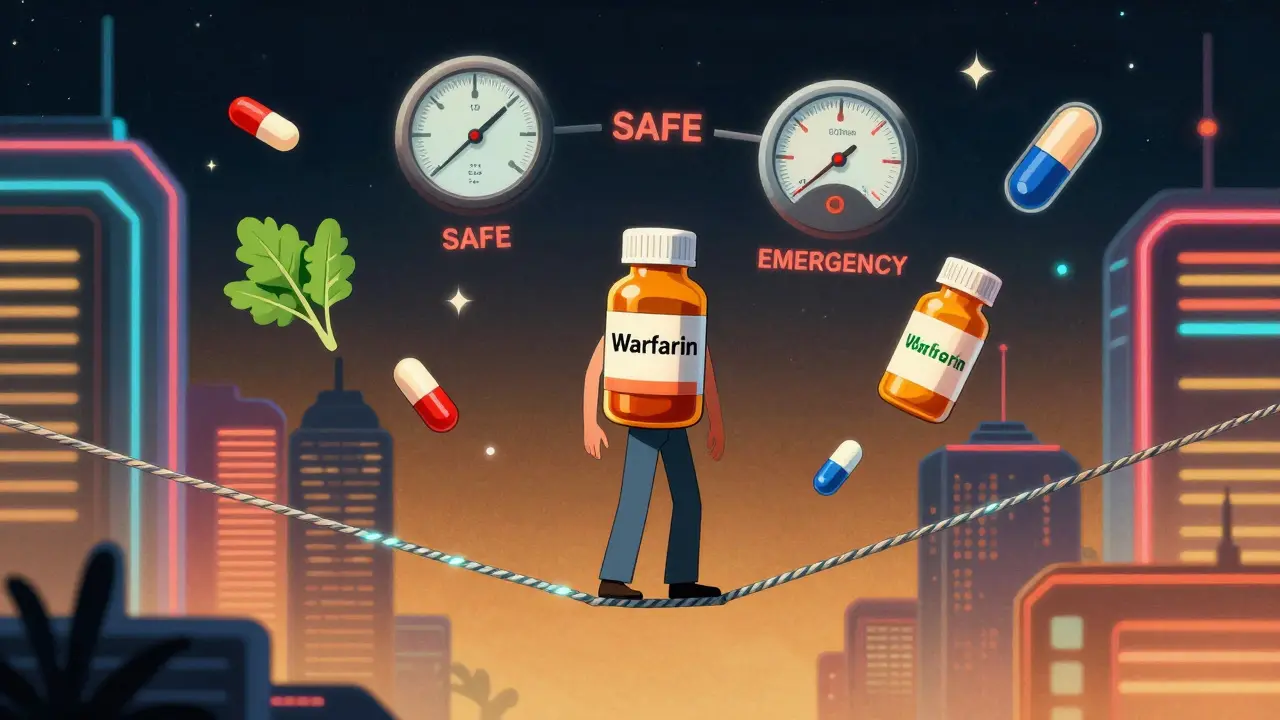
Some medications are like walking a tightrope. One tiny mistake - a slightly higher dose, a different pill brand, or even a change in what you ate - can push you from being safely treated to facing a medical emergency. These are called narrow therapeutic index drugs, or NTI drugs. They don’t have room for error. And if you’re taking one, you need to know exactly what that means.
What Does "Narrow Therapeutic Index" Actually Mean?
Every drug works best within a specific range in your bloodstream. Too little, and it doesn’t help. Too much, and it becomes dangerous. For most medications, that range is wide enough that small changes don’t matter much. But for NTI drugs, the line between right and wrong is razor-thin.
The FDA defines NTI drugs as those where even a 10% to 20% change in blood levels can cause serious harm. That might sound rare, but it’s not. These drugs are used for life-critical conditions: preventing blood clots, controlling seizures, managing thyroid function, or keeping a transplanted organ from being rejected. A small slip can mean a stroke, organ failure, or even death.
Think of it like this: if you’re taking a regular painkiller, going from 400 mg to 500 mg might just give you a stronger effect. But if you’re on warfarin and your dose goes up by 10%, your blood could stop clotting properly - and you could bleed internally without warning.
Common NTI Drugs You Might Be Taking
You might not realize you’re on one of these drugs. Here are the most common ones, and why they’re so sensitive:
- Warfarin (Coumadin, Jantoven) - Used to prevent clots. The right dose keeps your INR between 2.0 and 3.0. Go above 3.5? Risk of dangerous bleeding. Below 2.0? Risk of clots. Even small changes in diet, antibiotics, or supplements can throw it off.
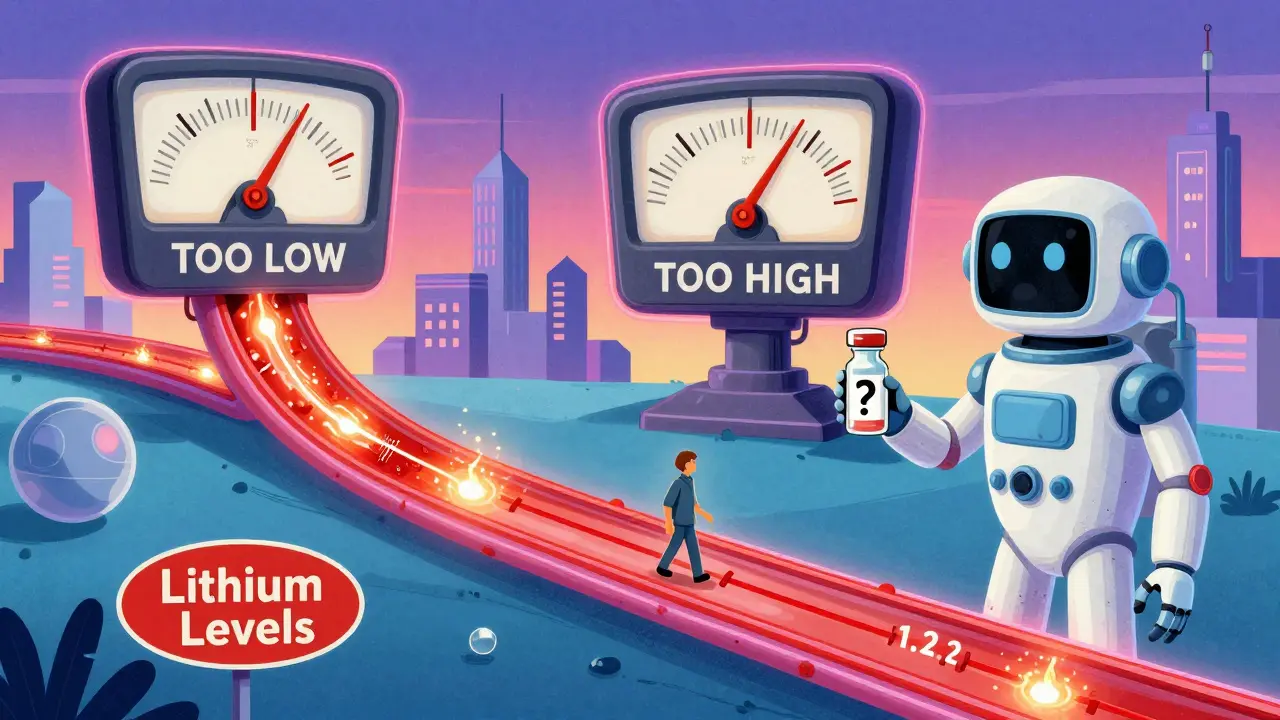
- Lithium (Lithobid) - For bipolar disorder. Therapeutic range: 0.6 to 1.2 mmol/L. Above 1.5? You’ll start shaking, feel confused, or even have seizures. Many patients say regular blood tests are the only thing keeping them stable for years.
- Levothyroxine (Synthroid) - For hypothyroidism. A tiny shift in dose can make you feel exhausted or anxious. Some patients report wild swings in TSH levels after switching between generic brands - from normal to severely underactive in just weeks.
- Digoxin (Lanoxin) - For heart failure and irregular heartbeat. Therapeutic level: 0.5-0.9 ng/mL. Above 2.0? Life-threatening heart rhythms. It’s easy to overdose because it builds up slowly in your body.
- Tacrolimus (Prograf) - For transplant patients. Too low? Your body attacks the new organ. Too high? Your kidneys get damaged. Levels must be checked twice a week after transplant.
- Phenytoin (Dilantin) and Carbamazepine (Tegretol) - For seizures. Both have narrow windows and interact with many other drugs. A change in liver function or even a new vitamin can alter how they work.
- Methotrexate (Trexall) - Used for cancer, rheumatoid arthritis, and psoriasis. Even small overdoses can damage bone marrow or the liver.
These aren’t rare drugs. Millions of people take them. But most don’t know how delicate their balance really is.
Why Generic Switches Can Be Risky
You’ve probably heard that generics are just as good as brand-name drugs. That’s usually true. But for NTI drugs, it’s not that simple.
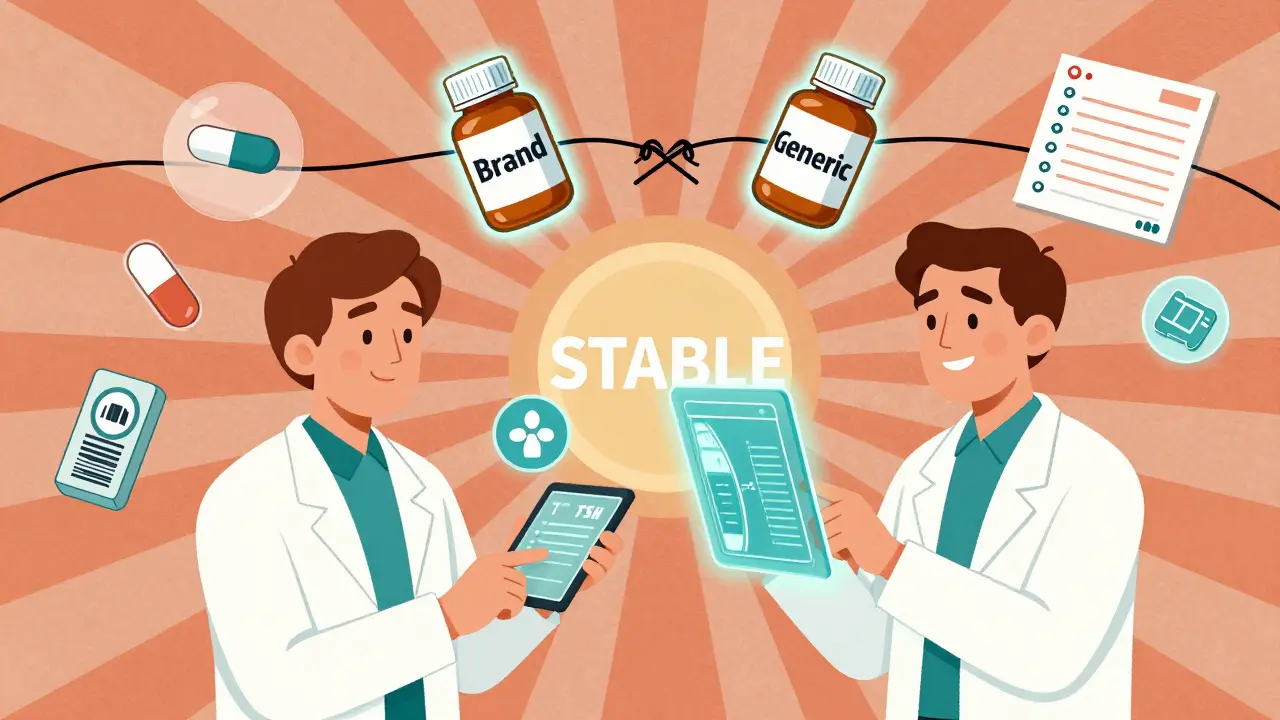
Generics must prove they’re "bioequivalent" - meaning they deliver about the same amount of drug into your bloodstream as the brand. For most drugs, that’s 80% to 125% of the brand’s level. But for NTI drugs? The FDA now requires a much tighter range: 90% to 111%. That’s still a 22% window - and it’s enough to cause problems.
Real patients have reported serious issues after switching:
- A warfarin user in Australia saw her INR jump from 2.5 to 4.1 after switching to a generic - leading to emergency treatment for bleeding.
- A patient on levothyroxine had her TSH level swing from 1.8 to 8.4 after changing generic manufacturers. She gained 10 kilos and couldn’t get out of bed.
- One Reddit user said, "I went from stable for 5 years to needing hospitalization after my pharmacy switched my lithium brand without telling me."
That’s why pharmacists in states like North Carolina are legally required to get your doctor’s approval before switching your NTI drug. It’s not about cost - it’s about safety.
What You Must Do to Stay Safe
If you’re on an NTI drug, your job isn’t just to take the pill. You have to become an active manager of your treatment. Here’s what works:
- Stick to the same brand or generic - If your doctor prescribes a specific product, ask your pharmacist not to switch it. If they do, call your doctor right away.
- Get blood tests on time - Don’t skip them. Warfarin? You might need an INR test every few weeks. Lithium? Every 3 to 6 months, or more often if your dose changes. These aren’t optional checkups - they’re your safety net.
- Know the warning signs - For warfarin: unexplained bruising, nosebleeds, blood in urine or stool. For lithium: shaking hands, confusion, nausea, dizziness. For levothyroxine: extreme fatigue, weight gain, or heart palpitations. Don’t ignore them.
- Track everything - Keep a simple log: what you took, when, any symptoms, and your test results. Patients who do this have 32% fewer bad events, according to the American College of Clinical Pharmacy.
- Talk to your pharmacist - Ask: "Is this the same as my last prescription?" If they say "it’s just a different brand," ask if it’s an NTI drug. Most pharmacists know the list.
What’s Changing Now (2026)
The rules are getting stricter - and that’s good news for patients.
In 2023, the FDA released new guidance for 15 NTI drugs, including levothyroxine and digoxin, with specific testing requirements to ensure consistency. Hospitals now use barcode scanning on 12 high-risk NTI drugs to prevent dosing mistakes.
Even better: genetic testing is starting to become standard. For warfarin, your genes (like CYP2C9 and VKORC1) can explain up to 60% of why you need a certain dose. Doctors in Sydney and elsewhere are already using this to set initial doses, reducing trial-and-error.
By 2026, experts predict pharmacogenetic testing will be routine for starting several NTI drugs. That means fewer hospital visits, fewer emergencies, and more stable health.
You’re Not Alone
NTI drugs aren’t rare. They’re essential. But they demand respect. You’re not being paranoid if you ask questions. You’re being smart.
Many patients say the hardest part isn’t the medication - it’s the fear. Fear that one mistake will undo everything. But with the right habits - consistent dosing, regular monitoring, clear communication - you can live safely with these drugs. Thousands do.
Don’t let confusion or cost push you into a risky switch. Your life depends on the details. Stay informed. Stay vigilant. And never hesitate to speak up.
Are all generic drugs unsafe for NTI medications?
No. Many generic versions of NTI drugs are safe and effective. But they must meet stricter standards than regular generics. The FDA now requires bioequivalence within 90% to 111% of the brand-name drug, compared to 80% to 125% for most others. Still, some patients react differently to different formulations - even if both are approved. That’s why sticking with the same product, when possible, is the safest approach.
Can I switch between different generic brands if they’re both approved?
Technically yes - but it’s not recommended. Even small differences in how the drug is absorbed can push your blood levels outside the safe range. Patients have reported serious side effects after switching, even between two FDA-approved generics. If you must switch, your doctor should monitor your blood levels closely right after the change. Always ask your pharmacist if the new version is the same as your old one.
How often should I get blood tests for my NTI drug?
It depends on the drug and your situation. For warfarin, expect tests every 1 to 4 weeks, especially when starting or changing doses. Lithium levels are checked every 3 to 6 months if stable, but monthly during dose changes. Tacrolimus requires testing twice a week right after a transplant, then less often. Levothyroxine usually needs TSH testing every 6 to 12 weeks after a dose change, then annually if stable. Always follow your doctor’s schedule - don’t skip tests just because you feel fine.
Do food and other medications affect NTI drugs?
Yes - often dramatically. Warfarin reacts with vitamin K (found in leafy greens), antibiotics, and even cranberry juice. Lithium levels rise with salt loss, dehydration, or NSAIDs like ibuprofen. Levothyroxine should be taken on an empty stomach - no coffee, calcium, or iron for at least an hour. Always tell your doctor about every supplement, OTC drug, or herbal product you take. What seems harmless can be dangerous with an NTI drug.
What should I do if I miss a dose of my NTI drug?
Don’t double up. For most NTI drugs, missing one dose won’t cause immediate harm - but it can throw off your balance. Call your doctor or pharmacist for advice. For warfarin, you might need an INR test sooner. For lithium, you might need to hold the next dose. For levothyroxine, take it as soon as you remember, unless it’s close to your next scheduled dose. Never guess - always check.
Ashlyn Ellison
February 7, 2026 AT 06:17Just took my levothyroxine this morning. Same brand, same time, same empty stomach. But I swear, last week I felt like a zombie. This week? Energy like I’m 25 again. No idea why. Maybe my coffee got weaker. Or maybe my body just needed a break. Either way-don’t mess with these meds.
Monica Warnick
February 7, 2026 AT 13:07Oh please. You think this is new? My aunt was on warfarin for 12 years. One day her pharmacy switched her to a "generic"-no warning, no consent. She bled internally in her sleep. Ended up in ICU for 11 days. The pharmacy said "bioequivalent." Like that’s a magic word. It’s not. It’s a loophole. The FDA doesn’t care about real people. They care about cost savings. And we’re the guinea pigs.
I’ve filed complaints. I’ve called senators. I’ve begged my doctor to stick with Coumadin. They all say "it’s fine." But when your blood’s not clotting right, "fine" doesn’t cut it. This isn’t about generics. It’s about greed wrapped in a lab coat.
And don’t get me started on how they switch you without telling you. I’ve seen the scripts. The pharmacy logs show the brand change. But the patient? Never notified. That’s not negligence. That’s malpractice by system design.
Brett Pouser
February 7, 2026 AT 14:01Man, I just want to say-I’m a transplant recipient on tacrolimus. Been on it for 7 years. My kidney’s still working. I owe that to two things: never switching brands, and getting my blood drawn like clockwork. Every Tuesday, 7 AM. Rain, snow, or hangover. My nurse knows me by name.
One time, my pharmacist switched me to a "new generic"-I didn’t catch it till I got home. Felt weird. Headache. Nausea. Called my doc the next day. They retested. My level was 30% higher than before. Scary stuff.
Now I always ask: "Is this the same as last time?" If they say "yes," I say "prove it." And they do. Because they know I’ll call my doctor if they don’t. It’s not paranoia. It’s survival.
Also-yes, food matters. I used to take it with breakfast. Then I found out grapefruit juice messes with it. Now I take it with water. Only water. No coffee. No orange juice. No sneaky smoothies. Just water. And a calendar. And a whole lotta patience.
Joshua Smith
February 9, 2026 AT 05:16My mom’s on lithium. She’s been stable for 8 years. I didn’t realize how fragile that balance was until she got sick with the flu last winter. She stopped eating, drank less water, and her levels spiked. She ended up in the ER with tremors and confusion.
Since then, we’ve got a system: weekly check-ins, a little notebook where she logs her mood, sleep, and water intake. We even have a reminder app that pings her to drink a glass of water every 3 hours. It’s not glamorous. But it works.
It’s wild how something so simple-drinking enough water-can be the difference between living fine and almost dying. These drugs aren’t just pills. They’re part of a whole lifestyle. And honestly? That’s kind of beautiful. You learn to listen to your body in a way most people never do.
Kathryn Lenn
February 9, 2026 AT 19:42So let me get this straight-you’re telling me the government lets drug companies swap out life-saving meds like they’re trading baseball cards, and we’re supposed to be grateful because it’s "within 90-111%"? That’s not science. That’s corporate theater.
And don’t even get me started on "pharmacogenetic testing." Yeah, right. Next thing you know, they’ll be charging $500 for a DNA test just to let you take your own damn pill. It’s not innovation. It’s monetized fear.
They want us to think we’re powerless. But we’re not. We’re the ones who take the pills. We’re the ones who bleed, shake, and crash. We’re the ones who notice when the pill looks different. We’re the ones who call the pharmacy. We’re the ones who survive.
Stop pretending this is about safety. It’s about profit. And if you’re not angry about that, you’re not paying attention.
John Watts
February 11, 2026 AT 02:30Hey, I just want to say-this thread is giving me hope. I’m on phenytoin. Been on it since I was 16. I’ve had seizures since I was 8. I didn’t know how much this mattered until I saw someone else describe the same fear I’ve lived with.
I keep a little card in my wallet: "I take phenytoin. Do not switch brands. Call my neurologist." I’ve shown it to pharmacists. One cried. She said she’d never realized how much pressure patients were under.
It’s not just about the drug. It’s about dignity. Being able to trust your own body. Knowing you’re not a statistic. You’re a person.
So if you’re reading this and you’re on one of these meds-keep going. Keep asking. Keep logging. Keep showing up. You’re not alone. We’re all out here. And we’re not backing down.
Angie Datuin
February 12, 2026 AT 16:22My doctor told me to switch from Synthroid to a generic because "it’s cheaper." I did. Three weeks later, I couldn’t get out of bed. My hair fell out. My heart raced. I thought I was dying.
I switched back. Within a week, I was me again.
Don’t let anyone tell you it’s "just a brand." Your body knows.
Marie Fontaine
February 13, 2026 AT 11:35Just wanted to say THANK YOU for this post 😭 I’ve been on warfarin for 3 years. I do my INR every 10 days. I log everything. I even have a little calendar with red X’s for test days. It’s weirdly satisfying. Like I’m winning at life. 💪
Also-no cranberry juice. Ever. I learned that the hard way. 😅
Ken Cooper
February 13, 2026 AT 14:32so i just got switched to a new generic for my carbamazepine and i swear i felt like a zombie for two weeks. like, i couldnt even walk to the fridge without getting dizzy. called my doc and they were like "oh, that happens sometimes" like its normal?? no it aint. i demanded my old brand back and they finally gave in. dont let them push you around. you know your body better than any algorithm. also-why do they even have the power to switch without asking? like wtf. i hate the system.
glenn mendoza
February 14, 2026 AT 17:56As a healthcare professional with over two decades of clinical experience, I must commend the thoroughness and accuracy of this post. The information presented aligns precisely with current clinical guidelines from the American College of Clinical Pharmacy and the FDA’s 2023 NTI Drug Safety Initiative. The emphasis on patient autonomy, consistent formulation, and proactive monitoring is not merely advisable-it is clinically imperative.
It is also worth noting that while pharmacogenetic testing is not yet universally accessible, its integration into routine care for drugs such as warfarin and phenytoin has demonstrated a 41% reduction in adverse drug events in peer-reviewed multicenter trials (JAMA, 2024). This is not speculative-it is evidence-based medicine in motion.
To every patient reading this: your vigilance is not excessive. It is the very foundation of safe pharmacotherapy. Continue to advocate for yourself. Document everything. Communicate with your care team. You are not a burden. You are a critical partner in your own healing.