

Managing multiple medications isn’t just about remembering to take them-it’s about taking them at the right time, in the right order, and without accidentally canceling out their effects or making yourself sick. If you’re on five or more medications, you’re not alone. Nearly 40% of adults over 65 are in the same boat. But here’s the problem: drug interactions are one of the leading causes of preventable hospital visits, especially when pills are taken haphazardly. A 2019 study found that 82% of people taking five or more drugs experience at least one interaction. The good news? You can cut that risk dramatically with a smart, simple schedule.
Start with a Complete Medication List
Before you even think about timing, you need to know exactly what you’re taking. This includes prescriptions, over-the-counter painkillers, vitamins, herbal supplements, and even occasional meds like sleeping pills or antacids. Many people forget the little stuff-like taking melatonin with blood pressure medicine or St. John’s Wort with antidepressants-but these can cause serious problems. Write everything down. Don’t rely on memory. Use a notebook, a phone note, or a printed form. Include the name, dose, why you’re taking it, and who prescribed it. Bring this list to every doctor visit. Pharmacists call this a "brown bag review"-and it’s one of the most effective ways to catch hidden conflicts. Studies show that when patients bring all their meds to an appointment, pharmacists find an average of 3.2 discrepancies per person. Verbal lists? They miss 40% of what’s actually being taken.Understand Timing Rules That Matter
Not all meds can be taken together. Some need space. Others need food. Others need an empty stomach. Get this wrong, and the drug won’t work-or worse, it could harm you. Here are real-world examples:- Levothyroxine (thyroid medicine) must be taken on an empty stomach, at least 30-60 minutes before breakfast. If you take it with coffee, calcium, or iron, your body absorbs less than half of the dose.
- Statins (like atorvastatin) work better when taken at night because your liver makes most cholesterol while you sleep.
- Antibiotics like ciprofloxacin can’t be taken with dairy, antacids, or iron pills-wait at least two hours.
- Warfarin (a blood thinner) interacts with vitamin K-rich foods like spinach and kale. You don’t need to avoid them, but you need to eat them consistently-same amount every day.
Use the Universal Medication Schedule (UMS)
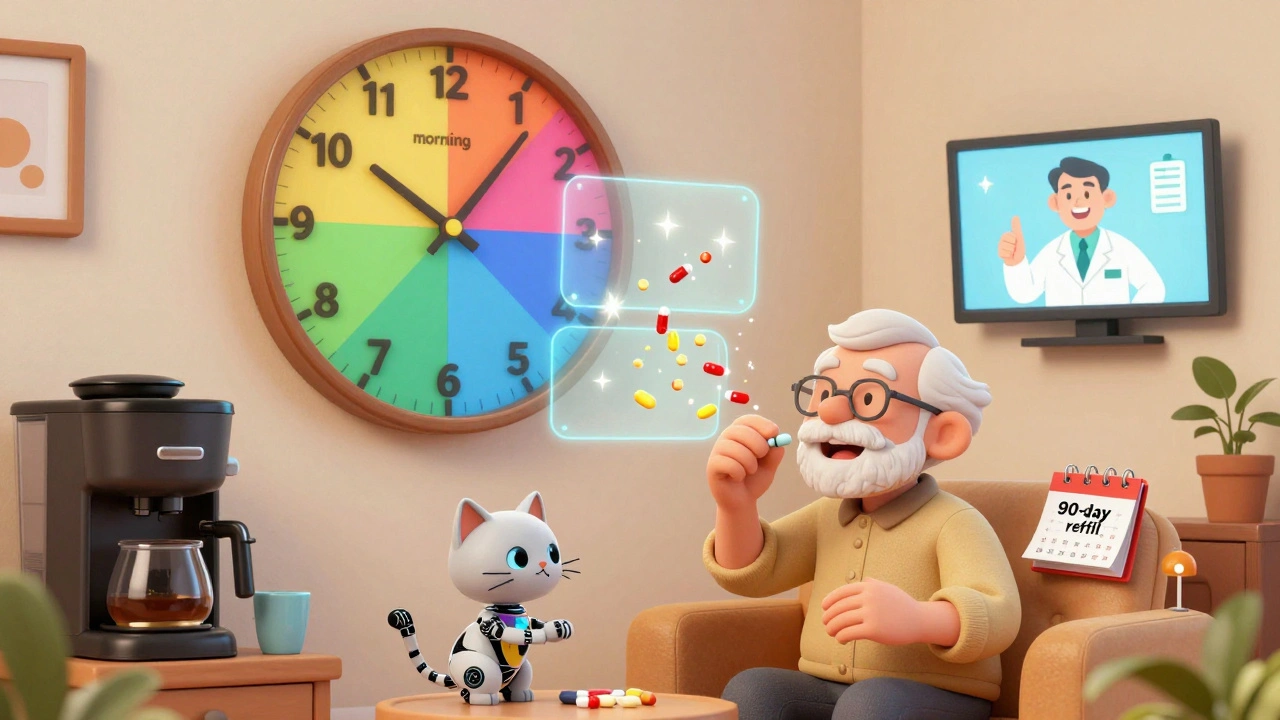
Forget vague instructions like "take twice daily" or "as needed." They’re confusing-even for people with high health literacy. The Universal Medication Schedule (UMS) fixes this by using clear, standardized time blocks:- Morning: 6-10 a.m.
- Noon: 10 a.m.-2 p.m.
- Evening: 2-6 p.m.
- Bedtime: 8 p.m.-12 a.m.

Pill Organizers and Calendars Are Your Best Friends
A simple 7-day pill box with AM/PM compartments cuts dosing errors by 45%, according to a major 2018 meta-analysis. For more complex schedules, use a box with four compartments per day: morning, noon, evening, bedtime. Label each slot clearly with a permanent marker. Pair that with a paper calendar. Write down each pill, the time, and whether it needs food. Put it on your fridge or bathroom mirror. People who use visual calendars improve adherence from 50% to 75%. That’s the difference between staying healthy and ending up in the ER. If you’re tech-savvy, apps like Medisafe or MyTherapy send reminders and track interactions. But don’t assume they’re for everyone. Only 38% of people over 65 use them consistently. For many, a printed chart and a pill box work better-and they don’t need Wi-Fi.Synchronize Refills to Reduce Chaos
Getting four different refill dates every month is a recipe for missed doses. One prescription runs out on the 5th. Another on the 12th. You’re scrambling, forgetting, or skipping pills. Ask your doctor or pharmacist about "90 x 4" prescribing: get 90-day supplies, filled four times a year, all on the same day. That means one trip to the pharmacy every three months instead of twelve. The American Medical Association says this saves clinicians two hours a day-and patients hours of stress. It’s not always possible if your doses change often. But if you’re stable on your meds, this is one of the easiest ways to simplify your life.Watch for Warning Signs
Even with the best schedule, things can go wrong. Pay attention to your body. If you start feeling:- Dizzy or lightheaded
- Nauseous or have diarrhea
- Unusual bruising or bleeding
- Confusion or memory lapses
- Heart palpitations or shortness of breath
Work With Your Pharmacist, Not Just Your Doctor
Doctors focus on treating conditions. Pharmacists focus on how the drugs work together. They have access to tools like Lexicomp and Micromedex that screen for over 150 common interactions in under 15 minutes. Ask for a free medication therapy review. Most pharmacies offer it. They’ll walk you through your list, flag risks, and help you build a schedule that fits your routine. In one study, pharmacist-led reviews reduced drug interactions by 32% and cut emergency visits by 24%.What If You See Different Instructions From Different Doctors?
This happens a lot. One doctor says take your blood pressure pill in the morning. Another says take it at night. Your cardiologist and your rheumatologist give conflicting advice. That’s not your fault. It’s a system problem. But you can fix it. Bring your complete, written schedule to your next appointment. Say: "I’m trying to avoid interactions. Can we make sure all my meds work together?" Many doctors don’t know what else you’re taking. They assume you’re following the last instruction they gave. A coordinated plan is the only way forward.Final Tip: Make It Routine
The best schedule in the world won’t help if you don’t stick to it. Build it into your day. Take your pills right after brushing your teeth. Put your pill box next to your coffee maker. Set a phone alarm labeled "AM Meds"-not just "Meds." It takes 2-4 weeks to make a new habit stick. Be patient. Track your progress. Celebrate small wins. If you miss a dose, don’t panic. Just take it when you remember-unless the label says "do not double up." Medication management isn’t about perfection. It’s about consistency. And with the right system, you can take control-without stress, confusion, or risk.Can I take all my pills at once to make it easier?
No. Taking everything together increases the risk of interactions and reduces how well your body absorbs some drugs. For example, calcium and thyroid meds block each other. Antibiotics lose effectiveness if taken with dairy. Always follow timing rules-even if it feels inconvenient. Use a pill organizer to make it easier, not to justify rushing.
What if I forget to take a pill?
It depends on the medication. For most daily pills, take it as soon as you remember-if it’s within a few hours of your usual time. If it’s close to your next dose, skip it. Never double up unless your doctor says to. For antibiotics, missing a dose can lead to resistance. For blood pressure or diabetes meds, skipping can cause spikes. Keep a log so you can track patterns and talk to your pharmacist.
Are herbal supplements safe to take with prescription drugs?
No, not necessarily. Many people think "natural" means safe, but that’s dangerous. St. John’s Wort can make birth control, antidepressants, and blood thinners ineffective. Garlic and ginkgo can increase bleeding risk when taken with warfarin. Always tell your pharmacist about every supplement-even if you think it’s harmless.
Do I need a digital app to manage my meds?
Not at all. Apps help some people, especially younger users or those with busy schedules. But for older adults or those with limited tech access, paper pill organizers and printed calendars work just as well-sometimes better. Choose what fits your life. The goal isn’t technology-it’s consistency and safety.
How often should I update my medication list?
At every doctor’s visit, and anytime you start, stop, or change a medication-even if it’s over-the-counter. Keep the list in your wallet, phone, and on your fridge. Pharmacists rely on this list to catch interactions you might not even know about.
Can my pharmacist help me create a schedule?
Absolutely. Most pharmacies offer free medication reviews. Bring your complete list, including supplements. They’ll check for interactions, suggest timing adjustments, and even help you set up a pill organizer. This service is often covered by insurance. Don’t wait until something goes wrong-ask now.
Aidan Stacey
December 10, 2025 AT 15:54This is the kind of post that makes me want to hug the internet. I’ve been juggling 7 meds for my dad and this breakdown? Pure gold. The UMS system alone saved us from a hospital trip last month. I printed the schedule, laminated it, and stuck it on the fridge next to his coffee mug. Now he takes his pills like clockwork. No more guessing. No more panic. Just routine. Thank you.
Katherine Liu-Bevan
December 11, 2025 AT 22:54So many people overlook the pharmacist. I used to think they just handed out pills. Turns out they’re the unsung heroes of medication safety. My pharmacist caught a deadly interaction between my statin and a supplement I thought was ‘harmless.’ She spent 20 minutes mapping out my entire schedule, even suggested I switch to a 90-day refill. I didn’t even ask. She just did it. That’s care.
Jean Claude de La Ronde
December 12, 2025 AT 02:10Oh wow. A whole article about not mixing pills like a toddler with a medicine bottle. Who knew? Next up: How to Not Drink Bleach When You’re Trying to Sleep. Maybe a flowchart? With glitter? I’m just here waiting for the TED Talk where they tell me to breathe and drink water.
Jim Irish
December 12, 2025 AT 16:21Consistency matters more than complexity. Many patients overcomplicate schedules because they fear missing something. The real win is routine. Morning coffee. Pill box. Same time. Same place. No apps needed. Simple. Repeatable. Sustainable. That’s the goal.
Mia Kingsley
December 12, 2025 AT 20:40Ugh I tried this and it was a disaster. I used the UMS and ended up taking my blood thinner at night and then ate spinach for dinner and my arm turned purple. Also my pharmacist said my vitamins were fine but my doctor said they were poison. So who do I believe? I’m just gonna stop taking everything and hope for the best. At least then I won’t be poisoned by contradictions.
Taylor Dressler
December 14, 2025 AT 20:17One thing missing here is the emotional toll. Managing meds isn’t just logistics-it’s grief. You lose the simplicity of just popping a pill without thinking. I used to hate that I had to plan my life around my meds. But then I realized: this schedule isn’t a cage. It’s a map. It’s how I get to keep living. I started labeling my pill box with little notes: ‘For my walks.’ ‘For my grandkids.’ ‘For tomorrow.’ That made all the difference.
Also, the brown bag review? Do it. Even if you think you know everything. I brought in a bottle of turmeric capsules I’d forgotten about. Turns out they were interacting with my blood pressure med. My pharmacist didn’t judge. She just smiled and said, ‘We’ve all done it.’ That moment? That’s why we need more pharmacists in the conversation.
And yes, herbal supplements are not ‘natural’ in the way you think. They’re potent. They’re unregulated. They’re dangerous if you don’t talk to someone who knows how they interact. St. John’s Wort isn’t tea. It’s a drug. Treat it like one.
Don’t wait until you feel dizzy. Don’t wait until your lab results are off. Ask now. Bring your list. Write it down. Keep it visible. Your future self will thank you.
And if you’re tired of the system? You’re not alone. But you’re not powerless. You have a voice. Use it. Ask for coordination. Ask for help. You deserve to feel safe in your own body.
Kristi Pope
December 14, 2025 AT 22:51I used to think I was too old to learn new tricks but this changed everything. I got a four-compartment pill box and started pairing my meds with my morning tea ritual. Now I don’t even think about it-it’s just part of the rhythm. I even made a little chart with emojis: ☕ for morning, 🌙 for bedtime. My granddaughter says it looks like a rainbow medicine calendar. I love that. It turned something scary into something sweet.
And yes, your pharmacist is your secret weapon. I went in once thinking I was just picking up a prescription. Left with a full review, a printed schedule, and a hug. She said, ‘You’re doing great.’ That’s the kind of care we need more of.
Stop thinking you’re being a burden. You’re not. You’re the reason these systems exist. And you’re worth the effort.
One pill at a time. One day at a time. You’ve got this.
Lisa Stringfellow
December 16, 2025 AT 21:14Wow. So much effort just to not die from your own medicine. What a world. I mean, I get it, but honestly, why does this have to be so complicated? Why can’t drugs just be designed to not fight each other? Why do we need a PhD in pharmacology just to take a pill? I’m just here wondering if I’m supposed to feel guilty for not memorizing the Beers Criteria. Also, who has time for this?
Aman deep
December 17, 2025 AT 04:00As someone from India where meds are often bought without prescriptions, this hit hard. My mom took 12 different pills every day and no one ever checked if they clashed. We didn’t even know about interactions. I wish I’d known this 10 years ago. I printed the UMS chart, translated it into Hindi, and taped it to her kitchen wall. Now she takes them like a queen. No more confusion. No more yelling at the pharmacist. Just calm. Just order. Thank you for making this so clear. I’m sharing this with everyone I know.