
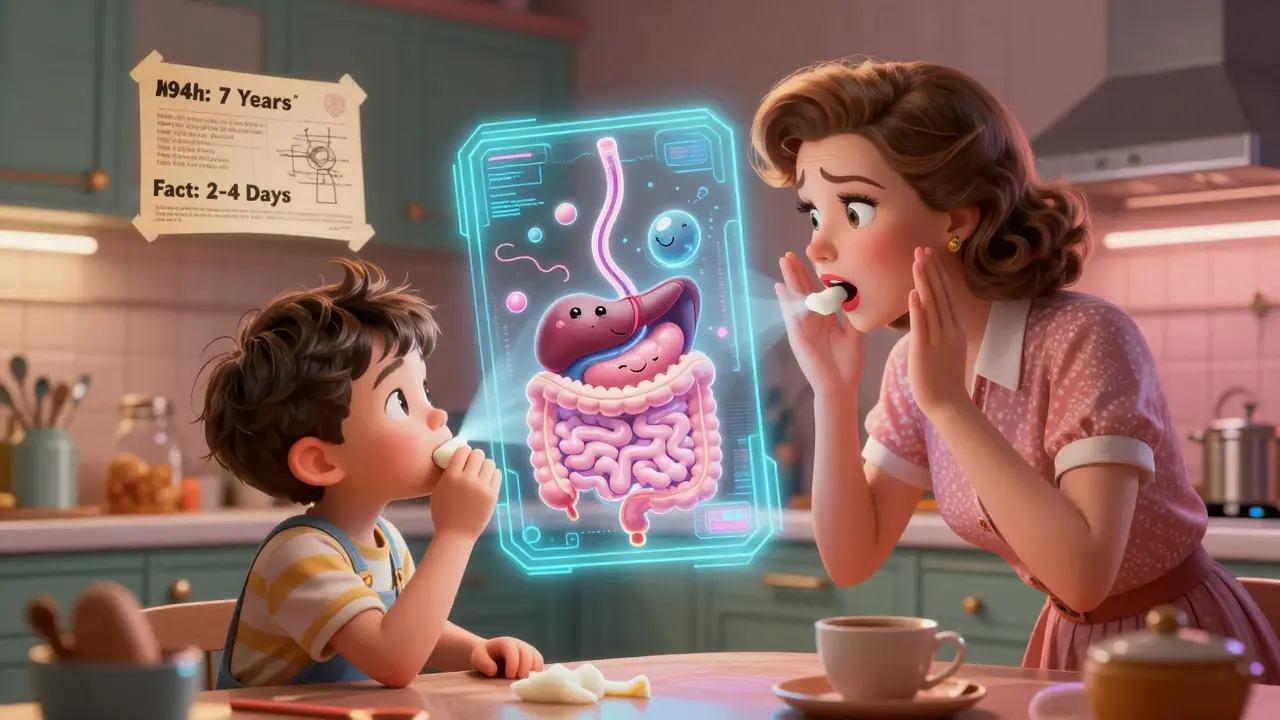
How many times have you heard that you need to drink eight glasses of water a day? Or that chewing gum stays in your stomach for seven years? What about the idea that we only use 10% of our brains? These aren’t just harmless jokes-they’re myths that shape how people make decisions about their health. And when those myths stick, they can lead to bad choices, wasted time, and even real harm.
Why Do Health Myths Stick Around?
Myths don’t spread because they’re clever. They spread because they’re simple. Our brains love easy answers. When a story fits what we already believe-or what we’ve heard since childhood-it feels true, even if it’s not. That’s why the myth about sugar making kids hyperactive still survives, even though 23 high-quality studies have shown it’s false. The sugar industry spent decades promoting this idea, and now, generations of parents still blame candy for wild behavior. The same thing happens with body heat. Many people think you lose most of your heat through your head. It’s a common belief, even among doctors. But here’s the truth: your head makes up only about 7-10% of your body’s surface area. If you’re cold and not wearing a hat, you’ll lose heat from your head-but you’d lose just as much from your hands, feet, or any other exposed skin. It’s not special. It’s just physics.The Eight-Glasses-of-Water Myth
You’ve probably seen it on every health website: "Drink eight glasses of water a day." It sounds simple. It’s easy to remember. But there’s zero scientific evidence backing it. Dr. Heinz Valtin from Dartmouth Medical School reviewed every peer-reviewed study on hydration back in 2002 and found nothing. Not one. The recommendation didn’t come from science-it came from a vague suggestion in a 1945 report that got misquoted over time. The original report said we get water from food and other drinks too, but that part got dropped. Your body is smarter than any arbitrary number. Thirst is your body’s natural hydration signal. If you’re eating fruits, vegetables, soups, or drinking tea or coffee, you’re already getting water. For most healthy adults, drinking when you’re thirsty and letting your urine be light yellow is all you need. Forcing down eight glasses can actually be harmful-especially for people with kidney or heart conditions.Superfoods: Marketing, Not Medicine
Goji berries. Acai bowls. Chia seeds. These are called "superfoods"-as if they’re magic pills wrapped in fruit. But here’s the reality: there’s no official definition of "superfood" in nutrition science. The term was created by marketers. A 2023 review by the European Food Information Council looked at dozens of so-called superfoods and found no evidence they offer health benefits beyond what you get from a balanced diet. A banana has just as much potassium as an acai bowl. Spinach has the same iron as kale. The only difference? Price. Acai bowls cost five times more than regular berries. Focusing on one "superfood" can also make people ignore the bigger picture. You don’t need to eat exotic berries to be healthy. You need variety: vegetables, whole grains, lean proteins, healthy fats. That’s it. No magic ingredient required."We Only Use 10% of Our Brain"
This one’s been around since the 1920s. It shows up in movies, self-help books, and even some teachers’ lectures. The idea? If you could unlock the other 90%, you’d become a genius. It’s completely false. Modern brain scans-fMRI and PET scans-show that every part of the brain has a function. Even when you’re resting, your brain is active. Damage to any area, no matter how small, causes measurable effects. Lose a bit of your frontal lobe? Your decision-making changes. Damage your occipital lobe? You lose vision. There’s no dormant 90% waiting to be unlocked. The myth likely started from a misunderstanding of psychologist William James, who said we only use a small fraction of our mental potential-not our brain cells. That’s a philosophical point, not a biological one.
Chewing Gum: Not a Seven-Year Resident
Parents have been scaring kids for decades: "If you swallow gum, it’ll stay in your stomach for seven years." It’s meant to stop kids from chewing it. But it’s nonsense. Your digestive system doesn’t break down gum the way it breaks down food. But that doesn’t mean it stays there. Chewing gum passes through your gut just like anything else. It might take a little longer-two to four days-but it exits the body naturally. Dr. Ian Tullberg from UCHealth confirmed this in 2022: "It doesn’t digest, but it travels through your system and comes out." The only real risk? Swallowing a big wad of gum along with other indigestible stuff-like a coin or a toy. That’s rare, and it’s not about the gum. It’s about the blockage.Why Debunking Doesn’t Always Work
You’d think once people see the facts, they’d change their minds. But that’s not how it works. In one study, when people were shown evidence that vaccines don’t cause autism, their belief in the myth actually strengthened. Why? Because the myth was tied to their identity-trust in nature, distrust of big pharma, fear of control. Correcting the fact felt like an attack on their worldview. That’s called the "backfire effect." And it’s why just listing facts doesn’t work. The best approach is the "truth sandwich": say the truth first, briefly mention the myth with a clear label like "Some people believe..." and then repeat the truth again. Also, visuals help. A video showing how gum moves through the digestive tract gets more engagement than a 500-word article. People remember what they see.What Works in Patient Education
Hospitals that use myth-busting in patient education see better outcomes. One study found that when doctors directly addressed common myths before prescribing treatment, patients followed instructions 31% more often. The CDC’s Myth vs. Fact template is used in 78% of U.S. health departments. It’s simple:- Myth: "Antibiotics cure the common cold."
- Fact: "Antibiotics only work on bacterial infections. Colds are caused by viruses. Taking antibiotics when you don’t need them can lead to drug-resistant infections."

What’s Changing Now
The World Health Organization launched its Myth Busters initiative in 2020. Since then, it’s corrected over 2,300 myths across 187 countries. In places where it was used, vaccine hesitancy dropped by 22%. Google’s "About This Result" feature now shows context for search results-like whether a claim has been fact-checked. YouTube’s algorithm now promotes videos from verified health experts over viral misinformation. And AI is stepping in. MIT’s "TruthGuard" system can now predict new myths before they go viral-by spotting patterns in social media language. It’s not perfect, but it’s getting better.What You Can Do
You don’t need to be a scientist to fight misinformation. Here’s what works:- When someone shares a health myth, say: "That’s a common belief, but here’s what the science says."
- Point them to trusted sources: WHO, CDC, Mayo Clinic, or peer-reviewed journals.
- Don’t argue. Ask questions: "Where did you hear that?" Often, people don’t realize they’ve been misled.
- Use visuals. A quick video or infographic is more powerful than a long explanation.
Final Thought
Health myths aren’t just annoying. They’re dangerous. They delay care. They fuel distrust. They make people spend money on useless products. But they can be corrected. Not by shouting. Not by shaming. But by offering clear, calm, and repeated facts-with empathy. The goal isn’t to make people feel stupid for believing a myth. It’s to help them feel smarter for knowing the truth.Is it true that you lose most of your body heat through your head?
No. This is a myth. Your head makes up only about 7-10% of your body’s surface area, so you lose roughly that percentage of heat through it-if it’s exposed. The same amount of heat is lost through any uncovered body part, like your hands or feet. The idea that the head is special comes from a misinterpreted military study from the 1950s.
Do I really need to drink eight glasses of water every day?
No. There’s no scientific basis for the "eight glasses" rule. Your water needs depend on your body size, activity level, climate, and diet. You get water from food, coffee, tea, and other drinks. Thirst is your body’s natural signal. If your urine is light yellow, you’re likely well-hydrated.
Are superfoods like acai or goji berries really better for you?
Not really. "Superfood" is a marketing term, not a scientific one. These foods may be nutritious, but they’re not magic. The same vitamins, antioxidants, and fiber you get from acai berries are also in blueberries, spinach, and beans-often at a fraction of the cost. A balanced diet is more effective than any single "superfood."
Does sugar make children hyperactive?
No. Over 23 double-blind, peer-reviewed studies have found no link between sugar intake and hyperactivity in children. The belief persists because it fits a cultural narrative-kids get excited at parties where sugar is served. But the excitement comes from the event, not the candy.
Can swallowing chewing gum cause it to stay in your stomach for seven years?
No. Chewing gum isn’t digested, but it doesn’t stick around. It passes through your digestive system in two to four days and exits naturally. The only risk is swallowing large amounts along with other non-digestible objects, which could cause a blockage-but that’s rare and not caused by gum alone.
Why do health myths persist even after they’re debunked?
Myths stick because they’re simple, emotionally satisfying, or tied to identity. When correcting a myth feels like an attack on someone’s beliefs or culture, people often double down. The best way to counter this is to lead with the truth, mention the myth briefly and clearly label it as false, then repeat the truth. This "truth sandwich" method improves retention by nearly 50%.
What’s the best way to correct a health myth in a conversation?
Use the FIRE method: Facts (state the truth), Interpretation (explain why it matters), Resolution (what to do instead), and Emotion (acknowledge their concern). For example: "I know you’ve heard antibiotics cure colds, but they only work on bacteria. Colds are viral, and taking them unnecessarily can cause resistance. If you’re sick, rest, hydrate, and talk to your doctor if symptoms last more than 10 days. I get why you’d want to fix it fast-it’s frustrating."
Can AI help stop health myths from spreading?
Yes. AI tools like MIT’s TruthGuard can detect emerging myths by analyzing language patterns on social media before they go viral. Google and YouTube now show fact-check labels on search results and videos. These tools don’t replace human judgment, but they help push accurate information to the top before misinformation takes hold.
Thomas Anderson
December 16, 2025 AT 13:40Man, I used to swear by the 8-glasses rule until I read this. My urine was always clear as day, and I’d force down water like it was my job. Turns out, my coffee and apples were doing the work. Who knew?
Sarthak Jain
December 17, 2025 AT 05:49soooo the superfood thing is just marketing?? 😮 i spent like 20 bucks on acai bowl last week and felt like a health god. now i feel scammed lmao
Rulich Pretorius
December 19, 2025 AT 01:01There’s a deeper layer here that isn’t often discussed: myths persist not because people are ignorant, but because they’re emotionally resonant. The idea that we only use 10% of our brain gives people hope-that there’s untapped potential inside them. The gum myth? It’s a parental control tool disguised as science. The truth is often boring. Simplicity sells. Empathy, not correction, is the real tool for change.
Debunking without understanding the human need behind the myth is like trying to fix a leak by yelling at the water. We need to replace the myth with something that fulfills the same psychological role-curiosity, control, belonging-not just facts.
That’s why the truth sandwich works. It doesn’t attack the belief; it recontextualizes it. And that’s why AI can help, but never replace the human conversation. Machines spot patterns. Humans understand meaning.
Dwayne hiers
December 19, 2025 AT 12:21It’s worth noting that the 8-glass myth originated from a 1945 Food and Nutrition Board recommendation that stated: ‘Approximately 1 mL of water per kcal of food energy consumed.’ For a 2,000 kcal diet, that’s ~2 liters-approximately 8 glasses. But the footnote-‘this includes water from food and other beverages’-was systematically omitted in popular media. This is a textbook case of citation decay and semantic drift in public health messaging.
Similarly, the head-heat myth stems from a 1950 US Army survival manual that had soldiers wear winter gear excluding headwear, leading to disproportionate heat loss via the scalp. The conclusion was misgeneralized. It’s not that the head is special-it’s that the experiment was poorly designed.
The ‘superfood’ phenomenon is a product of neoliberal nutritionism: reducing complex dietary ecology to single-nutrient heroics. This distracts from structural issues-food deserts, industrial agriculture, socioeconomic access. The real problem isn’t acai-it’s that kale is $5 a bunch and potatoes are $0.30.
Sinéad Griffin
December 20, 2025 AT 14:07OMG I just realized I’ve been scammed by chia seeds for YEARS 💸😭 I bought a $15 bag and now I’m eating oatmeal with blueberries like a peasant 😂 but honestly? I feel better. Also, WHO IS THE PERSON WHO CAME UP WITH THE 7-YEAR GUM THING??
Jonny Moran
December 22, 2025 AT 02:32As someone who’s worked in rural clinics, I’ve seen this play out daily. People believe the myths because they’ve heard them from family, from TV, from their pastor. When you correct them with data, they shut down. But if you say, ‘I used to think that too-until I saw my cousin’s blood sugar drop after cutting out sugar snacks,’ they listen. Stories beat stats every time.
We don’t need more infographics. We need more neighbors sharing real experiences. That’s how trust is built. Not by experts shouting from podiums, but by people saying, ‘Hey, this worked for me.’
Wade Mercer
December 23, 2025 AT 03:59It’s pathetic how easily people believe nonsense. You don’t need a PhD to understand that gum doesn’t stick in your stomach for seven years. If you’re still falling for this stuff, maybe you shouldn’t be making health decisions. The fact that this even needs to be explained says something awful about modern education.
jeremy carroll
December 23, 2025 AT 22:38hey i just wanted to say this post made me feel way less dumb for believing some of these myths. i mean, i thought the 10% brain thing was real! 😅 but now i get it-its not about being smart or dumb, its about how info gets passed down. thanks for breaking it down nice and clear. you’re a good human 🙌
Tim Bartik
December 25, 2025 AT 04:57Look, I’m not some science nerd, but I know one thing: AMERICA built the modern world. We don’t need some European food council telling us what’s a ‘superfood.’ We eat what we want. If people wanna pay $20 for acai, let ‘em. That’s capitalism, baby. And if you think chewing gum stays in your gut for seven years? Then you’re the one who needs a brain check. This whole post feels like woke propaganda from a university that’s never seen a real kitchen.