
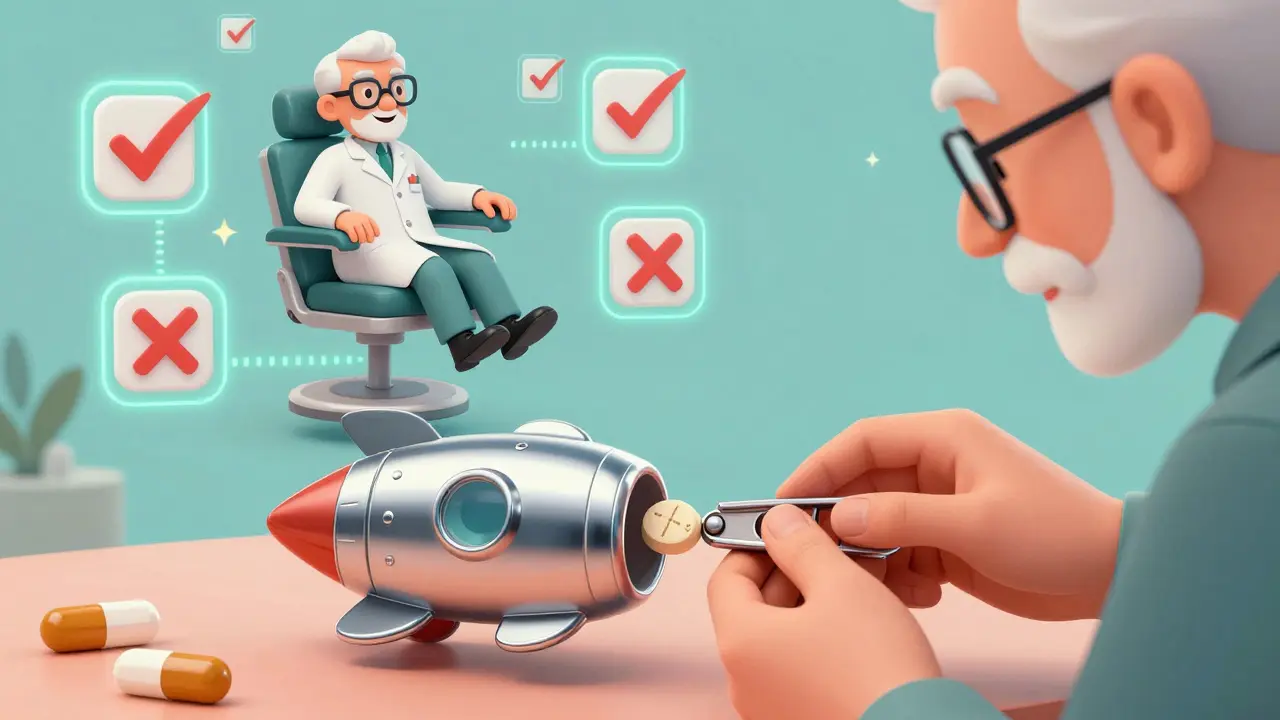
Millions of people split pills or crush tablets to save money, make them easier to swallow, or adjust doses. But what seems like a simple fix can turn dangerous-fast. A cracked pill doesn’t just look different; it can change how your body gets the medicine, sometimes with life-threatening results.
Why People Split or Crush Pills
People do this for a few real reasons. Cost is the biggest one. If a 40mg atorvastatin tablet costs almost the same as a 20mg one, splitting it saves nearly $35 a month. For seniors on fixed incomes, that adds up to hundreds a year. Others do it because swallowing large pills is hard-especially after a stroke or with Parkinson’s. Some just don’t know it’s risky. A 2023 survey found 68% of people who split pills never asked their doctor or pharmacist first.When It’s Okay (And When It’s Not)
Not all pills are created equal. Some can be split safely. Others? Never. Safe to split (if scored and approved):- Atorvastatin (Lipitor)
- Rosuvastatin (Crestor)
- Citalopram (Celexa)
- Sertraline (Zoloft)
- Lisinopril (Prinivil)
- Losartan (Cozaar)
- Fosinopril (Monopril)
These are usually immediate-release tablets with even drug distribution. They’re designed to be split. Look for a visible score line down the middle. But even then, you need the right tool. Never split or crush:
- Extended-release pills like OxyContin, Concerta, or Metformin XR
- Enteric-coated tablets like Ecotrin or Asacol
- Sublingual tablets like nitroglycerin
- Effervescent tablets
- Any drug on the NIOSH hazardous list: methotrexate, tamoxifen, paroxetine (Paxil), olanzapine (Zyprexa)
- Drugs with narrow therapeutic indexes: digoxin, carbamazepine, warfarin Crushing an extended-release pill? That’s not just ineffective-it’s dangerous. The whole dose hits your system at once. For oxycodone, that can spike blood levels by 300-500% in under 30 minutes. One study documented a patient going from stable pain control to respiratory failure after crushing OxyContin. Enteric-coated pills are made to pass through your stomach and dissolve in the intestine. Crush them, and the acid destroys the drug-or worse, burns your stomach lining. Nitrofurantoin and potassium chloride are known to cause ulcers when crushed.
The Hidden Dangers of Crushing
Crushing isn’t just for people who can’t swallow. Sometimes, caregivers crush pills to mix them into applesauce or juice. That’s a huge risk. Hazardous drugs like chemotherapy agents or certain antidepressants release toxic dust when crushed. Healthcare workers have developed reproductive issues after handling just one crushed methotrexate tablet without gloves or a mask. The NIOSH list includes 261 oral drugs that require special handling. If you’re crushing one of these at home, you’re exposing yourself and others to airborne toxins. Even non-hazardous drugs can become dangerous. Film-coated pills taste awful when crushed. Kids refuse them. Elderly patients gag. Some medications, like clopidogrel (Plavix), lose potency within 48 hours after being split. If you split a pill and don’t use it right away, you might be giving yourself a weak, ineffective dose.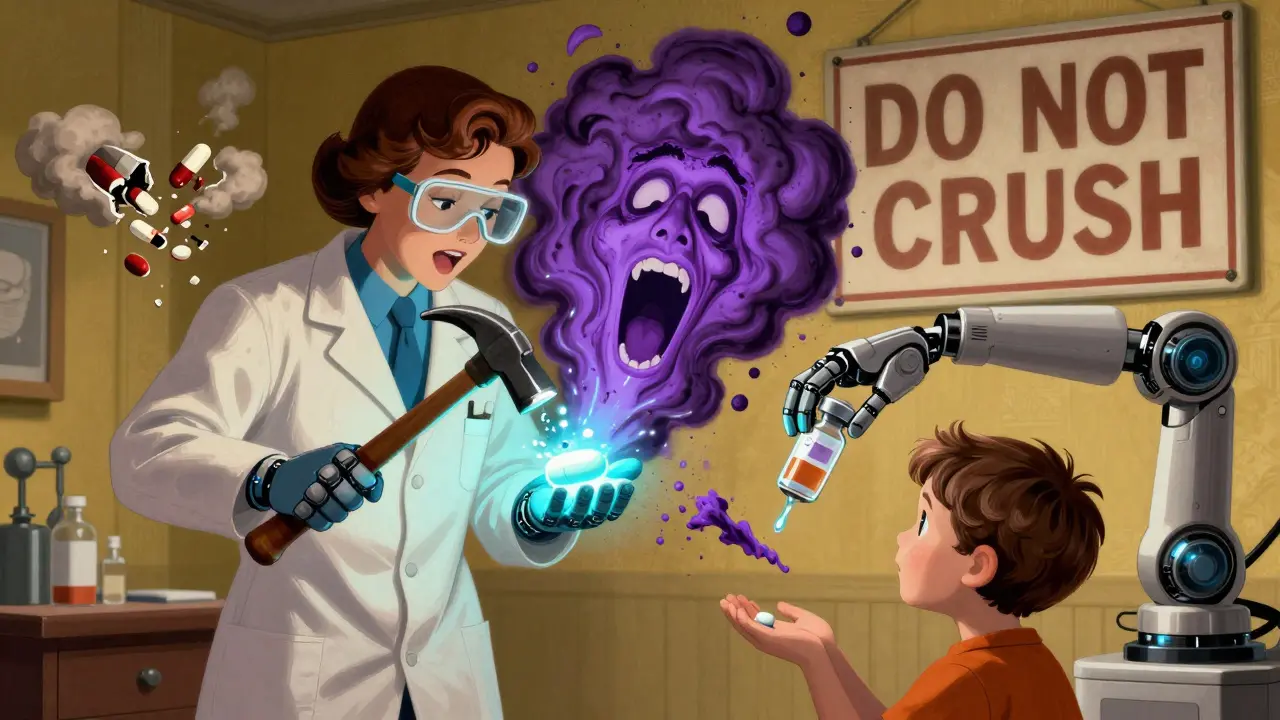
How to Split Pills Safely (If You Must)
If your doctor and pharmacist say it’s okay, here’s how to do it right:- Use a dedicated pill splitter-not a knife, scissors, or your fingers. A V-shaped holder with a retractable blade cuts cleanly. Manual methods create 15-25% dose variation. A good splitter brings that down to 5-8%.
- Only split scored tablets. A score line doesn’t guarantee safety-only 50-60% of scored tablets are actually safe to split, according to the FDA.
- Split one pill at a time. Don’t pre-split a week’s supply. Exposure to air and moisture degrades potency.
- Store split halves in a dry, cool place. Humidity kills some drugs fast. Keep them in their original blister pack or a sealed container.
- Use the split dose immediately. If you’re splitting a pill for the morning, don’t save the other half for later unless your pharmacist says it’s stable.
Who Shouldn’t Split Pills at All
Not everyone can do this safely-even with the right tools. - People with vision worse than 20/40 (even with glasses) are 4.7 times more likely to split unevenly.- Those with shaky hands due to arthritis, Parkinson’s, or tremors.
- Anyone with cognitive issues who can’t remember storage rules or dosing schedules.
- Caregivers who aren’t trained in handling hazardous drugs. A University of Jordan study found that nearly half of elderly patients who split pills at home gave themselves the wrong dose. One woman split her amlodipine tablet and ended up with blood pressure readings over 165/100-up from 130/85. That’s not a small change. That’s a hospital visit waiting to happen.
What Pharmacists and Doctors Want You to Know
The American Society of Health-System Pharmacists says pill splitting should only happen after a conversation with your prescriber and pharmacist. It’s not a DIY project. Pharmacists are trained to spot dangerous splits. They know which tablets crumble, which lose potency, and which are legally off-limits. If your pill isn’t on the approved list, they’ll tell you. If cost is the issue, they might suggest a different brand, a lower-strength version, or even a liquid form. A 2023 campaign by the American Pharmacists Association led to a 22% drop in unsafe splitting at participating pharmacies. That’s because they started asking: “Why are you splitting this?” and offering real alternatives.What’s Changing in 2026
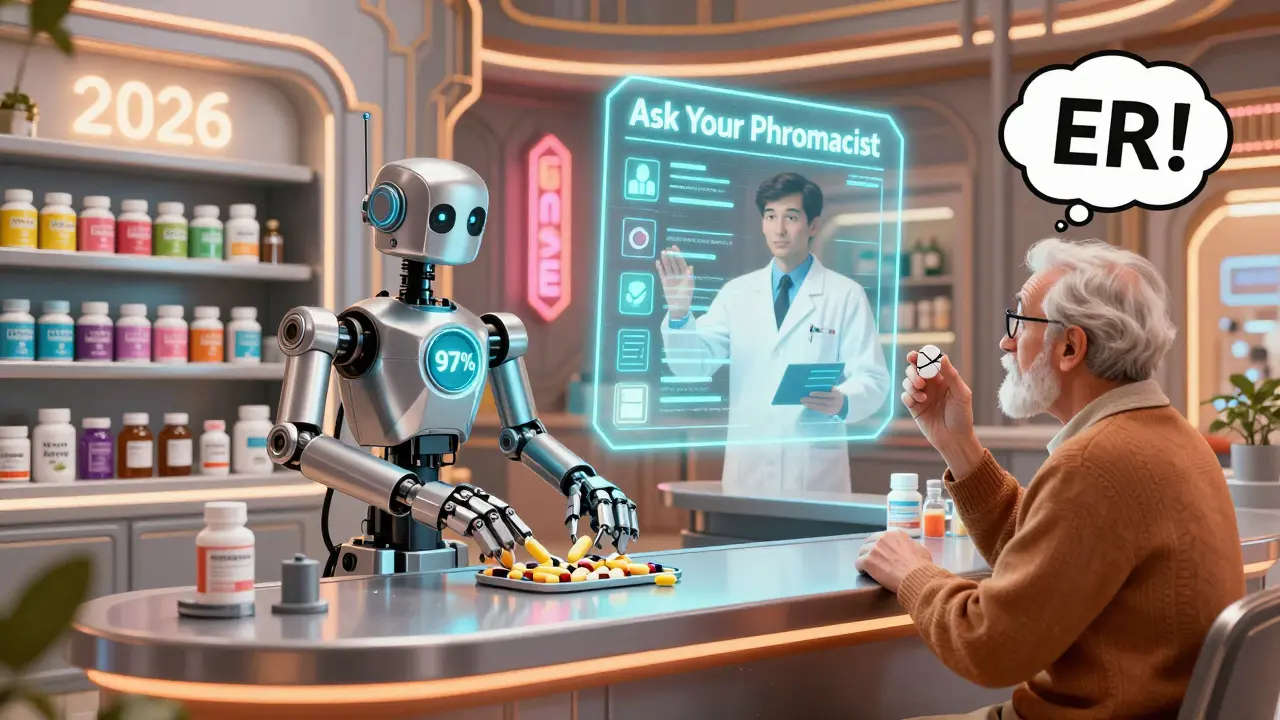
The good news? More drugs now come in multiple strengths. Between 2018 and 2023, the percentage of new medications with built-in dose options jumped from 52% to 67%. That means fewer people need to split. Hospitals are starting to use robotic pill splitters that cut pills with 97% accuracy-under 3% variation. By 2026, 30% of U.S. hospitals will have them. That’s a step toward safety. But at home? The trend is still risky. The pill splitter market is growing-$26 million by 2027-but most people buy them without understanding how to use them safely.Bottom Line: Don’t Guess. Ask.
Pill splitting isn’t inherently bad. But doing it without knowing the rules? That’s where things go wrong. If you’re thinking about splitting or crushing a pill:- Talk to your pharmacist first. Not your friend. Not Google. Your pharmacist.
- Ask: “Is this tablet safe to split or crush?”
- Ask: “What happens if I do?”
- Ask: “Is there a cheaper or easier way to get the right dose?”
The cost savings might seem worth it. But a wrong dose can cost you more-time in the ER, hospital stays, or worse. Your medicine is powerful. Treat it like it matters.
Can I split any pill with a score line?
No. A score line doesn’t mean it’s safe to split. Only about half of scored tablets are approved for splitting by the FDA. Always check with your pharmacist. Some scored pills are designed for appearance only, not accurate dosing.
Is it safe to crush pills for my elderly parent who can’t swallow them?
Only if the pill is specifically approved for crushing and isn’t extended-release, enteric-coated, or hazardous. Crushing can destroy how the drug works or release toxic dust. Ask your pharmacist for liquid alternatives or smaller tablets instead.
What’s the safest tool for splitting pills?
A dedicated pill splitter with a V-shaped holder and retractable blade. Knives, scissors, or your fingers cause uneven splits and increase the risk of dose variation by up to 25%. A good splitter reduces that to under 8%.
Can splitting pills cause side effects?
Yes. Splitting can lead to too much or too little medicine. People have reported high blood pressure, dizziness, nausea, or no effect at all after splitting pills incorrectly. In rare cases, crushing extended-release opioids has caused fatal overdoses.
How long can I store a split pill?
Ideally, use it right away. Some medications, like clopidogrel (Plavix), lose effectiveness within 48 hours after splitting. Store split pills in a dry, cool place, but don’t pre-split more than a day’s supply unless your pharmacist says it’s safe.
Are there alternatives to splitting pills?
Yes. Many drugs now come in multiple strengths, including lower doses. Liquid formulations, chewable tablets, or smaller pills are often available. Ask your pharmacist-cost savings might be possible without splitting at all.
Mandy Vodak-Marotta
February 3, 2026 AT 17:18So I split my lisinopril every morning because my hands shake from the Parkinson’s, and my pharmacist said it’s fine as long as I use the little plastic splitter. I used to just break it with my fingers-big mistake. One half was basically dust, the other was a rock. Now I use the splitter, store the half in the original blister pack, and take it same day. No more dizzy spells. Also, I didn’t know crushed pills could be toxic dust? Holy crap. I’m gonna stop crushing my mom’s antidepressant right now.
Y’all need to stop treating meds like cereal boxes.
Joseph Cooksey
February 3, 2026 AT 20:02Let me just say this: if you’re splitting pills because you’re too cheap to buy the right dose, you’re not saving money-you’re gambling with your life. I’ve seen people end up in the ER because they crushed a 24-hour metformin and got a sugar rush followed by a crash that looked like a zombie movie. And don’t get me started on the folks who think ‘scored’ means ‘safe.’ That’s like saying a red light means you can speed through it if you look both ways. The FDA doesn’t score pills for aesthetics, but most people act like it’s a decorative line drawn by a bored intern. You think your grandma’s arthritis makes her a pharmacist? Nah. She’s a liability with a pill splitter and a prayer.
And don’t even start with ‘but my cousin does it and she’s fine.’ Your cousin might be fine-until she isn’t. Then you’ll be the one Googling ‘how to clean blood off the carpet’ while sobbing over a half-crushed oxycodone tablet.
Just. Ask. The. Pharmacist.
Jesse Naidoo
February 4, 2026 AT 13:12Wait, so you’re telling me I’ve been crushing my dad’s zyprexa into his applesauce for two years because he hates swallowing pills… and I’ve been poisoning myself?
…Oh my god.
Susheel Sharma
February 5, 2026 AT 18:41While I appreciate the general cautionary tone, the article lacks statistical granularity regarding the actual incidence of adverse events due to pill splitting. For instance, the 68% statistic regarding patients not consulting professionals is cited without a sample size or confidence interval. Furthermore, the claim that crushing extended-release opioids can increase blood concentration by 300–500% is alarming but not contextualized with pharmacokinetic models or human trial data. One must also consider the socioeconomic imperative-many patients in developing nations have no access to lower-dose formulations. While safety is paramount, blanket condemnation without acknowledging structural healthcare inequities borders on elitist.
Also, emoticon: 😬
Janice Williams
February 6, 2026 AT 23:08It is profoundly irresponsible to suggest that pill-splitting is ever acceptable, regardless of scoring or physician approval. The human body is not a laboratory; it is a delicate, irreplaceable system that does not tolerate amateur pharmacology. The fact that this practice is even discussed as if it were a DIY home improvement project is a testament to the erosion of medical literacy in this country. I have personally witnessed a patient suffer a myocardial infarction due to an improperly split beta-blocker. This is not a ‘cost-saving hack.’ It is a medical hazard dressed in the clothing of convenience. The FDA’s 50–60% approval rate for scored tablets is not a green light-it is a red flag waving in a hurricane. If you are considering splitting a pill, you are already on the wrong path. Seek alternatives. Demand better. Or, God help you, die foolishly.
Katherine Urbahn
February 7, 2026 AT 21:29Let’s be clear: if you’re crushing pills, you’re not being clever-you’re being dangerous. And if you’re doing it because you’re too lazy to ask your pharmacist for a liquid form or a smaller tablet, you’re not just risking your life-you’re wasting the time of every healthcare worker who has to clean up your mess. I’ve seen people come into the clinic with half a pill stuck in their throat, shaking, asking if it’s ‘normal’ to feel like they’re dying. It’s not normal. It’s preventable. And yet, people still do it. Why? Because they think they know better. They don’t. The pill doesn’t care how much you ‘saved.’ It only cares if you got the right dose. And if you didn’t? Congrats. You just turned a $35 monthly savings into a $35,000 hospital bill. Stop it. Ask. Please.
Alex LaVey
February 9, 2026 AT 12:12Big shoutout to pharmacists everywhere-you’re the real MVPs. I used to think splitting pills was just a quirky habit, but after my aunt ended up in the hospital from crushing her warfarin, I got it. Turns out, she didn’t know it was a blood thinner with a narrow therapeutic window. She thought it was just ‘a little red pill.’
Now I take my grandma to the pharmacy every month and make sure they check her meds. She doesn’t have to split anything anymore-they gave her a liquid version of her blood pressure med. She says it tastes like grape soda and she loves it. And it’s cheaper than buying the 40mg and splitting it.
It’s not about being cheap. It’s about being smart. And your pharmacist? They’re not trying to sell you more pills-they’re trying to keep you alive. Talk to them. They’re awesome.
Also, if you’re crushing chemo meds at home? Please. Just… please don’t.
caroline hernandez
February 9, 2026 AT 17:31As a clinical pharmacist, I see this every single day. The biggest misconception? That ‘scored’ = ‘safe.’ Nope. We have a whole internal database of tablets that are scored but have uneven drug distribution-some have 30% more active ingredient on one side. That’s not a split. That’s a lottery ticket. And when patients come in with a week’s worth of pre-split pills sitting in a Ziploc bag? We have to do a full med reconciliation. It’s not just dangerous-it’s a workflow nightmare.
Pro tip: If your pill isn’t on the NIOSH hazardous list, it doesn’t mean it’s safe to crush. Even ‘benign’ drugs like sertraline can degrade in humidity. Split one pill. Use it that day. Store the rest whole. Simple. And if you’re caring for someone with cognitive decline? Don’t let them handle the splitter. The risk of error is too high. We’ve had patients give themselves double doses because they forgot they already took the half.
Bottom line: Your pharmacist isn’t being bossy. They’re being your last line of defense.
Lorena Druetta
February 11, 2026 AT 02:42I’m so glad this was posted. My mom used to split her pills with a knife because she didn’t have a splitter. She said it was ‘good enough.’ She had a stroke last year because her blood pressure spiked after splitting amlodipine wrong. I didn’t know it could be so dangerous. Now I buy her the 5mg pills instead. It’s more expensive, but I’d rather pay than lose her. Thank you for sharing this. I’m going to send this to everyone I know who splits pills. We need to stop pretending this is harmless.