
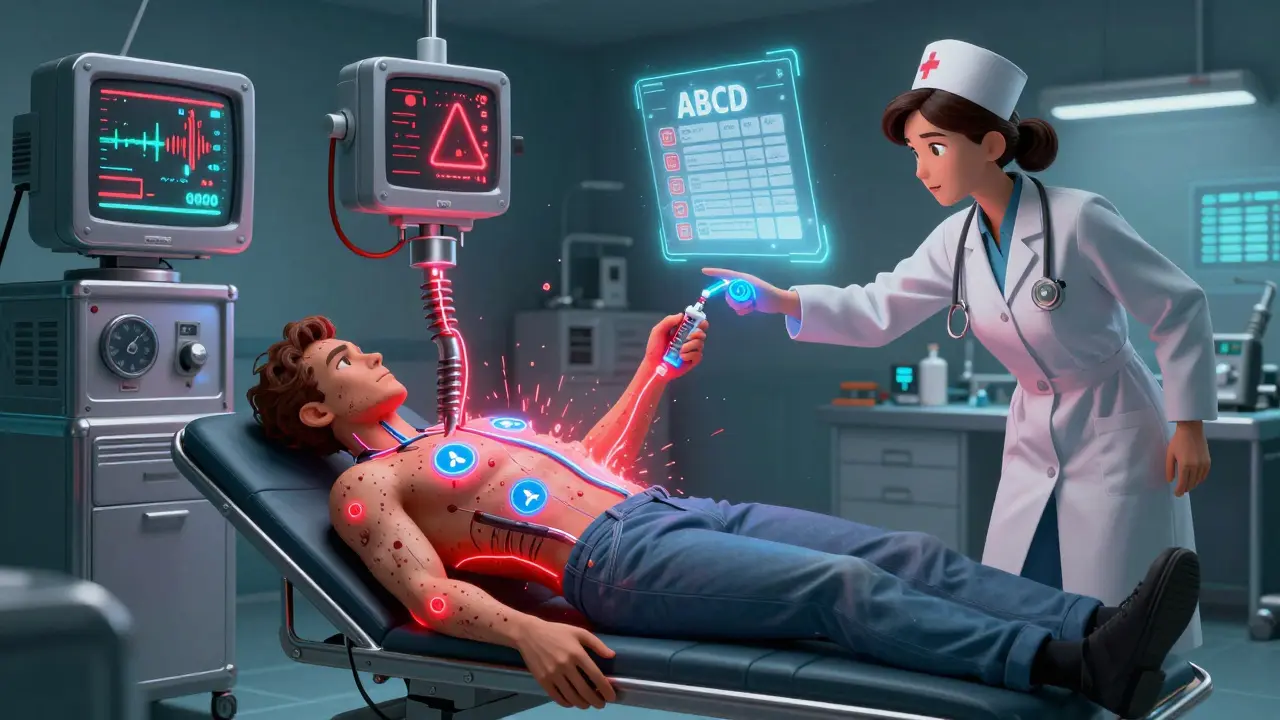
Anaphylaxis Assessment Tool
Medication Reaction Assessment
Use this tool to determine if symptoms meet anaphylaxis criteria within 2 hours of medication exposure. Based on the ABCD checklist from the article.
When a medication triggers a severe allergic reaction, it doesn’t just make you itchy or break out in hives. It can shut down your breathing, drop your blood pressure to dangerous levels, and kill you within minutes. This isn’t a rare event. In the U.S. alone, medication-induced anaphylaxis sends over 38,000 people to emergency rooms every year. And too often, it’s missed-until it’s too late.
What Exactly Is Medication-Induced Anaphylaxis?
Anaphylaxis isn’t just a bad allergy. It’s a full-body emergency. Your immune system overreacts to a drug, releasing chemicals like histamine and tryptase that cause blood vessels to leak, airways to tighten, and your heart to struggle. Symptoms can appear in under five minutes, especially if the drug is given by IV. For some, it takes up to six hours, which is why people often think they’re fine after leaving the clinic.
The World Allergy Organization defines anaphylaxis as a reaction involving at least two body systems after exposure to a likely trigger. For medications, that usually means:
- Skin: hives, swelling, flushing
- Respiratory: wheezing, throat tightness, trouble breathing
- Cardiovascular: dizziness, fainting, low blood pressure
- Gastrointestinal: vomiting, cramps, diarrhea
If you’ve had a reaction before, even a mild one, you’re at higher risk. And here’s the scary part: 78% of fatal cases happen because epinephrine was given too late-or not at all.
Which Medications Cause the Most Reactions?
Not all drugs are equal when it comes to triggering anaphylaxis. The top offenders are clear:
- Antibiotics - responsible for nearly 70% of all drug-induced cases. Penicillin and its cousins (amoxicillin, ampicillin) make up 70-80% of those.
- NSAIDs - drugs like ibuprofen and naproxen cause about 15% of reactions. These aren’t always IgE-mediated, which makes them harder to predict.
- Monoclonal antibodies - medications like rituximab and cetuximab are growing in use for cancer and autoimmune diseases. They account for nearly 6% of reactions and often trigger severe symptoms on first exposure.
- Chemotherapy agents - platinum-based drugs like cisplatin can cause reactions in over 4% of patients.
- IV contrast dye - used in CT scans, this isn’t a true allergy but can mimic anaphylaxis. Still, it kills people because it’s misdiagnosed.
Here’s what’s surprising: food allergies are the most common overall trigger for anaphylaxis. But when it comes to medications, the reactions are deadlier. A 2022 JAMA study found that drug-induced anaphylaxis has a death rate of 1.8%, compared to 0.7% for food-triggered cases. Why? Because in hospitals, symptoms are often mistaken for something else-like a vasovagal faint, sepsis, or even anxiety.
How to Spot It Before It’s Too Late
You don’t need to be an expert to save a life. The ABCD checklist works every time:
- Airway - Is their voice hoarse? Are they gasping? Is their throat swelling?
- Breathing - Are they wheezing? Is their oxygen level dropping? Are they using their neck muscles to breathe?
- Circulation - Are they pale, clammy, dizzy? Did they pass out? Is their pulse weak or fast?
- Dermatologic - Are hives appearing? Is their face or lips swelling?
If two or more of these are happening within two hours of taking a new medication? This is anaphylaxis. Don’t wait for all symptoms. Don’t assume it’s "just a rash." Don’t give antihistamines and call it a day.
One ER nurse in Boston told me about a 68-year-old man who got IV contrast for a scan. He turned pale, started sweating, and his BP dropped. The team thought he was having a vasovagal episode. It wasn’t until he started wheezing and his oxygen saturation plunged to 82% that they gave epinephrine. He recovered in four minutes. That’s the difference between a scare and a corpse.
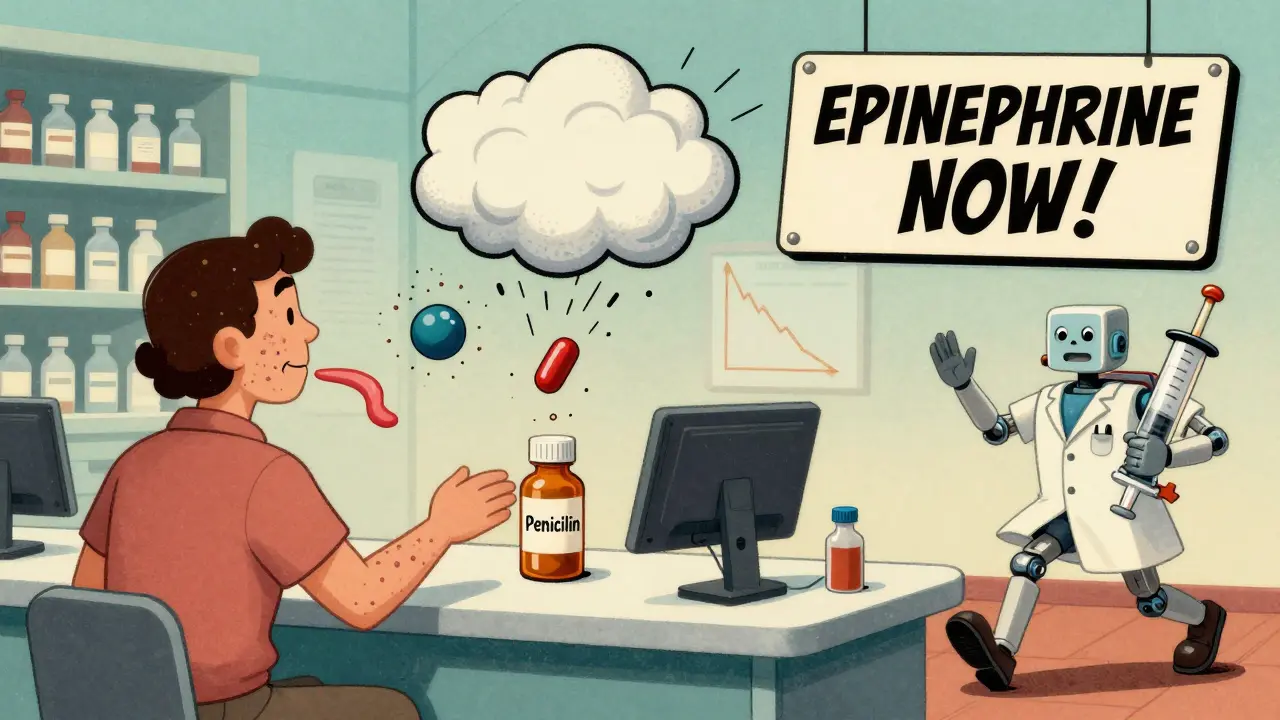
Epinephrine Is the Only Treatment That Saves Lives
Antihistamines? They help with itching. Steroids? They prevent delayed reactions. But only epinephrine stops the cascade that kills you.
It works by tightening blood vessels, opening airways, and boosting heart function. The dose for adults is 0.3-0.5 mg injected into the outer thigh. That’s it. No waiting. No debating. No "let’s check labs first."
Studies show that if epinephrine is given within 5-15 minutes, survival rates jump to over 90%. Delay it beyond 30 minutes? Mortality triples. And here’s the worst part: 34% of fatal cases never got epinephrine at all.
Many hospitals now keep epinephrine auto-injectors on every crash cart. But in clinics, pharmacies, and outpatient settings? Still too rare. If you’ve had a reaction before, you should have one at home. And you should know how to use it. Practice on a training device. Show your family how. Because when your throat closes, you won’t be able to read instructions.
Why Misdiagnosis Is the Silent Killer
Doctors miss anaphylaxis more than you think. A 2022 survey of 1,247 clinicians found that two-thirds had misdiagnosed at least one case. Common mistakes:
- Calling it a "vasovagal reaction" when the patient has low BP and hives.
- Attributing wheezing to asthma, not realizing the trigger was a new antibiotic.
- Thinking "red man syndrome" (a flushing reaction from vancomycin) is anaphylaxis - it’s not. No hypotension? No airway swelling? Then it’s not anaphylaxis. But if you don’t know the difference, you might withhold epinephrine when you should give it.
And it’s not just doctors. Nurses, EMTs, pharmacists - all of them can miss it. A 2023 study showed that simulation training boosted correct epinephrine use from 48% to 89% in just six months. Training saves lives.
What Happens After the Reaction?
Surviving anaphylaxis isn’t the end. It’s the beginning of a new routine.
First, you need an allergy action plan. That includes:
- Identifying the exact drug that caused it
- Getting tested (skin prick or blood IgE test) to confirm the trigger
- Wearing a medical alert bracelet
- Carrying two epinephrine auto-injectors at all times
- Informing every doctor, dentist, and pharmacist you see
Here’s the shocker: over half of patients who survive medication-induced anaphylaxis never get prescribed an epinephrine auto-injector. That’s not negligence-it’s ignorance. Even some allergists forget to follow up.
And if you’re on long-term meds like monoclonal antibodies? Premedication with antihistamines and steroids can reduce your risk. But you still need a plan. Still need epinephrine nearby.
The Future: Better Detection, Fewer Deaths
Technology is helping. In 2023, the FDA approved the first rapid blood test for penicillin allergy-results in 15 minutes. AI tools are now analyzing EHRs to flag patients at high risk before they even get a prescription. A 2023 NIH algorithm predicted anaphylaxis risk with 89% accuracy using past records, allergies, and medications.
But tech alone won’t fix this. The real solution is training. Awareness. Protocol.
The Joint Commission now requires every U.S. hospital to have an anaphylaxis response plan by January 2024. That means drills. That means stocked epinephrine. That means staff who know the signs.
And if you’ve ever had a reaction? You owe it to yourself to carry epinephrine. To educate your loved ones. To speak up. Because the next time someone says, "It’s probably just anxiety," you need them to say, "Give me the EpiPen. Now."
Can you survive anaphylaxis without epinephrine?
Yes, but it’s extremely risky. Epinephrine is the only treatment that reverses the life-threatening effects of anaphylaxis-airway swelling, low blood pressure, and shock. Without it, survival depends on how fast you get to a hospital and how severe the reaction is. Many people die because they wait for antihistamines or steroids to work. Those don’t stop the process. Epinephrine does. Delaying it increases death risk by 300%.
Can you develop anaphylaxis to a drug you’ve taken before without issue?
Absolutely. Anaphylaxis doesn’t require prior exposure. Your immune system can suddenly recognize a drug as a threat after multiple safe uses. This is especially common with antibiotics, IV contrast, and monoclonal antibodies. You might take penicillin five times without a problem-and then the sixth time, your body goes into overdrive. That’s why every dose should be treated as potentially dangerous if you have a history of reactions.
Is anaphylaxis the same as a regular allergic reaction?
No. A regular allergic reaction might mean hives, sneezing, or a runny nose. Anaphylaxis is systemic-it affects multiple organs and can cause collapse. The key difference is involvement of the airway, breathing, or circulation. If you’re having trouble breathing, your blood pressure drops, or you feel faint, it’s not just an allergy. It’s an emergency.
What should you do if someone near you has anaphylaxis?
Call emergency services immediately. If they have an epinephrine auto-injector, help them use it or administer it yourself. Inject into the outer thigh-even through clothing. Don’t hesitate. Lay them flat, raise their legs if possible, and keep them warm. Don’t let them stand or walk. Even if they seem to improve, they still need emergency care-reactions can rebound.
Do all medications have warning labels for anaphylaxis?
Not all, but most high-risk ones do. The FDA now requires stronger warnings for biologics like monoclonal antibodies and IV contrast. But common drugs like penicillin, NSAIDs, and even some vaccines don’t always carry clear alerts. That’s why knowing your own history matters more than reading labels. Always tell your provider about past reactions-even if they seemed minor.
Next Steps: What You Should Do Today
- If you’ve had a reaction: Get tested by an allergist. Confirm the trigger. Get two epinephrine auto-injectors. Wear a medical alert bracelet.
- If you’re a caregiver: Learn how to use an EpiPen. Practice with a trainer. Know the signs. Don’t wait for symptoms to worsen.
- If you’re a healthcare worker: Push for anaphylaxis drills. Make sure epinephrine is accessible. Use the ABCD checklist every time a patient reacts.
- If you’re taking a new medication: Ask if it’s linked to anaphylaxis. Know the symptoms. Don’t assume you’re safe just because you’ve taken it before.
Anaphylaxis doesn’t care if you’re young, healthy, or have no allergies. It strikes fast. It kills silently. But it doesn’t have to. Knowledge saves lives. And epinephrine? It’s not just medicine. It’s a second chance.
Tommy Chapman
February 18, 2026 AT 01:25Robin bremer
February 19, 2026 AT 05:41Jayanta Boruah
February 20, 2026 AT 07:24Maddi Barnes
February 21, 2026 AT 21:33Irish Council
February 22, 2026 AT 08:20Hariom Sharma
February 24, 2026 AT 03:06Benjamin Fox
February 25, 2026 AT 05:38Jana Eiffel
February 26, 2026 AT 21:56Nina Catherine
February 28, 2026 AT 03:57Freddy King
March 1, 2026 AT 23:39Jonathan Rutter
March 2, 2026 AT 00:26Taylor Mead
March 3, 2026 AT 05:37John Cena
March 3, 2026 AT 17:54Laura B
March 4, 2026 AT 14:10aine power
March 5, 2026 AT 13:10