

When a drug hits the market, the clock starts ticking. After 20 years, the patent expires - and suddenly, cheaper generics can flood in. But for many big pharma companies, that 20-year window isn’t enough. That’s where evergreening comes in: a legal strategy to delay generic competition by filing new patents on tiny changes to old drugs. It’s not about innovation. It’s about keeping prices high.
What Evergreening Actually Looks Like
Evergreening isn’t a single tactic. It’s a playbook. Companies take a drug that’s about to lose patent protection and make small tweaks - a new dosage form, a different release timing, a combination with another ingredient - then file a new patent. These aren’t breakthroughs. They’re tweaks. But under patent law, even minor changes can qualify for a fresh 20-year monopoly. Take AstraZeneca’s Prilosec to Nexium switch. Prilosec, a heartburn drug, was set to lose patent protection. So AstraZeneca tweaked the molecule slightly and launched Nexium - marketed as a "better" version. The problem? Studies showed Nexium wasn’t more effective. But because it had a new patent, generics couldn’t enter. That one move added over a decade of exclusivity. And that’s just one example. The U.S. patent office has granted over 247 patents for Humira, a drug used for arthritis and Crohn’s disease. AbbVie, the maker, didn’t invent 247 new treatments. They filed patents on things like dosing schedules, packaging, and minor chemical variations. The result? Humira stayed exclusive for nearly 20 years beyond its original patent, generating about $40 million a day in revenue.The Five Common Evergreening Tactics
There are five main ways companies stretch patent life:- New formulations: Switching from a pill to a liquid, or from immediate-release to extended-release. Even if the active ingredient is identical, the new form gets a new patent.
- Combination drugs: Adding a second, often unrelated, drug to the original. The combo gets its own patent, even if the original drug is about to expire.
- Pediatric extensions: Companies run small studies on children to earn an extra six months of exclusivity - even if the drug isn’t used in kids.
- Orphan drug status: Repurposing a common drug for a rare disease to qualify for seven years of exclusivity under orphan drug laws.
- Product hopping: Phasing out the original drug and pushing patients onto the new, patented version. Then, they stop making the old version - forcing patients to pay more.
Why This Hurts Patients and Systems
Generic drugs cut prices by 80-85% within a year of launch. That’s not theory - it’s data. When a drug like Lipitor or Plavix went generic, millions of patients suddenly paid a fraction of what they did before. Evergreening blocks that. When companies delay generics, patients pay hundreds or thousands more per month. For chronic conditions like diabetes or autoimmune diseases, that’s not a minor cost - it’s life or death. A 2023 report from Strathmore University found that in low-income countries, evergreening practices directly prevent access to life-saving medications. In the U.S., Medicare spends billions annually on drugs kept off the market by evergreening. The Inflation Reduction Act of 2022 tried to fix this by letting Medicare negotiate prices for the most expensive drugs. But if a drug is still under patent, Medicare can’t touch it. Evergreening turns patents into financial shields.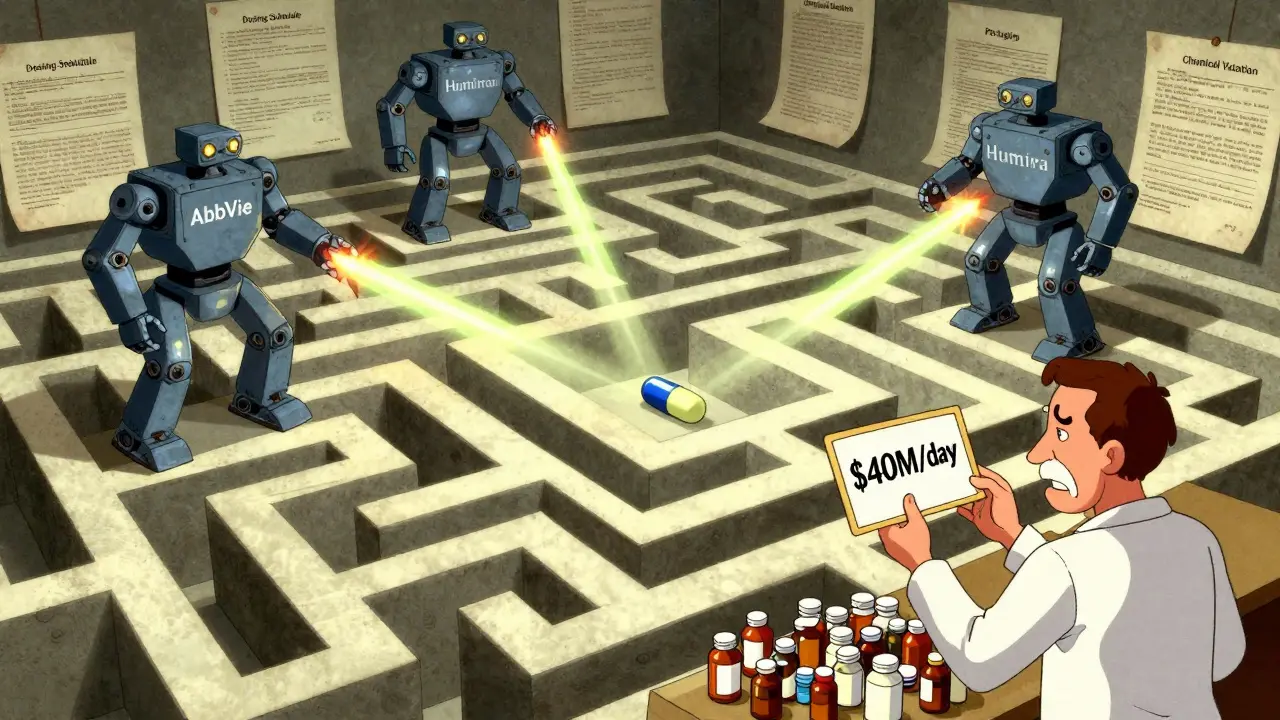
Is It Legal? Yes. Is It Right? That’s the Question
Legally, most evergreening tactics are allowed - for now. The Hatch-Waxman Act of 1984 was meant to balance innovation with access. It gave brand-name companies exclusivity to recoup R&D costs, then opened the door for generics. But it didn’t foresee how companies would exploit loopholes. The U.S. Patent and Trademark Office (USPTO) has started pushing back. In 2022, the Federal Trade Commission sued AbbVie over Humira’s 247 patents, calling it an "anticompetitive patent thicket." Courts are beginning to question whether some patents are even valid. In one case, a judge ruled that a patent on a slightly altered version of a blood thinner was "obvious" - and therefore unenforceable. But the system is still stacked. Challenging a patent costs millions. Most generic manufacturers can’t afford to fight 10 or 20 patents at once. So they wait - and patients pay.What’s Changing? And What’s Next
Regulators are waking up. The European Medicines Agency now requires proof of "significant clinical benefit" before granting extra exclusivity for modified drugs. Canada and Australia have tightened rules on product hopping. In 2023, the World Health Organization called evergreening a "barrier to global health equity." But pharma companies aren’t standing still. They’re moving into harder-to-copy territory: biologics, nanotech formulations, and pharmacogenomic tests. These aren’t pills you can easily copy. They’re complex therapies that require advanced labs to replicate. That’s the next frontier of evergreening. Some experts argue we need a new system - one that rewards real innovation, not legal gymnastics. Ideas include: patent buyouts, prize funds for breakthroughs, or direct government funding for R&D. But until then, the game continues.
What You Can Do
If you’re on a brand-name drug that’s about to go generic, ask your doctor or pharmacist: "Is there a generic version available?" Sometimes, it’s there - but your doctor hasn’t been told because the brand still controls prescriptions. If you’re paying over $500 a month for a drug that’s been on the market for 15+ years, you’re likely paying for evergreening - not innovation. Ask for alternatives. File a complaint with your state’s attorney general. Support policy efforts to reform patent law. The truth? Most drugs aren’t expensive because they’re hard to make. They’re expensive because someone decided to keep the door closed.Is evergreening the same as patent infringement?
No. Evergreening is legal under current patent law. It’s not breaking rules - it’s exploiting them. Companies don’t copy drugs. They make small changes and file new patents. The system allows it, even if the changes offer little or no clinical benefit.
Do all pharmaceutical companies use evergreening?
Most major ones do. AstraZeneca, AbbVie, Pfizer, and Johnson & Johnson have all been named in studies for extensive evergreening. It’s not rare - it’s standard practice for blockbuster drugs. Smaller companies rarely have the resources to run the multi-year legal and clinical campaigns needed.
Can generic drugs ever be blocked even after a patent expires?
Yes. Even if the original patent expires, companies often file multiple follow-up patents on formulations, methods of use, or delivery systems. These create a "patent thicket" - so many overlapping patents that generic makers can’t enter without risking lawsuits. It’s like a maze of legal traps.
What’s the difference between evergreening and real innovation?
Real innovation creates a new medicine that treats a disease better, safer, or for the first time. Evergreening changes how a drug is delivered or packaged - not what it does. A new pill form that doesn’t improve outcomes isn’t innovation. It’s a financial tactic.
Are there any countries that have stopped evergreening?
India and Brazil have strict rules against patenting minor modifications. India’s patent law requires a drug to show "enhanced efficacy" to qualify for a new patent. The European Union has also tightened rules, demanding proof of clinical benefit. In these places, generics enter faster - and prices drop faster.
Carlos Narvaez
December 24, 2025 AT 21:43Evergreening isn't innovation. It's corporate theater. Patent offices are basically playing whack-a-mole with lawyers who design tweaks like a kid building a LEGO tower out of single bricks.
sagar patel
December 26, 2025 AT 01:56Pharma doesn't care if you live or die. They care if you pay.
Michael Dillon
December 27, 2025 AT 13:13Wait, so you're saying the system works exactly as designed? That's not a bug, that's a feature. The real scandal is how we all just accepted this as normal.
Harbans Singh
December 27, 2025 AT 17:55In India, we've seen this play out. A drug like Glivec got generic versions after 2013 because our courts said the modification wasn't enough. It saved thousands. The system can work if we have the will.
It's not about hating pharma. It's about demanding that innovation means something more than changing the pill color.
Jason Jasper
December 27, 2025 AT 21:02I've been on a brand-name statin for 8 years. My copay was $400. The generic? $12. I didn't know it existed until my pharmacist mentioned it. The system is designed to keep you in the dark.
Gary Hartung
December 28, 2025 AT 00:30Oh, here we go again-the noble underdog narrative about generic drugs. Let me remind you: without the 20-year monopoly, no one would invest $2.6 billion to develop a single drug. You want cheaper meds? Fine. But who's gonna pay for the next breakthrough? The taxpayer? The government? The poor? You can't have your cake and eat it too.
And let's not pretend that every single patent extension is a scam. Sometimes, a new formulation DOES reduce side effects. Sometimes, the extended release actually improves adherence. You're reducing a complex, high-stakes industry to a cartoon villain.
Also, the fact that you're quoting Strathmore University like it's the WHO? Cute. Try citing a peer-reviewed journal next time. Or better yet, actually read the FDA's guidance on bioequivalence.
And yes, I know Humira's patent thicket is absurd. But that doesn't mean the entire system is broken. It means we need better patent review-not populist outrage.
Also, 'product hopping'? That's just called innovation. If you don't like the new version, don't take it. Nobody's holding a gun to your head.
And before you say 'but people can't afford alternatives'-then fix the insurance system. Don't blame the patent office for your broken healthcare.
Oh, and India's patent law? It's a disaster for global R&D. Big pharma moved away from India because they couldn't protect IP. Guess what? Innovation moved too.
You want cheap drugs? Fine. But don't pretend this is about morality. It's about redistribution. And redistribution without innovation is just poverty with better marketing.
Katherine Blumhardt
December 28, 2025 AT 02:09so like… if i take a pill that’s been around since 2005 and they just change the shape and call it new… i’m still paying 500 a month?? like… that’s literally theft??
my mom has crohn’s and she’s been on humira since 2010 and they just kept raising the price and now she’s choosing between food and meds
why does this feel like a horror movie
Bailey Adkison
December 28, 2025 AT 20:33So you're blaming the patent system for the fact that people can't afford healthcare? That's like blaming the alphabet for illiteracy. Fix the insurance model. Fix the pricing structure. Don't punish innovation because the system is broken.
Also, 'product hopping' is called progress. If the new version is better, why shouldn't patients use it? If it's not, they won't. Market forces exist for a reason.
And let's not forget: generics are cheaper because they don't have to pay for R&D. That's not a moral victory. That's free-riding.
Rick Kimberly
December 29, 2025 AT 18:52It is worth noting that the Hatch-Waxman Act, while well-intentioned, created an unintended incentive structure wherein patent thickets became economically rational. The solution is not to eliminate patents, but to reform the criteria for non-obviousness in pharmaceutical modifications. The USPTO must adopt a more rigorous standard for incremental changes-particularly those lacking demonstrable clinical superiority.
Moreover, the economic burden of evergreening is disproportionately borne by public payers such as Medicaid and Medicare. A 2021 JAMA study estimated that patent extensions on 12 top-selling drugs cost U.S. payers over $250 billion between 2005 and 2020.
Policy reform must be data-driven, not emotionally reactive. The goal should be to preserve incentives for true innovation while eliminating legal arbitrage.
Sophie Stallkind
December 30, 2025 AT 14:27As a healthcare provider, I see the consequences daily. Patients skip doses because they can’t afford the branded version. Others abandon treatment entirely. This isn’t theoretical. It’s clinical. And it’s preventable.
The pharmaceutical industry has become a financial engineering firm disguised as a medical innovator. We must recalibrate the balance between profit and public health.
Oluwatosin Ayodele
December 30, 2025 AT 14:51You people are naive. The entire global pharmaceutical supply chain is built on patent protection. Without it, China and India would dominate drug development. You want cheap drugs? Fine. But then you’ll get cheap quality too. Who’s going to test for safety? Who’s going to monitor adverse effects? Who’s going to innovate when the returns are zero?
Evergreening is the price of progress. If you want breakthroughs, you have to pay for them. The alternative is a world where no new cancer drugs are ever developed because no one can afford the risk.
And don’t get me started on India. Their generic industry thrives because they steal IP. That’s not freedom. That’s theft dressed as justice.
Zabihullah Saleh
January 1, 2026 AT 01:33It’s funny how we treat medicine like a commodity. We don’t do this with fire engines or vaccines. Why? Because we know some things are too important to leave to the market.
Evergreening isn’t just about money. It’s about power. Who gets to decide what’s a real improvement and what’s a legal loophole? The FDA? The courts? Or the boardroom?
Maybe we need to treat medicine like a public good. Not a product. Not a profit center. A right.
And if that means the industry makes less money? So be it. We’ve done it before-with penicillin. With polio vaccines. With insulin.
Human life isn’t a balance sheet.
Mussin Machhour
January 1, 2026 AT 11:13Hey, if you're on a brand-name drug and it's been out for 15+ years, ask your doc for the generic. Seriously. Most don't even know it exists because reps don't push it. I saved $300/month just by asking. Small move, huge difference.
Ben Harris
January 1, 2026 AT 13:44They're not just stretching patents-they're stretching the truth. A new capsule shape doesn't cure you better. A different dosing schedule doesn't make you live longer. It's just a shell game with your life on the line.
And the worst part? The people who suffer the most don't even know why.
They think the drug is just expensive. They don't know it's been legally rigged.
That's not capitalism. That's fraud.