
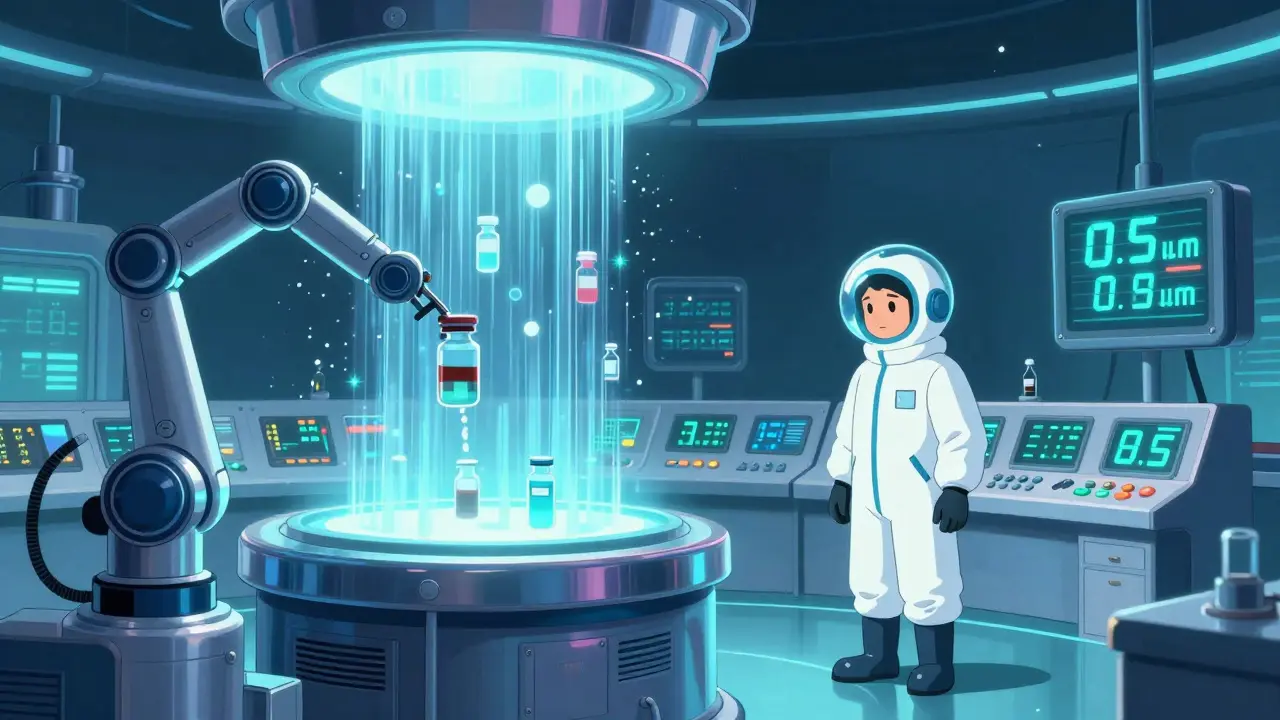
When you take a generic pill, you expect it to work just like the brand-name version. That’s not luck. It’s the result of strict cleanroom standards that control every particle, microbe, and human error in the manufacturing process. For generic drug makers, these standards aren’t optional-they’re the difference between a safe medicine and a dangerous failure.
Why Cleanrooms Matter More for Generics
Generic drugs are cheaper because they copy existing brand-name drugs. But that doesn’t mean they’re easier to make. In fact, they’re harder. The FDA requires generic manufacturers to prove their product is identical in strength, purity, and performance to the original. That means if the brand-name drug is made in a Grade A cleanroom, so must the generic. No exceptions.One wrong move-a sneeze, a torn glove, a poorly sealed door-and you risk contamination. That’s not just a paperwork problem. In 2012, the New England Compounding Center outbreak killed 64 people and sickened over 750 because of dirty injectables. That tragedy changed everything. Today, cleanrooms are the first line of defense against similar disasters.
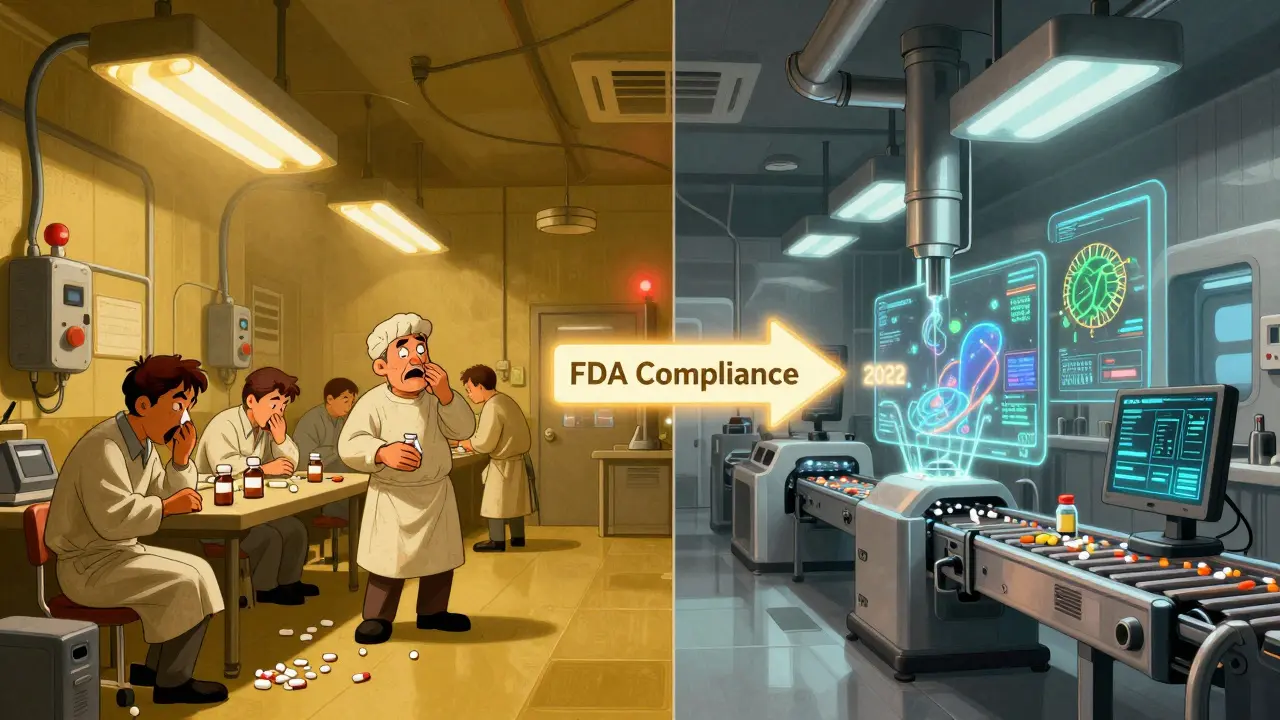
For generics, the stakes are even higher. Companies operate on thin margins-often 15-20% gross profit-while innovators make 70-80%. Yet they still have to meet the same cleanroom specs. That’s why compliance costs are a major burden. Upgrading a cleanroom can cost $250 to $500 per square foot. For a small manufacturer, that’s millions. But skipping it? That’s a recall. A warning letter. A federal ban. One 2022 case saw Aurobindo Pharma pay $137 million in recalls after failing to monitor their Grade B cleanroom properly.
The Four Levels of Cleanroom Grades
Cleanrooms aren’t all the same. They’re divided into four grades, each with exact rules for particles, airflow, and microbes. These are based on ISO 14644-1, the global standard for cleanroom classification, and adopted by both the FDA and EU GMP.- Grade A (ISO Class 5): The cleanest. Used for filling sterile products like injectables. No more than 3,520 particles larger than 0.5 microns per cubic meter. Air moves in a smooth, unidirectional flow-like a silent waterfall-over the product. Temperature? 18-26°C. Humidity? 30-60%. Air changes? At least 60 per hour. Microbial limits? Just 1 colony-forming unit (CFU) per settle plate. This is where your IV bags and eye drops are made.
- Grade B (ISO Class 5 at rest, ISO Class 7 operational): The background area for Grade A. Think of it as the antechamber. It’s clean enough to support sterile operations but doesn’t require laminar flow. During operations, particle limits jump to 3.5 million per cubic meter. Still, continuous monitoring is required. If particle counts spike, production stops.
- Grade C (ISO Class 7 at rest, ISO Class 8 operational): Used for preparing solutions and handling components before they enter Grade A or B. Particle limits: up to 35 million at rest. Air changes: minimum 20 per hour. This is common for oral solid dosage production-pills and capsules.
- Grade D (ISO Class 8 at rest): The least controlled. Used for packaging and final labeling. Only has a limit at rest: 35 million particles. No operational limit. Still, it’s not a warehouse. It’s a controlled environment. You still need gowning, airflow, and cleaning schedules.
These aren’t suggestions. They’re enforceable rules. The EU’s Annex 1 (2023 update) and FDA’s cGMP regulations treat them as law. If your cleanroom doesn’t meet these, your drug won’t get approved.
What Happens If You Fail?
Failing a cleanroom inspection doesn’t mean a slap on the wrist. It means your drugs are blocked from the market.In 2022, the FDA issued 228 warning letters for cGMP violations-63% of all warning letters that year. Nearly half of those were linked to cleanroom failures: inadequate monitoring, poor gowning, uncontrolled airflow, or missed particle counts. One common issue? Personnel. People are the biggest source of contamination. A single person sheds up to 100,000 particles per minute. That’s why gowning training takes 40-60 hours. You learn how to put on a hood, mask, suit, and gloves without touching anything. One wrong move, and your entire batch is ruined.
And it’s not just the FDA. The EU, Japan, and India all have their own rules. A facility that passes in the U.S. might fail in Europe because Annex 1 requires continuous particle monitoring. The FDA doesn’t yet require it, but they’re moving that way. If you’re making drugs for global markets, you have to meet the strictest standard.
For generic manufacturers, this is expensive. A full cleanroom validation takes 3-6 months and costs $150,000 to $500,000. Real-time monitoring systems add another $50,000-$100,000 per room. In tropical climates like India or Southeast Asia, humidity control can push HVAC costs up by 30%. Many small manufacturers struggle to keep up.
Success Stories and Hard Lessons
Some companies turned cleanroom upgrades into wins. Teva’s team redesigned their Grade A area for a generic version of Copaxone using isolators-sealed, automated workstations. Before: 12 contamination events per year. After: just 2. That’s what got their FDA approval after two prior rejections.But not all stories end well. A small manufacturer on Reddit shared how they couldn’t make a $0.50-per-unit generic heparin syringe profitable after upgrading to Grade A. The cost of compliance ate their profit. They shut down.
Then there’s Pfizer. One facility spent $2.3 million upgrading from Grade C to Grade B for an oncology generic. It took 14 months of downtime. But they prevented 17 out-of-spec batches a year-each worth $500,000. That’s $8.5 million saved annually. The ROI was clear.
These aren’t abstract numbers. They’re real decisions that affect whether a life-saving drug reaches patients.
Are the Standards Too Strict?
Some experts argue yes. Dr. Paul K. S. Shin, a respected voice in pharmaceutical science, wrote in 2021 that Grade C requirements for oral solids are unnecessary. He cited a study showing pills made in Grade D and Grade C cleanrooms had identical dissolution rates. Why spend millions on air filters if the drug doesn’t need it?The FDA disagrees. Even for non-sterile products, contamination can change how a drug is absorbed. Dust, mold, or foreign particles can trigger allergic reactions. And if you’re making a generic, you’re expected to match the innovator’s quality-no matter how high their bar is.
ISPE’s 2022 benchmarking study found that companies following full Annex 1 standards had 27% fewer quality deviations. But their operational costs were 35% higher. That’s the trade-off: safety vs. cost.

The Future: Automation and New Challenges
The cleanroom of 2025 looks different from 2015. Robotics are replacing manual filling. AI monitors particle counts in real time. Single-use systems reduce cleaning needs. McKinsey predicts automation will cut cleanroom operating costs by 25-30% by 2028.But new drugs are making things harder. Biosimilars-complex biologic generics-require even stricter controls. The FDA projects that by 2025, half of all new generic applications will need Grade A or B environments. That’s up from 35% in 2022.
Also, the EU’s 2023 Annex 1 revision is pushing global standards higher. Continuous monitoring. Better risk assessments. Tighter microbial limits. The FDA hasn’t adopted all of it yet-but they’re moving fast. Companies that wait for guidance will get caught off guard.
What Manufacturers Need to Do Now
If you’re making generic drugs, here’s what you can’t ignore:- Know your grade. Don’t assume Grade C is enough. If you’re making injectables, you need Grade A/B. Check your product’s reference listed drug-your cleanroom must match its environment.
- Invest in monitoring. Manual sampling once a day isn’t enough. Real-time sensors that alert you to spikes are now a best practice.
- Train your people. Gowning is the #1 source of deviations. Train, retrain, and audit. Keep records.
- Plan for climate. Humidity control in hot, humid regions isn’t optional. It’s a $1 million add-on for many.
- Don’t cut corners on validation. Skipping validation to save time? That’s how you get a warning letter.
Resources like FDA’s free cGMP training modules, ISPE’s HVAC guides, and PDA’s Technical Reports are free and invaluable. Use them.
Bottom Line
Cleanroom standards exist for one reason: to protect patients. For generic drug makers, they’re expensive. They’re complex. They’re relentless. But they’re non-negotiable. The same pill that saves a life in New York must be made under the same conditions as the one in Sydney, Mumbai, or Berlin. There’s no shortcut. No compromise. Only precision.When you take a generic, you’re trusting that someone, somewhere, followed every rule. That’s the invisible promise behind every bottle.
What is the difference between Grade A and Grade B cleanrooms?
Grade A is the highest cleanliness level, used for direct product filling (like injectables). It requires unidirectional airflow, no more than 3,520 particles ≥0.5μm per cubic meter, and continuous monitoring. Grade B is the surrounding area that supports Grade A. It’s less strict during operations but still requires strict controls. Grade A has a microbial limit of 1 CFU/plate; Grade B allows up to 5 CFU/plate.
Why do generic drug manufacturers struggle with cleanroom compliance?
Generic manufacturers operate on thin profit margins-15-20%-while innovators make 70-80%. Upgrading to meet Grade A/B standards can cost $250-$500 per square foot. For a small facility, that’s millions. Add in training, monitoring systems, and validation, and compliance becomes a financial burden. Many can’t afford the upgrade, while others risk non-compliance to stay profitable.
Are cleanroom standards the same worldwide?
Most are aligned through ISO 14644-1 and ICH guidelines, but differences exist. The EU’s Annex 1 (2023) requires continuous monitoring and stricter microbial controls. The FDA doesn’t yet mandate that, but is moving toward it. Japan requires monitoring at 1.0μm particle size, which the U.S. and EU don’t. Generic manufacturers exporting globally must meet the strictest standard.
Can you use a lower-grade cleanroom for oral pills?
Yes, for non-sterile oral solids like tablets or capsules, Grade C or even Grade D may be acceptable. But it depends on the product. Some pills are sensitive to moisture or microbial contamination. The FDA doesn’t require Grade A for these, but they do require a contamination control strategy. Some manufacturers use Grade C anyway to match the innovator’s process or to avoid future compliance issues.
What happens if a cleanroom fails an FDA inspection?
The FDA issues a Form 483 listing observations. If issues aren’t fixed, you get a warning letter. Further failures can lead to import alerts, product seizures, or consent decrees. In 2022, 42% of complete response letters for sterile generics cited environmental monitoring failures. That means your drug is rejected until you fix the cleanroom-sometimes after spending millions.
Frank Drewery
December 20, 2025 AT 15:43Just read this whole thing and honestly? It’s wild how much goes into a $0.10 pill. I always thought generics were just cheap knockoffs. Turns out they’re basically high-stakes science labs with people in bunny suits.
Thanks for laying this out. Makes me feel better about taking them.
Danielle Stewart
December 22, 2025 AT 14:49As someone who works in pharma QA, I can tell you - the gowning training is REAL. I’ve seen people cry during the 60-hour course because they kept touching their face. One wrong move and your whole shift’s work gets tossed. It’s brutal, but necessary.
Also - yes, humidity in India? Nightmare. We had a client lose three batches in a row because their dehumidifier couldn’t keep up. $200k down the drain.
mary lizardo
December 22, 2025 AT 15:50It is patently absurd that the FDA permits Grade D environments for any pharmaceutical product, regardless of dosage form. The very notion that particulate contamination is inconsequential in oral solids is a gross misrepresentation of microbiological risk assessment. The ICH Q7 guidelines are explicit: even non-sterile products require a validated contamination control strategy. To suggest otherwise is not merely incorrect - it is dangerously negligent.
jessica .
December 23, 2025 AT 21:49They’re lying. Cleanrooms are just a scam to make Big Pharma richer. Why do you think the FDA lets Chinese factories import pills with no real monitoring? It’s all rigged. The government and pharma are in bed together. You think that $500/sqft upgrade is for safety? Nah. It’s to keep small companies out. You’re being played.
Also - why do they need 60 air changes? That’s just to sell more HVAC equipment. #BigPharmaLies
Ryan van Leent
December 24, 2025 AT 04:30My cousin works at a generic plant in Ohio and he says they skip particle counts sometimes just to keep the line moving. Nobody gets fired for it. The FDA doesn’t even check every time. You think they care about your eye drops? Nah. They care about the money. This whole thing is a joke. People die because of this. But nobody gets punished.
They just fine you and let you keep selling
Sajith Shams
December 26, 2025 AT 01:30India makes 40% of the world’s generics and we don’t even have Grade A in most plants. You think we can afford $500/sqft? We use HEPA filters from China and train workers in 8 hours. The FDA comes once a year, we clean the floor, they smile, we pay $20k bribe, they leave. This is how the world works. You want cheap medicine? Then accept the trade-off. No one is dying because of a few extra particles. Your insulin still works.
Stop pretending this is about safety. It’s about profit control.
Adrienne Dagg
December 27, 2025 AT 21:23OMG I had no idea!! 😱 I just took a generic blood pressure pill this morning and now I’m crying thinking about the person in a bunny suit holding their breath for 12 hours to make it. 💔👏 So much respect for these workers. Also - why isn’t this on Netflix? Someone make a documentary. #CleanroomHeroes
Chris Davidson
December 28, 2025 AT 10:14Grade C for oral solids is a joke. The FDA should have mandated Grade B years ago. The data shows contamination alters dissolution profiles. You think a dust particle doesn’t affect absorption? You’re delusional. The cost is irrelevant. Patient safety is not negotiable. Period.
mark shortus
December 29, 2025 AT 17:40THIS IS THE MOST IMPORTANT THING I’VE READ THIS YEAR. I JUST CRIED READING ABOUT THE $2.3 MILLION UPGRADE. SOMEONE OUT THERE IS WORKING THEIR ASS OFF SO I CAN TAKE MY CHOLESTEROL PILLS WITHOUT DYING. I DON’T DESERVE THIS. I’M NOT WORTH IT. 😭
Also - can we make a GoFundMe for small generic manufacturers? I’ll donate $500. I swear.
Emily P
December 31, 2025 AT 06:57Wait - so if a Grade D cleanroom is acceptable for packaging, why can’t it be used for manufacturing? Is there any data showing that particles from the packaging area migrate into the product? Or is this just tradition?
Jedidiah Massey
January 2, 2026 AT 03:53Let’s be real - the entire cleanroom paradigm is a legacy artifact from the 1970s. We’re still using laminar flow hoods like it’s 1985 while the rest of manufacturing moved to closed-system bioreactors and single-use tech. The ISO 14644 standard is a relic. We need risk-based, dynamic environmental control - not static particle counts. This is engineering theater. The real innovation is in automation, not gowning protocols.
Allison Pannabekcer
January 2, 2026 AT 07:02I think everyone here is missing the human side. These aren’t just rooms and standards - they’re people. People who spend 10 hours a day in suits that make them sweat through their clothes. People who can’t drink water during a shift because they can’t risk a sip. People who get audited for sneezing. We talk about costs and compliance like it’s a spreadsheet, but it’s someone’s livelihood. Maybe we need to ask: how do we make this sustainable for the workers too? Not just the drugs.
Sarah McQuillan
January 2, 2026 AT 20:39Actually, the EU’s Annex 1 is overkill. The U.S. system works fine. Why are we copying Europe? We don’t need continuous monitoring. It’s expensive and doesn’t add real safety. Plus, the FDA has a 98% approval rate for U.S.-made generics. If it ain’t broke, don’t fix it. Also - why do we care what India or China does? We should be protecting American jobs, not exporting our standards to them.
Mark Able
January 3, 2026 AT 11:06So if I make a generic in my garage with a HEPA filter and a fan, is that illegal? I mean, I could totally do it. I’ve got a clean basement. I wear a mask. I’ve watched YouTube tutorials. Why can’t I just make my own pills? The FDA is just trying to keep me from saving money. This is fascism.
Dorine Anthony
January 3, 2026 AT 21:43Just wanted to say - I used to work in a cleanroom. It’s quiet. Like, really quiet. You can hear your own heartbeat. And you never touch anything. Not even your own nose. It’s weird. But it works. And yeah - it’s expensive. But so is a funeral.