
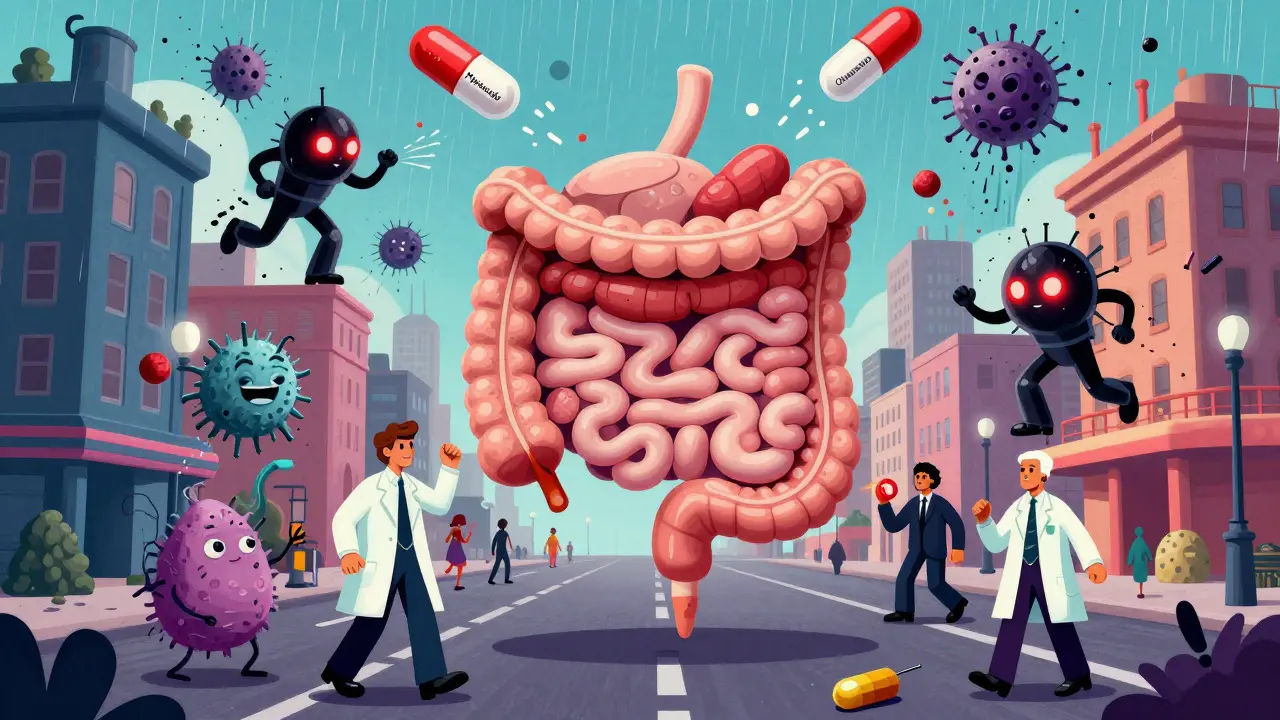
It starts with a simple course of antibiotics. Maybe it was for a sinus infection, a urinary tract issue, or even a dental procedure. You take the pills as directed, feel better, and move on. But days or weeks later, the diarrhea hits - not the mild kind, but watery, frequent, and relentless. Then comes the cramping, the fever, the exhaustion. If you’ve been told you have C. diff colitis, you’re not alone. Every year, half a million people in the U.S. get it. And for many, it’s not a one-time problem - it comes back, again and again.
How Antibiotics Open the Door to C. diff
Your gut is home to trillions of bacteria. Most of them are harmless, even helpful. They digest food, train your immune system, and keep harmful bugs like Clostridioides difficile in check. But when you take antibiotics - especially broad-spectrum ones - you don’t just kill the bad bacteria. You wipe out the good ones too. And that’s when C. diff takes over.Not all antibiotics carry the same risk. Some are like sledgehammers. Others are more like scalpels. Research shows that beta-lactam/beta-lactamase inhibitors - especially piperacillin-tazobactam - carry the highest risk, nearly doubling your chance of getting C. diff. Carbapenems and later-generation cephalosporins like ceftriaxone are close behind. Even more surprising: clindamycin, a common drug for skin infections, has long been known as one of the biggest culprits. On the other end of the spectrum, tetracyclines like doxycycline show much lower risk.
It’s not just the type of antibiotic - it’s how long you take it. Each extra day on antibiotics increases your risk by about 8%. And the danger doesn’t drop off after a few days. It spikes again after two weeks. That’s why doctors are now told to review antibiotic prescriptions within 48 to 72 hours. If the infection isn’t improving, maybe you don’t need it anymore.
And here’s the scary part: you don’t have to be in the hospital to get C. diff. More than half of cases now happen in the community - in people who haven’t been hospitalized. One study found nearly half of those who got C. diff had taken an antibiotic within the past 30 days. That means your local pharmacy, your family doctor, even your dentist could unknowingly be part of the problem.
Why Recurrent C. diff Is So Hard to Treat
Most people think if you treat the infection, you’re done. But with C. diff, that’s rarely true. About 20% of people get it again after their first episode. And for one in five of those, it comes back a third, fourth, or even fifth time.Why? Because antibiotics like vancomycin or fidaxomicin kill the C. diff bacteria - but they don’t fix the gut. The microbiome stays broken. The good bacteria don’t come back. So the C. diff spores, which are tough and resistant, wait in the lining of your colon. When the environment is right - after another antibiotic, or even just stress - they wake up and start producing toxins again.
That’s why repeating the same treatment often fails. Vancomycin, the old standard, only works about 30% of the time for recurrent cases. Fidaxomicin is better - it has a higher cure rate and lowers the chance of relapse - but it’s expensive. And even then, many people still bounce back.
Doctors have tried probiotics, but the evidence is weak. Some studies show harm - especially in people with weakened immune systems. The IDSA says there’s not enough proof to recommend them. So what’s left? When standard treatments fail, there’s one option that changes everything: fecal microbiota transplantation.
The Surprising Power of Fecal Transplants
Imagine taking poop from a healthy person and putting it into your colon. Sounds gross? It’s also one of the most effective treatments in modern medicine.In a landmark 2013 study published in the New England Journal of Medicine, researchers compared three treatments for recurrent C. diff: vancomycin, vancomycin plus bowel lavage, and fecal transplant via colonoscopy. The results were shocking. Vancomycin alone cured just 31% of patients. The fecal transplant cured 94%.
Since then, dozens of studies have confirmed it. FMT works in 85 to 90% of cases for people with three or more recurrences. It’s not magic - it’s science. The healthy donor’s stool contains hundreds of bacterial strains that repopulate the gut, crowd out C. diff, and restore balance. It’s like reseeding a lawn after a fire.
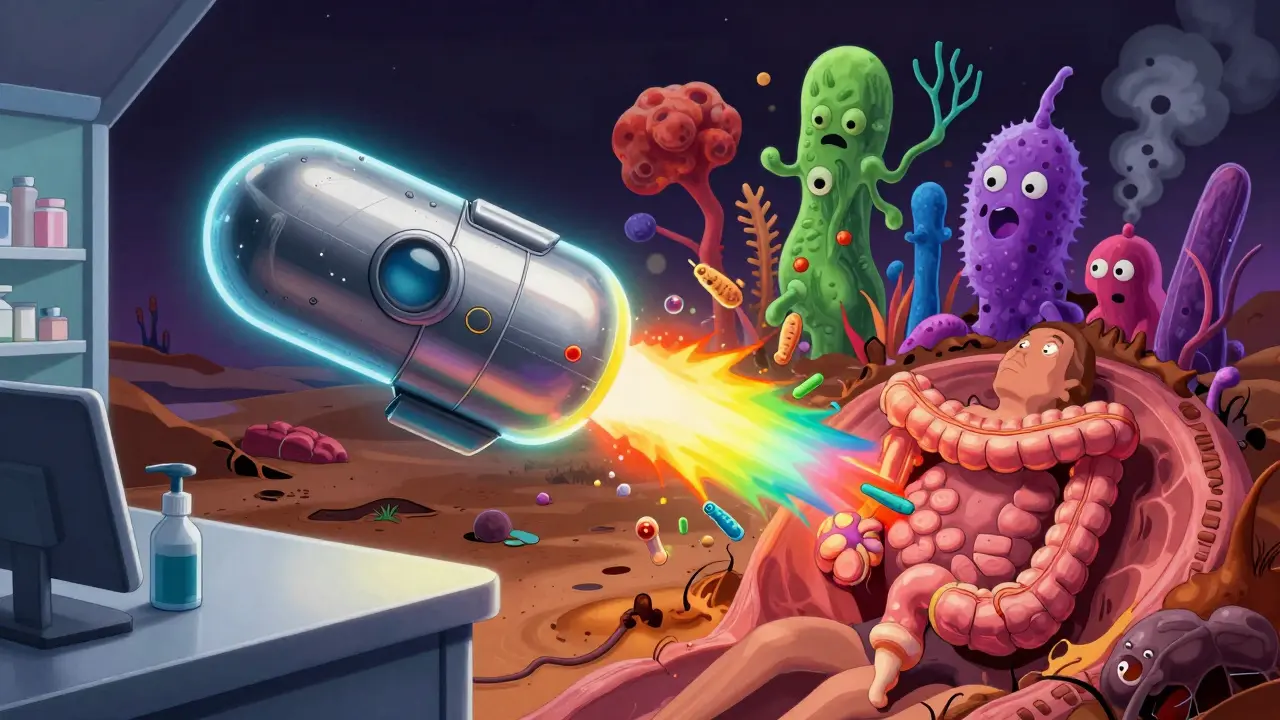
Today, FMT isn’t just a last-resort trick. It’s a standard treatment. The American Gastroenterological Association recommends it for anyone with three or more recurrences. And it’s not just done with a colonoscopy anymore. You can now take it in pill form - freeze-dried capsules swallowed like vitamins. Some clinics use enemas. Colonoscopy is still the most common method, used in about 65% of cases.
And it’s getting easier to access. In 2022 and 2023, the FDA approved two branded FMT products: Rebyota and Vowst. These aren’t raw stool - they’re standardized, screened, and regulated. They’re not cheap - around $1,500 to $3,000 per dose - but they’re far cheaper than repeated hospital stays, which average $11,000 per episode.
Who Should Consider FMT - and Who Shouldn’t
FMT isn’t for everyone. It’s reserved for people who’ve tried at least two rounds of antibiotics and still have symptoms. It’s not a first-line treatment. And it’s not without risk.Donors are screened for everything - HIV, hepatitis, syphilis, parasites, even rare genetic conditions. But there’s still a small chance of transferring harmful bacteria. There have been rare cases of drug-resistant infections spreading through FMT. That’s why the FDA requires informed consent. You have to know the risks.
People with weakened immune systems - those on chemotherapy, organ transplant recipients, or people with advanced HIV - are at higher risk of complications. FMT isn’t recommended for them unless it’s absolutely necessary.
And here’s something most people don’t realize: some people carry C. diff without ever getting sick. These asymptomatic carriers are common in hospitals. But antibiotics don’t make them sick - they just make them spreaders. That’s why infection control matters. Handwashing, isolation, and cleaning surfaces are just as important as treating the patient.
What’s Next for C. diff Treatment?
The future of C. diff treatment is moving away from poop and toward precision. Scientists are developing targeted microbiome therapies that deliver only the good bacteria - no feces needed.One such drug, SER-109, is an oral capsule made from purified bacterial spores. In a major 2022 trial, it cured 88% of patients with recurrent C. diff - nearly matching FMT’s success. It’s expected to be approved soon. Other companies are testing engineered bacteria, phage therapies, and even monoclonal antibodies that neutralize C. diff toxins.
Meanwhile, hospitals are finally waking up to antibiotic stewardship. Programs that limit unnecessary prescriptions, shorten treatment durations, and switch to lower-risk antibiotics are cutting C. diff rates. But progress has slowed. Community cases are still rising.
The CDC now calls C. diff an "urgent threat" - not just because it kills, but because it’s becoming harder to control. The fluoroquinolone-resistant strain 027 is spreading in the community. And we’re still not good enough at identifying who’s at risk before they get sick.

What You Can Do
If you’re prescribed an antibiotic, ask these questions:- Is this really necessary? Could this infection clear on its own?
- Is there a narrower-spectrum option? Could I take doxycycline instead of ceftriaxone?
- How long do I really need to take it? Could I stop after five days instead of ten?
If you’ve had C. diff before, tell every doctor you see. That includes dentists and specialists. Keep a record of your history. And if you’re facing a recurrence, don’t accept another round of vancomycin without asking about FMT.
It’s not just about treating the infection. It’s about protecting your gut - your whole body - from the long-term damage of repeated antibiotic use. The microbiome isn’t just a collection of bugs. It’s part of your immune system, your brain, your metabolism. Once it’s broken, it doesn’t always fix itself.
For many, FMT isn’t a last resort. It’s a second chance. And it’s working.
Frequently Asked Questions
Can C. diff go away without treatment?
In some mild cases, especially in younger, healthy people, stopping the antibiotic that triggered the infection is enough. The body’s natural defenses can restore balance and clear the infection. But this doesn’t work for everyone. If you have fever, severe cramping, or blood in your stool, you need medical treatment. Waiting can lead to dangerous complications like toxic megacolon or colon perforation.
Is fecal transplant safe?
When done through approved programs with screened donors, FMT is very safe. The risk of serious infection is less than 1%. The FDA requires donors to be tested for HIV, hepatitis, syphilis, parasites, and drug-resistant bacteria. There have been rare cases of antibiotic-resistant infections spreading through FMT, which is why it’s only used when other treatments fail. For most people with recurrent C. diff, the benefits far outweigh the risks.
Are probiotics helpful for C. diff?
The evidence is mixed and not strong enough to recommend probiotics for preventing or treating C. diff. Some studies show no benefit. Others suggest they might even increase the risk of bloodstream infections in people with weakened immune systems. The Infectious Diseases Society of America does not endorse probiotics for this use. Stick to proven treatments like fidaxomicin or FMT.
How long does it take to recover after a fecal transplant?
Most people notice improvement within 24 to 48 hours after the procedure. Diarrhea slows down, cramps ease, and energy returns. Full recovery of the gut microbiome takes weeks to months, but you don’t need to wait for that to feel better. The key is that relapse rates drop dramatically - from 60% with antibiotics to under 15% after FMT.
Can you get C. diff from someone else?
Yes - but only if you’re exposed to spores and your gut is vulnerable. C. diff spores live on surfaces like toilets, doorknobs, and medical equipment. They’re hard to kill - regular soap and alcohol don’t destroy them. You need bleach-based cleaners. Most infections happen in healthcare settings, but community spread is rising. If you’ve had C. diff before, you’re more likely to get it again - especially if you take antibiotics.
Is there a vaccine for C. diff?
Not yet, but several are in development. One vaccine targeting C. diff toxins is in phase 3 trials and has shown promise in preventing first-time and recurrent infections. If approved, it could be given to high-risk groups - like older adults or people on long-term antibiotics - before they get sick. That would be a game-changer for prevention.
Next Steps
If you’ve had C. diff once, keep a list of all antibiotics you’ve taken. Avoid them unless absolutely necessary. Talk to your doctor about lower-risk options if you need an antibiotic in the future. If you’re facing a recurrence, ask about FMT - don’t wait until you’ve had three relapses. The sooner you consider it, the better your chances of getting back to normal.
And if you’re a caregiver or family member - remember: handwashing with soap and water (not just hand sanitizer) is the best way to prevent spreading spores. Clean surfaces with bleach. And don’t blame the patient. C. diff isn’t a personal failure. It’s a consequence of how we use antibiotics - and how we’re only now learning to fix it.
Lana Kabulova
January 22, 2026 AT 18:56Wow, this is one of the most comprehensive breakdowns of C. diff I’ve ever read-seriously, someone should turn this into a pamphlet for every pharmacy counter. The part about beta-lactamase inhibitors doubling risk? Mind blown. I’ve had three courses of piperacillin-tazobactam in five years and never connected the dots. Now I’m terrified to take any antibiotic without a second opinion.
Kenji Gaerlan
January 23, 2026 AT 03:09so like… fecal transplants are just… poop in a tube???
Oren Prettyman
January 24, 2026 AT 06:46While the article presents a compelling narrative regarding the efficacy of fecal microbiota transplantation, one must not overlook the methodological limitations inherent in the cited 2013 NEJM study, particularly the small sample size and the lack of long-term follow-up data beyond one year. Furthermore, the normalization of FMT as a standard-of-care intervention, while clinically appealing, risks undermining the foundational principles of evidence-based medicine when the mechanistic understanding of microbial engraftment remains incomplete. The FDA’s recent approval of Rebyota and Vowst, though regulatory milestones, should not be misconstrued as validation of the underlying biological paradigm-rather, they represent pragmatic responses to an escalating public health crisis.
Rob Sims
January 25, 2026 AT 03:07Oh great. So now we’re giving people poop pills because doctors can’t stop overprescribing antibiotics like they’re giving out candy at a parade. Meanwhile, Big Pharma is quietly patenting purified bacterial spores and charging $3,000 for a dose while hospitals make $11k per stay. Classic. The real cure? Stop giving antibiotics to people with sinus infections that could clear up with a nap and some chicken soup.
Tatiana Bandurina
January 25, 2026 AT 03:37Let’s be honest-the entire FMT industry is built on the assumption that the human microbiome is a black box we can fix by dumping someone else’s guts into ours. But what if the donor’s microbiome carries latent autoimmune triggers? Or epigenetic markers from chronic stress? We’re not just transplanting bacteria-we’re transplanting trauma, diet history, and possibly even the donor’s unresolved anxiety. And nobody’s tracking that. Not even the FDA. And you call this medicine?
arun mehta
January 26, 2026 AT 21:08This is an extraordinary article, deeply informative and beautifully structured. As someone from India, where antibiotic misuse is rampant due to over-the-counter availability, I see this crisis daily. The rise of community-acquired C. diff here is alarming. I hope this reaches every medical student and pharmacist in my country. We need stewardship programs, not just pills. Thank you for highlighting the science behind FMT-it’s not magic, it’s microbiology. 🙏
Malik Ronquillo
January 26, 2026 AT 23:31poop cures. who woulda thought. i mean… i guess if your gut is a dumpster fire, you gotta throw in some fresh logs. 🤷♂️
Hilary Miller
January 27, 2026 AT 20:40My mom had 4 recurrences. FMT saved her. No joke.
Philip House
January 28, 2026 AT 04:45Look, I get it. Antibiotics are overused. But let’s not pretend this is some ancient wisdom. FMT is basically medieval medicine with a lab coat. We’re living in 2024. We have CRISPR. We have AI-driven drug design. And we’re still shoving poop into people because we’re too lazy to develop targeted probiotics? I’m all for science, but this feels like giving up.
shivani acharya
January 30, 2026 AT 04:15So… who’s to say the donors aren’t secretly working for Big Pharma? I mean, they screen for everything except… I don’t know… microchips? Or maybe the spores are engineered to make you dependent on future doses? Why do you think they’re so eager to patent it? And why do hospitals refuse to let you use your own family member’s stool? Coincidence? I think not. Also, did you know the CDC has been quietly funding FMT research since 2015? That’s the same year the FDA approved the first gut microbiome patent. Hmmmm.
Margaret Khaemba
January 30, 2026 AT 04:29I’ve been researching this since my brother got C. diff after a tooth extraction. The fact that dentists don’t even warn patients is wild. I’m going to start printing out this article and handing it to every doctor I meet. We need to change how we think about antibiotics. They’re not harmless.
Chiraghuddin Qureshi
January 31, 2026 AT 07:43As an Indian, I’ve seen people buy antibiotics from roadside shops without prescriptions. This article is a wake-up call for my country too. We need public awareness campaigns-like those for handwashing during COVID. Maybe even billboards: ‘Antibiotics ≠ Candy.’ 🌏💙
Akriti Jain
February 1, 2026 AT 00:28Wait… so if FMT works, does that mean the real cure was never medicine at all… but just… poop? And they’ve been lying to us for decades? I bet the FDA banned home FMT because they want you to pay $3,000 for a capsule. And why do they only use ‘healthy’ donors? What if the real secret is… the donor’s trauma? Their stress? Their diet? Their hidden parasites? They’re not just transplanting bacteria-they’re transplanting… energy. I’m not joking. You ever read about the gut-brain axis? That’s not science. That’s magic. And they’re selling it.