
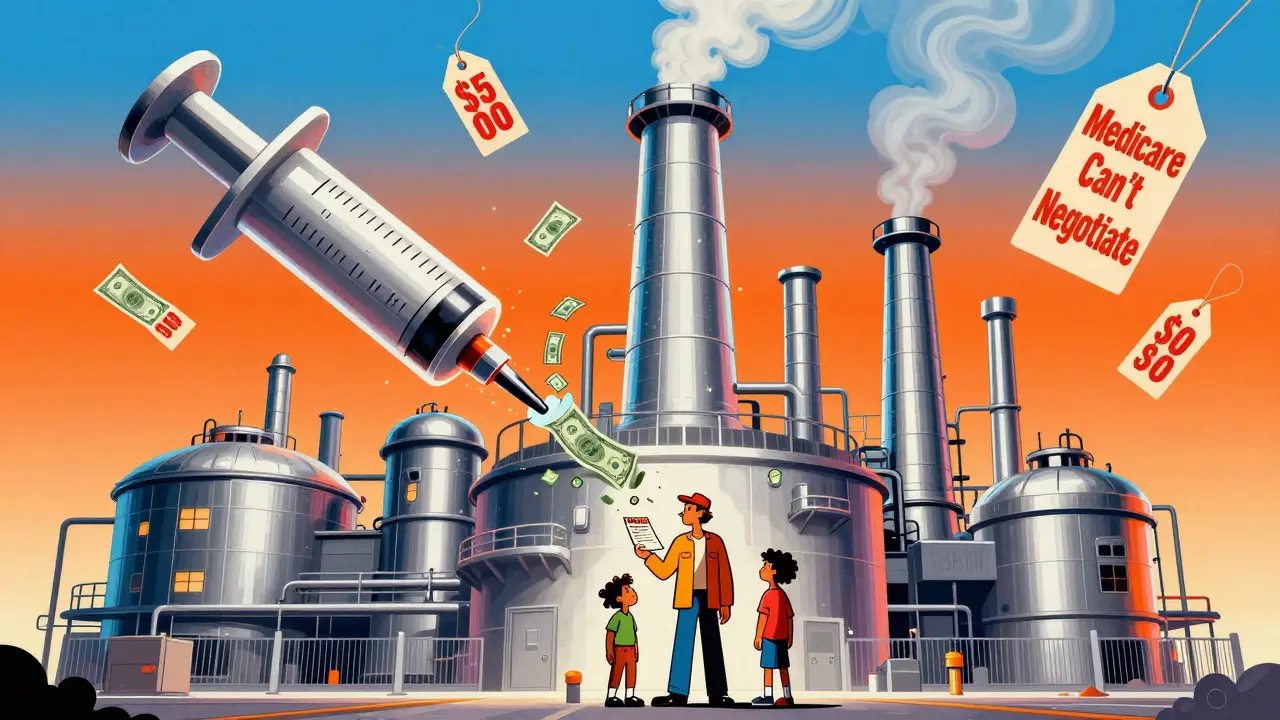
Every year, millions of Americans face a brutal choice: pay for their medicine or pay for rent, groceries, or electricity. It’s not a hypothetical dilemma - it’s daily reality for people with diabetes, cancer, or rare diseases. The same pill that costs $30 in Canada or €25 in Germany can cost over $500 in the U.S. Why? The answer isn’t one thing. It’s a system built over decades that rewards profit over people.
The System Is Designed This Way
The U.S. doesn’t have high drug prices because of bad luck or corporate greed alone. It’s because the rules were written to allow it. In 2003, Congress passed the Medicare Modernization Act. One clause stood out: Medicare was banned from negotiating drug prices with manufacturers. That’s not how it works anywhere else in the developed world. Countries like the UK, Germany, and Canada negotiate directly. They say, “We’ll buy this drug, but not at your list price.” The U.S. said nothing. That single decision gave drug companies a blank check. Fast forward to 2025, and the results are clear. Americans pay over three times more for brand-name drugs than people in other OECD countries. The same medication - Galzin for Wilson’s disease - costs $88,800 a year here. In the UK, it’s $1,400. That’s not a pricing error. That’s a policy choice.Who’s Really in Charge? Meet the Middlemen
You might think drug prices are set by manufacturers alone. But there’s a hidden layer: Pharmacy Benefit Managers, or PBMs. These are the middlemen between drug makers, insurers, and pharmacies. Originally, they were supposed to cut costs by negotiating discounts. Today, they’re big corporations that own pharmacies, insurance plans, and even drug manufacturers. Their profit? It comes from rebates - and the higher the list price, the bigger the rebate. Here’s how it works: A drug company sets a list price of $1,000. The PBM negotiates a $300 rebate. The final price to the insurer is $700. But the list price stays at $1,000. That’s the number you see on your pharmacy receipt. The patient pays based on that inflated price - even if their insurance only covers part of it. So PBMs have a financial incentive to keep prices high. It’s a perverse system where the people meant to lower costs actually profit from them.Specialty Drugs Are Breaking the Bank
Not all drugs are created equal. The biggest price spikes come from specialty drugs - treatments for cancer, rare diseases, obesity, and diabetes. These aren’t generic pills. They’re complex biologics, often made with cutting-edge science. But that doesn’t justify what’s happening. Take Ozempic and Wegovy. These drugs for diabetes and weight loss cost over $1,000 a month in the U.S. In 2025, the White House announced deals with manufacturers to cut those prices to $350. That’s progress. But here’s the catch: those deals only apply to Medicare. Millions of people with private insurance still pay full price. And even $350 a month is $4,200 a year - more than most people spend on rent. IQVIA reports that novel obesity and diabetes drugs drove an 11.4% increase in U.S. drug spending in 2024. That’s not just inflation. That’s a business model built on locking patients into lifelong, high-cost therapies.
The Inflation Reduction Act - A Start, But Not a Solution
In 2022, Congress passed the Inflation Reduction Act. For the first time, Medicare could negotiate prices for a small number of drugs. In 2026, that list includes ten drugs - all high-cost, high-demand medications. The projected savings? $1.5 billion in out-of-pocket costs for seniors. That sounds good. But look closer. There are 10,000+ prescription drugs on the market. Ten is less than 0.1%. And even that limited power was weakened in 2025 by a budget reconciliation bill that reduced funding for the negotiation program. Meanwhile, drug companies are still allowed to raise prices faster than inflation - unless they’re on the negotiation list. For the rest? No limits. The law also created a $2,000 annual cap on out-of-pocket drug costs for Medicare beneficiaries. That’s huge. For someone taking three expensive medications, that could mean saving $5,000 a year. But it only helps seniors on Medicare. It doesn’t touch the 150 million Americans with private insurance.Why Other Countries Don’t Have This Problem
Germany uses reference pricing. If a new drug costs more than similar ones already on the market, the government says, “We won’t pay more than the average.” France negotiates directly with manufacturers before a drug even hits shelves. Canada uses bulk purchasing and price caps. None of them let companies set prices at will. The U.S. is the only OECD country without any form of direct price control. And it’s not because we’re smarter or more innovative. It’s because we have a powerful pharmaceutical lobby that spends over $300 million a year on lobbying and campaign donations. The system works perfectly - for them.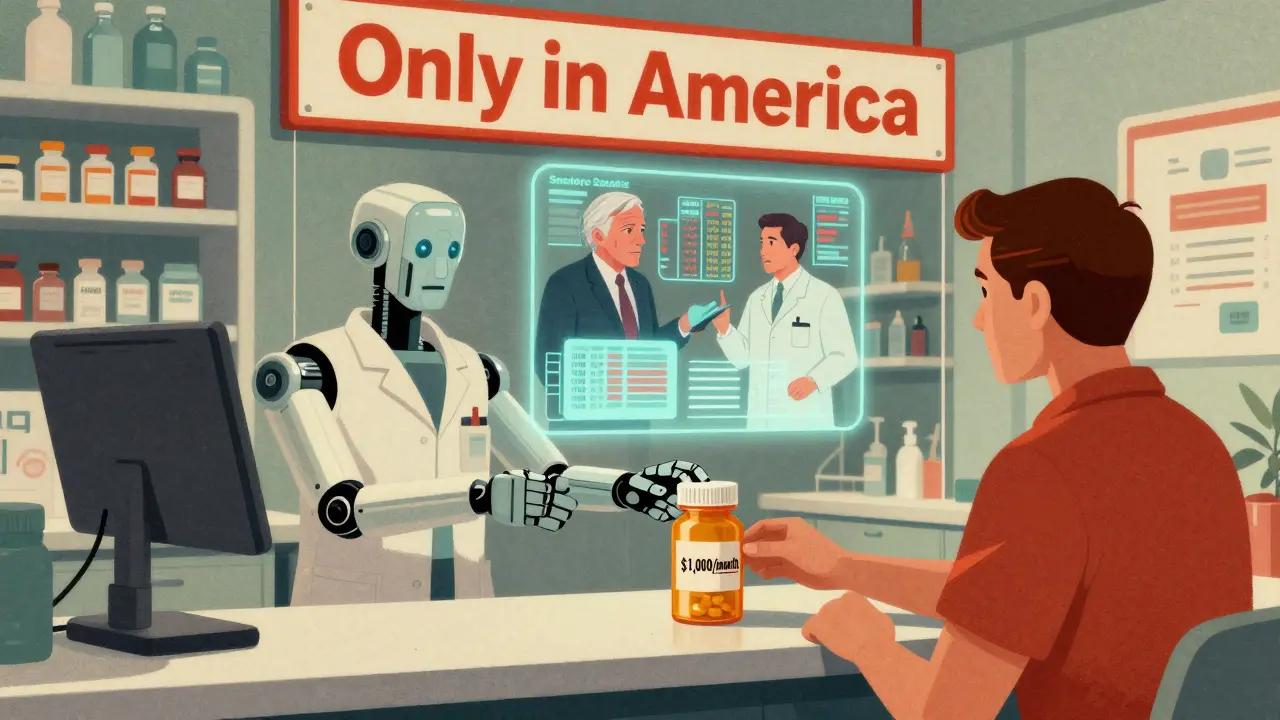
Darlene Gomez
March 22, 2026 AT 22:08It breaks my heart that we live in a country where a kid with diabetes has to choose between insulin and dinner. I’ve seen it firsthand - my sister’s insulin went from $300 to $800 in three years. No one should have to ration medicine. We’re not just talking about profit margins here - we’re talking about people dying because a corporation decided to jack up prices. This isn’t capitalism. This is cruelty dressed up as business.
And let’s be real - PBMs aren’t middlemen. They’re parasites. They profit from the pain. The system isn’t broken - it was built this way. And we let it happen because we were told it was too complicated to fix. But it’s not complicated. It’s just inconvenient for the people who profit from it.
Katie Putbrese
March 23, 2026 AT 00:41Stop blaming pharma. The real problem is government overreach. Medicare negotiating prices? That’s socialism. We don’t need bureaucrats telling companies what to charge. If you can’t afford your meds, get a better job or move to Canada. We don’t owe you a free ride. The market works. If you don’t like it, don’t buy it. Simple.
Amber Gray
March 25, 2026 AT 00:10lol the gov should just print more money and give everyone free drugs 🤡💸
also pbms are just a scam but honestly i dont even care anymore im on disability so i get mine cheap
but yeah rich people need to stop whining about $350 a month lmao
James Moreau
March 26, 2026 AT 04:59I’ve worked in healthcare administration for 18 years. The PBM model is absolutely insane. I’ve seen the spreadsheets. The list price is a fiction. The real price paid by insurers is often 40-60% lower. But the patient still gets hit with the full list price because of how copays are calculated. It’s designed to confuse. And it works.
It’s not just greed. It’s a structural flaw in how we’ve outsourced pricing to third parties with zero transparency. We need to cut out the middlemen entirely - not just regulate them.
J. Murphy
March 27, 2026 AT 12:17drug prices high? maybe if people stopped taking so many pills they’d save money
also who even needs ozempic anyway
just eat less and walk more lol
Jesse Hall
March 28, 2026 AT 18:57you know what’s wild? the same companies that charge $500 for a pill in the U.S. sell the exact same pill in Germany for $25. Same factory. Same ingredients. Same packaging.
That’s not innovation. That’s exploitation.
And honestly? I’m tired of hearing ‘it’s complicated.’ It’s not. It’s moral. We’re a rich country. We can do better. We just have to choose to.
Also - if you’re reading this and you’re struggling to afford meds? You’re not alone. Reach out. There are patient assistance programs. I’ve helped people get free meds before. It’s possible. You’re not broken. The system is.
Donna Fogelsong
March 29, 2026 AT 07:23the whole thing is a deep state operation. the fda, the cdc, the pbs - all connected to big pharma via the illuminati. they pump up prices so they can control the population. the covid vaccines were just the start. now they’re locking us in with lifelong meds so we stay dependent. 87 drugs raised prices? that’s not market forces - that’s a coordinated reset. they want us weak. they want us docile. and they’re using insulin and diabetes drugs as the weapon. you think this is about money? no. it’s about power.
winnipeg whitegloves
March 29, 2026 AT 20:37as a canuck, i just shake my head. we pay like $15 for the same omeprazole you’re paying $120 for. we don’t have PBMs. we don’t have list prices. we have a single-payer system that says ‘nope, that’s too much’ and the company either lowers it or doesn’t sell here.
you think we’re socialist? nah. we’re just not stupid. you have the wealth. you have the innovation. you just chose to let hedge funds and lobbyists run the pharmacy.
you’re not special. you’re just being robbed.
Marissa Staples
March 30, 2026 AT 12:09i’ve been thinking about this a lot lately. we talk about prices like they’re numbers on a screen. but they’re not. they’re the difference between someone breathing tonight or not.
the system doesn’t care if you’re a single mom or a veteran or a kid with cystic fibrosis. it only cares if you’re profitable.
we’ve been trained to think of medicine like a car or a phone - something you ‘choose’ to buy. but you don’t choose to have cancer. you don’t choose to be diabetic. you choose to live.
and if we’ve built a system where living is a luxury - then we’ve lost something way bigger than money.
peter vencken
March 31, 2026 AT 16:09real talk: i used to work in a pharmacy. people would come in crying because their copay was $400 for a 30-day supply. one lady asked if she could pay in quarters. i saw a guy split a 10mg pill into four pieces because he couldn’t afford the full dose.
the pbs? they’re the worst. they jack up the list price so they can get a bigger rebate. then they own the pharmacy so they get paid twice - once from the insurer, once from the patient’s copay.
and congress? they take money from the same companies that do this. it’s a revolving door. the fix isn’t hard. ban rebates. cap list prices. let medicare negotiate everything. done.
but nobody wants to touch it because the lobbyists are too loud.
Chris Crosson
April 1, 2026 AT 07:14why is this even a debate? we spend more per capita on healthcare than any country on earth. yet we have the worst outcomes for chronic disease. that’s not a coincidence. that’s a failure.
the fact that we’re still arguing about whether drug prices should be capped means we haven’t learned anything. we let corporations decide who lives and who dies based on their quarterly earnings. that’s not a market. that’s a moral collapse.
and if you think this isn’t about race or class - you’re not paying attention. the people getting priced out? they’re the ones already struggling. this isn’t about ‘freedom.’ it’s about who we are.
Linda Foster
April 2, 2026 AT 09:32While the systemic issues presented in this article are indeed compelling, one must also consider the substantial capital investment required to bring novel therapeutics to market. The average cost of drug development exceeds $2.8 billion, with a success rate under 10%. Without the ability to recoup these costs through market pricing, innovation will inevitably stagnate. A balanced approach - one that preserves incentive structures while introducing targeted price controls - may offer a more sustainable path forward than sweeping regulatory intervention.
Rama Rish
April 3, 2026 AT 14:22in india we pay $2 for same insulin. no one dies. no one starves. why? because we dont let pharma run our health. simple.
you dont need a phd to fix this. you need courage.
Chris Farley
April 3, 2026 AT 16:29you think drug companies are the villains? nah. the real villain is the government that lets people live on welfare while charging $500 for a pill. if you’re poor, you shouldn’t be alive. capitalism rewards effort. if you can’t afford meds, you didn’t try hard enough. stop whining and get a job. or better yet - move to a country that doesn’t care about your life. like, i dunno, the third world.