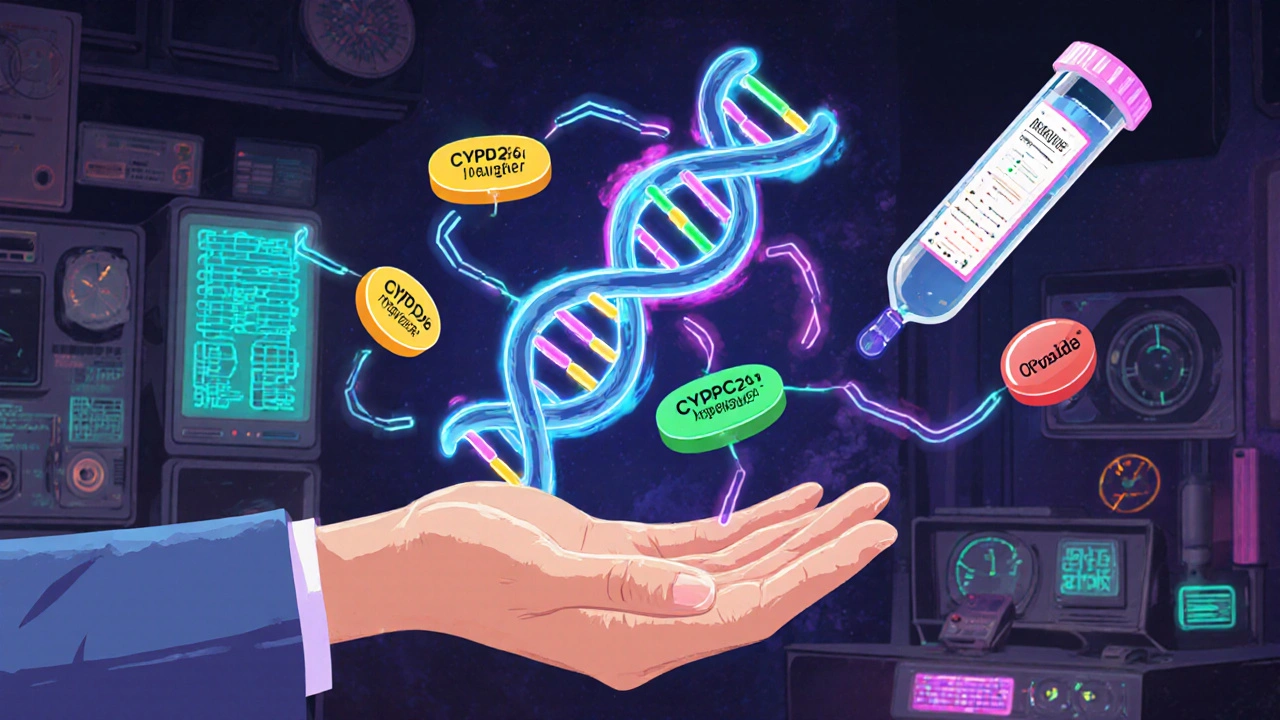
When you take a pill, your body doesn’t just react the same way everyone else does. Pharmacogenomics testing, the study of how your genes affect how your body processes drugs. Also known as pharmacogenetics, it explains why one person gets sick from a standard dose while another feels fine—even if they’re taking the exact same medication. This isn’t science fiction. It’s happening right now in clinics, hospitals, and pharmacies every day.
Why does this matter? Because drug side effects aren’t random. They’re often tied to your DNA. Some people metabolize drugs too fast, so the medicine never works. Others process them too slow, leading to dangerous buildups. That’s why two people on the same antidepressant can have wildly different outcomes—one feels better, the other feels worse. Pharmacogenomics testing looks at specific genes like CYP2D6, CYP2C19, and VKORC1 to predict how you’ll respond to common drugs: blood thinners, antidepressants, painkillers, even cholesterol meds. It’s not about guessing. It’s about knowing.
This science connects directly to personalized medicine, tailoring treatments based on individual biology rather than one-size-fits-all guidelines. Think of it like a key fitting a lock—your genes are the lock, and the drug is the key. If the key doesn’t match, it won’t turn. That’s why doctors are starting to use genetic tests before prescribing certain drugs, especially for heart conditions, mental health, and cancer. It reduces trial and error. It cuts down on hospital visits from bad reactions. And it saves money in the long run.
And it’s not just about avoiding bad reactions. It’s about finding the right dose faster. For example, warfarin dosing used to be a guessing game—now, with pharmacogenomics, we can start closer to the right level. Same with clopidogrel: if your genes make you a poor metabolizer, that drug won’t work at all, and you’re at higher risk for a heart attack. Testing catches that before you even take the first pill.
You’ll find posts here that dive into real cases: how hydroxyzine can mess with your heart rhythm in some people, why levothyroxine fails if taken with calcium, or why rifampin can make birth control useless. These aren’t random side effects. They’re genetic signals. And they’re all part of the same bigger picture: your body’s unique response to drugs.
Pharmacogenomics testing isn’t for everyone yet—but it’s becoming more common, more affordable, and more necessary. If you’ve ever been told, "This drug just doesn’t work for me," or "You’re unusually sensitive to that medication," this is why. The answers aren’t in your lifestyle alone. They’re in your DNA. And below, you’ll find real, practical guides that show how this science is already changing how drugs are used, monitored, and prescribed.