
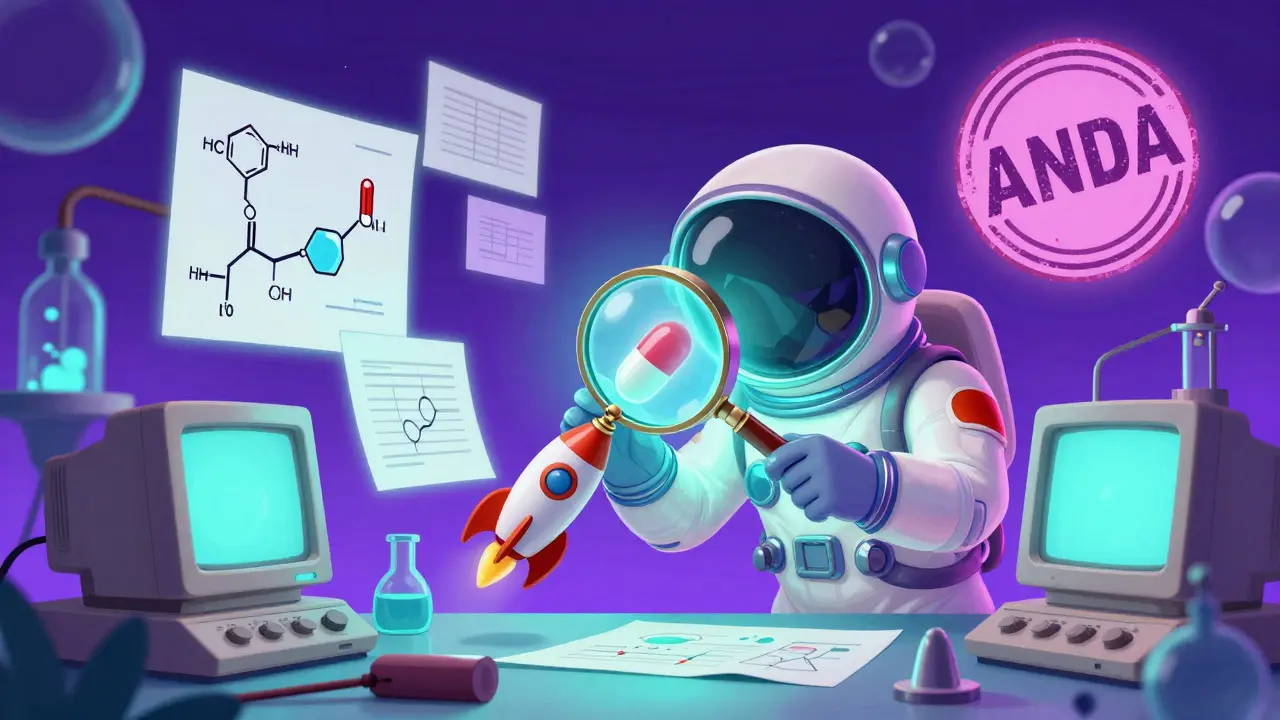
Every day, millions of people in the U.S. take generic drugs without even realizing it. That pill you picked up at the pharmacy for $4 instead of $40? It’s likely a generic. But how exactly are these low-cost versions made? And how can they be so much cheaper while still working just as well as the brand-name drug you’ve heard of on TV?
The answer isn’t magic. It’s science, regulation, and a tightly controlled manufacturing process that’s been refined over 40 years. The system was created by the Hatch-Waxman Act of 1984, which gave rise to the Abbreviated New Drug Application (ANDA) - a shortcut that lets generic companies skip expensive clinical trials by proving their version behaves the same way in the body as the original. But that doesn’t mean the process is simple. Far from it.
Step 1: Reverse Engineering the Original Drug
Before a single tablet is pressed, manufacturers must fully understand the brand-name drug they’re copying. This isn’t just looking at the label. It’s breaking the drug down chemically and physically. They analyze the active ingredient - the part that actually treats the condition - and every single inactive ingredient, called excipients, that help with absorption, stability, or taste. These include things like lactose, cellulose, or magnesium stearate. Even small changes in particle size or purity can affect how the drug dissolves in your stomach.
This stage is called characterizing the Reference Listed Drug (RLD). It’s like reverse-engineering a locked phone to build a compatible case. The goal isn’t to copy the brand’s packaging or appearance - that’s illegal under U.S. trademark law - but to match its performance. This phase can take months, especially for complex drugs like inhalers or topical creams where delivery method matters as much as the ingredient itself.
Step 2: Designing the Formula with Quality by Design (QbD)
Modern generic drug development doesn’t rely on trial and error. Instead, manufacturers use a framework called Quality by Design (QbD), developed by the International Council for Harmonisation (ICH). This means they identify what’s critical to the drug’s safety and effectiveness - called Critical Quality Attributes (CQAs) - and then figure out which raw materials and manufacturing steps affect those attributes.
For example, if a drug needs to dissolve slowly over 12 hours, the thickness of its coating and the density of the tablet core become CQAs. The particle size of the active ingredient, the humidity during mixing, and the pressure used to compress the tablet are Critical Process Parameters (CPPs). Change any of these, and you risk making a drug that doesn’t work the same way.
Manufacturers run hundreds of small-scale tests to find the exact recipe and process that hits all the targets. This isn’t guesswork. It’s data-driven engineering.
Step 3: Manufacturing - The Seven Key Stages
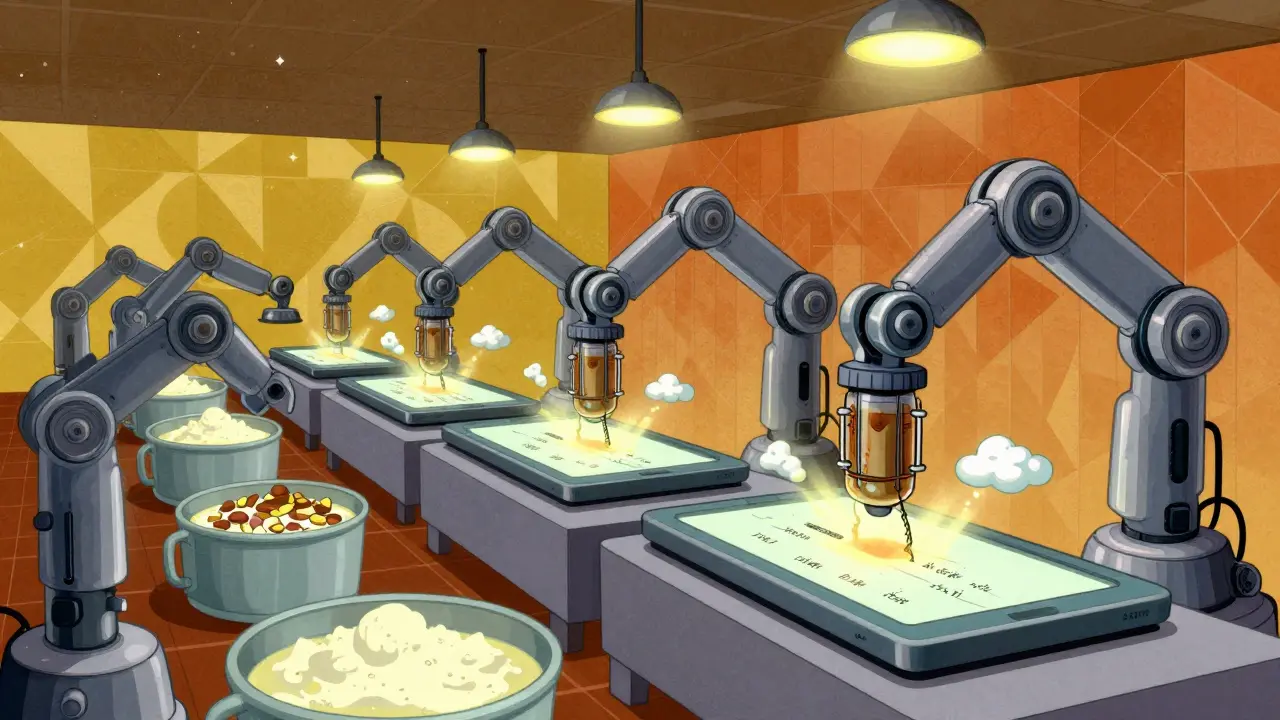
Once the formula is locked in, production begins in a facility that meets strict Current Good Manufacturing Practices (CGMP) standards. These rules, enforced by the FDA, ensure every batch is safe, pure, and consistent. Here’s how it actually happens:
- Formulation: The active pharmaceutical ingredient (API) is mixed with excipients in precise ratios. Even a 0.1% error can throw off the dose.
- Mixing and Granulation: Powders are blended until uniform. For tablets, the mixture is turned into granules - small clumps - to improve flow and compression. This step often uses high-shear mixers or fluid bed granulators.
- Drying: Moisture is removed to prevent degradation. Too much water can cause tablets to crumble or bacteria to grow. Temperature and time are tightly controlled.
- Compression and Encapsulation: Granules are pressed into tablets using high-speed machines that apply up to 10 tons of pressure. Capsules are filled with powder or pellets using automated fillers. Each tablet must weigh within ±5% of target if under 130mg, or ±7.5% if between 130-324mg.
- Coating: Tablets get a thin outer layer to mask taste, protect the drug from stomach acid, or control release. Some coatings dissolve in minutes; others take hours. This step is especially tricky for extended-release drugs.
- Quality Control: At every stage, samples are pulled for testing. They check for identity (is it the right drug?), strength (is there enough active ingredient?), purity (are there harmful contaminants?), and dissolution (does it release the drug at the right rate?). Dissolution tests must match the brand-name drug within 80-125% of its profile - the bioequivalence benchmark.
- Packaging and Labeling: Bottles, blister packs, or unit-dose packaging are filled, sealed, and labeled. Labels must list the generic name, strength, manufacturer, and expiration date. No brand names, no logos, no misleading imagery.
Every batch gets a unique number and is tracked from raw material to shelf. If a tablet fails a test, the entire batch is scrapped. There’s no room for compromise.
Step 4: The ANDA Approval Process
Manufacturing the drug is only half the battle. To sell it, you must get FDA approval through the ANDA pathway. Unlike brand-name drugs, which require years of clinical trials on thousands of patients, generics only need to prove they’re bioequivalent.
Here’s how the ANDA process works:
- Submission: The company files a 5,000-10,000-page application with detailed data on chemistry, manufacturing, and controls.
- Bioequivalence Testing: 24-36 healthy volunteers take both the generic and brand-name drug on different days. Blood samples are taken over 24-72 hours to measure how much of the drug enters the bloodstream (Cmax) and how long it stays there (AUC). The generic’s values must fall within 80-125% of the brand’s - with 90% confidence.
- Facility Inspection: The FDA sends inspectors to the manufacturing site. They check cleanroom conditions, equipment calibration, record-keeping, and staff training. The facility must meet ISO Class 5-8 standards for air purity, with temperature at 20-25°C and humidity at 45-65% RH.
- Labeling Review: The label must match the brand’s in content, but not appearance. Colors, shapes, and logos are different to avoid confusion.
- Post-Approval Monitoring: Even after approval, the FDA can inspect the facility again, review adverse event reports, and require additional studies if issues arise.
The average review time for an ANDA is now under 10 months thanks to GDUFA IV (2022), down from 17 months just a few years ago. But complex drugs - like injectables or nasal sprays - can still take 2-3 years.
Why Some Generics Are Harder to Make Than Others
Not all generics are created equal. Simple pills like metformin or lisinopril have dozens of manufacturers and cost pennies. But complex drugs - those with special delivery systems - are much harder to copy.
Examples include:
- Topical creams (like Clobetasol Propionate)
- Inhalers (like Advair)
- Extended-release tablets
- Injectable suspensions
For these, traditional blood tests aren’t enough. The drug’s physical structure - how it’s suspended, how it’s sprayed, how it’s absorbed through skin - matters just as much as the chemical. Some companies spend over $40 million and seven years just to match one complex product. That’s why only 2-5 manufacturers typically enter these markets, keeping prices higher.
In 2022, a generic version of Clobetasol Propionate took seven years and $47 million to develop because the original cream had a unique skin penetration profile that couldn’t be replicated with standard methods. The manufacturer had to build new testing equipment just to measure it.

Quality Concerns and Real-World Evidence
Some people worry that cheaper means lower quality. But the data tells a different story. A 2023 survey by the Association for Accessible Medicines found that 89% of pharmacists have high confidence in generic drug quality. Only 3% reported any meaningful difference in patient outcomes.
Still, there are risks. In 2021, Teva recalled 14 generic drugs after an FDA inspection found CGMP violations at its Puerto Rico plant. The issue? Inadequate investigation of out-of-specification results - a common failure cited in 37% of FDA warning letters.
Another concern is excipient variability. As one pharmaceutical engineer on Reddit shared, “A slight change in lactose particle size from your supplier can throw off your tablet hardness and dissolution profile.” That’s why top manufacturers like Dr. Reddy’s require 160 hours of initial GMP training and 40 hours of annual refresher training for every employee.
For patients on drugs with a narrow therapeutic index - like warfarin or levothyroxine - even small differences in absorption can matter. But studies show that when generics are properly manufactured and tested, the risk is minimal. The FDA requires batch-to-batch consistency, and most patients never notice a difference.
The Bigger Picture: Cost, Supply, and Future Trends
Generic drugs saved the U.S. healthcare system over $1.7 trillion in the last decade. Today, 90% of all prescriptions are filled with generics. But the system is under pressure.
Over 78% of active pharmaceutical ingredients (APIs) now come from China and India. That creates supply chain risks, as seen during the pandemic. The FDA is pushing for more domestic production and has approved 17 new continuous manufacturing lines - where drugs are made in one seamless flow instead of in batches. This reduces errors and cuts production time from weeks to hours.
AI is also entering the mix. Pfizer’s pilot program cut visual inspection errors by 40% using machine learning to spot defects in tablets. Digital twins - virtual models of manufacturing lines - are being tested to predict problems before they happen.
And while simple generics face fierce price competition - with prices dropping 70-80% within two years - complex generics are becoming the new frontier. They now make up 35% of all pending ANDA applications, up from just 12% in 2015. These are the drugs that will shape the next decade of affordable medicine.
Final Thoughts: Trust, But Verify
Generic drugs aren’t cheap because they’re low quality. They’re cheap because the system was designed to cut out unnecessary costs - not corners. The same FDA standards apply. The same testing is done. The same inspectors show up unannounced.
If you’re worried about switching from a brand to a generic, talk to your pharmacist. They can tell you if the drug is simple or complex. For most people, the switch is seamless. For others, especially those on critical medications, the FDA’s bioequivalence rules are there to protect you.
The truth is, without generics, millions of Americans couldn’t afford their prescriptions. The manufacturing process is complex, tightly regulated, and constantly improving. And for the most part - it works.
Are generic drugs really as effective as brand-name drugs?
Yes. The FDA requires generic drugs to have the same active ingredient, strength, dosage form, and route of administration as the brand-name version. They must also prove bioequivalence - meaning they deliver the same amount of medicine into your bloodstream at the same rate. Over 90% of prescriptions in the U.S. are filled with generics, and studies show no meaningful difference in effectiveness for the vast majority of patients.
Why do generic drugs look different from brand-name drugs?
By U.S. law, generic drugs cannot look identical to brand-name drugs to avoid confusion and trademark infringement. That’s why generics may have different colors, shapes, or markings. But the active ingredient and how it works inside your body are identical. The differences are only in inactive ingredients like dyes or flavorings, which don’t affect the drug’s performance.
Can generic drugs cause different side effects?
Side effects from the active ingredient are the same. But because generics can use different inactive ingredients, some people may experience minor differences - like stomach upset from a different filler or a taste change. These aren’t true side effects of the drug itself, but reactions to excipients. If you notice a change after switching, talk to your doctor or pharmacist. For most people, this isn’t an issue.
How does the FDA ensure generic drug quality?
The FDA inspects every generic drug manufacturing facility before approval and conducts unannounced inspections afterward. Facilities must follow Current Good Manufacturing Practices (CGMP), which include strict controls on environment, equipment, and documentation. Every batch is tested for identity, strength, purity, and dissolution. The FDA also monitors adverse event reports and can pull products from the market if safety issues arise.
Why are some generic drugs more expensive than others?
Price depends on competition and complexity. Simple pills like ibuprofen have dozens of manufacturers, driving prices down to pennies. Complex drugs - like inhalers, injectables, or extended-release tablets - are harder to make and have fewer competitors. That means higher prices. Some complex generics cost hundreds of dollars because it takes years and tens of millions to develop them.
Are generic drugs made in the U.S.?
Some are, but most active ingredients come from China and India. However, final packaging and many manufacturing steps happen in U.S. facilities. The FDA inspects all facilities worldwide that supply drugs to the U.S. market. There’s a growing push to bring more production back to the U.S. and allied countries to reduce supply chain risks.
What’s the difference between a generic and an authorized generic?
An authorized generic is made by the original brand-name company and sold under a generic label. It’s identical to the brand drug - same ingredients, same factory, same packaging - just without the brand name. These are often released when the brand’s patent expires and are used to compete with other generics. They captured 23% of first-generic market share in 2023.
Johanna Baxter
January 9, 2026 AT 09:26Jerian Lewis
January 9, 2026 AT 16:05Kiruthiga Udayakumar
January 10, 2026 AT 16:44Patty Walters
January 12, 2026 AT 15:51tali murah
January 14, 2026 AT 14:23Jenci Spradlin
January 16, 2026 AT 00:52Alicia Hasö
January 16, 2026 AT 12:32Ashley Kronenwetter
January 18, 2026 AT 12:17Heather Wilson
January 18, 2026 AT 17:23Micheal Murdoch
January 19, 2026 AT 09:44Meghan Hammack
January 19, 2026 AT 10:21Matthew Maxwell
January 20, 2026 AT 13:12Ian Long
January 21, 2026 AT 11:08