

When a baby develops dry, itchy patches on their cheeks or arms, parents often worry it’s just a rash. But for many, this is the first sign of something bigger - the atopic march. It’s not a single disease. It’s a pattern: eczema showing up in infancy, then food allergies, then asthma and hay fever - all linked by one broken system: the skin barrier.
For decades, doctors thought eczema inevitably led to other allergies. That’s what the old model taught us. But new research is turning that idea upside down. Only 3.1% of kids with eczema follow the classic path. Most don’t. So why does it matter? Because for the 25% who do, early action can change everything.
What Really Starts the Atopic March?
The story begins with skin. Not just any skin - skin that’s missing its natural armor. In babies who develop eczema, the outer layer of skin doesn’t form properly. One key protein, called filaggrin, is often missing or damaged due to genetic mutations. This isn’t rare. About 1 in 5 people carry a filaggrin variant. And when this protein is weak, tiny cracks form in the skin.
These aren’t just dry patches. They’re open doors. Allergens like peanut dust, egg particles, or cow’s milk proteins slip through. When they touch immune cells in the skin, the body learns to see them as threats. That’s how an allergy starts - not from eating the food, but from touching it through broken skin.
Think of it like this: if your skin were a brick wall, filaggrin is the mortar holding the bricks together. When the mortar cracks, everything gets in. That’s why babies with severe eczema are at highest risk. Their walls are crumbling.
It’s Not a Straight Line - It’s a Web
Forget the idea of a step-by-step march. That’s outdated. The old model said: eczema → food allergy → asthma → hay fever. But real life doesn’t work that way.
Studies show that 80% of children with eczema become sensitized to allergens - meaning their immune system recognizes them. But only 20-30% ever develop symptoms. Sensitization isn’t the same as allergy. You can test positive for peanut without ever reacting to it. That’s why blanket warnings don’t help.
What matters more is severity. Kids with moderate to severe eczema are 3-4 times more likely to develop asthma or allergic rhinitis. And if they have both eczema and a food allergy early on? Their risk for asthma jumps even higher. The real pattern isn’t linear. It’s a web. Eczema, food allergy, asthma, and hay fever often show up together, not one after the other.
And genetics? They play a role too. Mutations in genes like TSLP and IL-33 don’t just cause eczema. They also raise the chance of asthma and allergic rhinitis. These genes are like shared wiring - one flaw, multiple outcomes.
Why Skin Care Isn’t Just About Comfort - It’s Prevention
Most parents treat eczema as a symptom to manage. But now we know: it’s a warning sign. And fixing the skin barrier early might stop the whole chain before it starts.
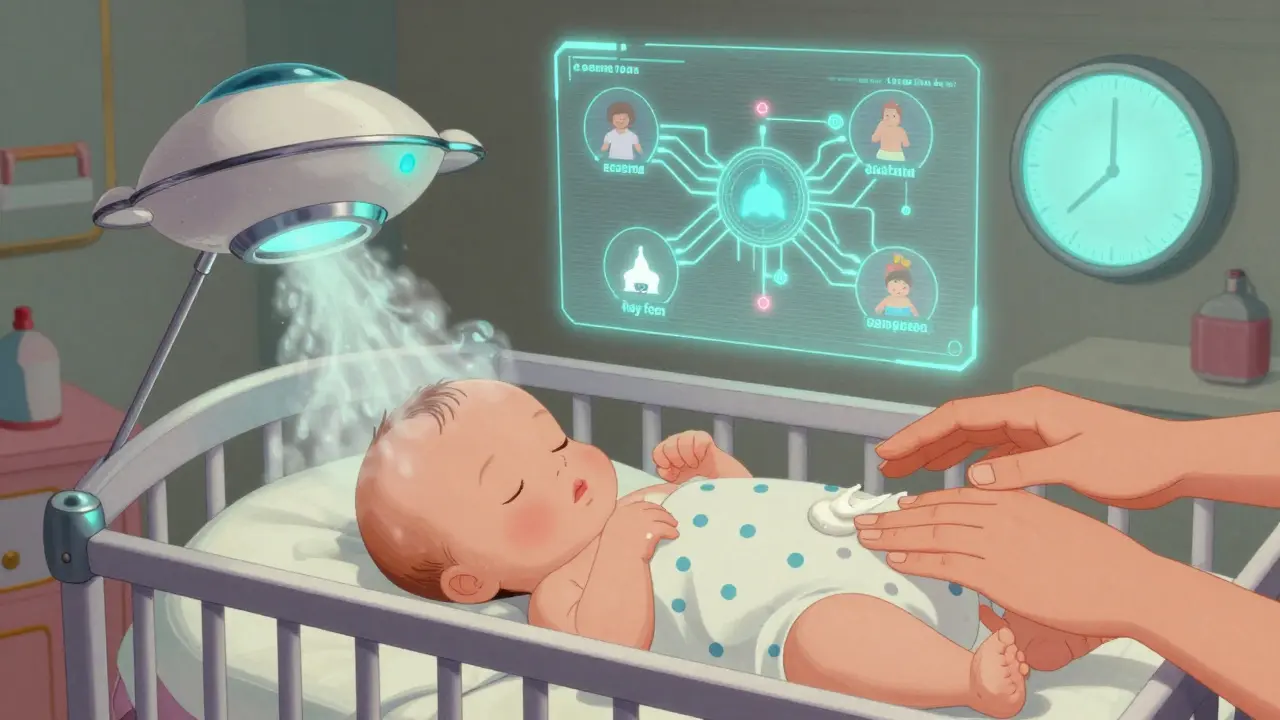
The PreventADALL trial tested this idea. Researchers applied fragrance-free emollients daily to newborns with a family history of allergies. By age 1, those babies had 20-30% less eczema. That’s not just comfort - that’s prevention.
It’s not about curing eczema. It’s about sealing the cracks. Daily moisturizing with a simple ointment - like petroleum jelly or ceramide-rich creams - rebuilds the skin’s natural barrier. No fancy products. No fragrances. Just consistent, thick protection.
And timing matters. The first 3 months of life are critical. That’s when the skin is most vulnerable. If you start early, you’re not just soothing dryness. You’re blocking allergens before they can trigger an immune response.
What About Food? Should You Avoid It?
This is where things get confusing. For years, parents were told to delay peanut, eggs, and dairy. Now? The opposite.
The LEAP study changed everything. It followed 600 high-risk infants - those with severe eczema or egg allergy. Half were fed peanut regularly from 4 to 11 months. The other half avoided it. By age 5, the peanut-fed group had 86% fewer cases of peanut allergy.
Here’s the twist: exposure through the skin causes allergies. Exposure through the mouth builds tolerance. That’s the dual-allergen hypothesis. So if your baby has eczema, avoid putting peanut butter on their cheeks. But if they’re cleared by a doctor, feeding them small amounts of peanut (like peanut powder mixed into puree) might protect them.
Same goes for eggs. Introduce cooked egg around 6 months - not raw, not in big chunks. Just a tiny smear on the tongue. If there’s no reaction, slowly increase. This isn’t risky. It’s protective.
Don’t wait. Don’t fear. But don’t guess. Talk to your pediatrician or allergist before starting.
Is Your Gut Involved Too?
It’s not just skin. It’s gut. New research is showing that babies who develop allergies often have different gut bacteria from birth.
One study found that infants who later became multi-sensitized had less of a specific type of bacteria that makes butyrate - a compound that helps calm the immune system. It’s like their gut was missing the right teachers to tell the immune system: “This is safe.”
That doesn’t mean you need probiotics. Not all probiotics work. And not all babies need them. But it does mean diet matters - especially if you’re breastfeeding. Eating fiber-rich foods (beans, oats, vegetables) supports good gut bacteria. Formula-fed babies? Look for formulas with prebiotics.
There’s no magic pill. But feeding your body well - and keeping your baby’s skin protected - gives their immune system the best chance to learn the right lessons.

Who’s at Real Risk? And What Should You Do?
Not every child with eczema will develop asthma. But some are. Here’s how to tell who’s at real risk:
- Severe eczema - covers large areas, wakes baby at night, needs prescription creams
- Early onset - started before 3 months
- Family history - parent or sibling with asthma, hay fever, or food allergy
- Other signs - dry skin on elbows/knees, red cheeks, flaking scalp
If your child fits this profile, here’s what to do:
- Apply thick moisturizer twice daily - especially after baths
- Use mild, fragrance-free soap
- Keep baths short (under 10 minutes) and lukewarm
- Start peanut or egg around 6 months (after checking with your doctor)
- Watch for worsening rashes or breathing issues - don’t wait
And if your child’s eczema flares despite care? See a dermatologist. Aggressive early treatment can change the course. Steroid creams aren’t scary when used correctly. They heal the barrier - and that’s the goal.
What’s Next? The Future of Prevention
Scientists aren’t done. Right now, they’re building tools to predict who will progress. It’s not about guessing. It’s about combining:
- Genetic testing (filaggrin status)
- Early skin condition scoring
- Gut microbiome analysis
- Environmental exposures (pets, pollution, breastfeeding)
Imagine a baby’s first checkup: a simple skin test, a stool sample, and a family history. Within days, you get a risk score. If high? You get a personalized plan - moisturizing routine, diet tips, monitoring schedule.
We’re not there yet. But in Australia, trials are underway. And the message is clear: the atopic march isn’t destiny. It’s a warning - and we now have the tools to listen.
Bottom Line: Protect Skin, Don’t Fear Food
The atopic march isn’t a straight path. It’s a puzzle. And skin is the first piece. If you have a child with eczema, focus on three things:
- Seal the skin - daily moisturizing, no fragrances
- Feed early - introduce allergens like peanut and egg under guidance
- Watch closely - if breathing changes or rashes spread, get help
You’re not just treating a rash. You’re protecting a future. And that’s worth every drop of cream, every spoonful of peanut, every visit to the doctor.
trudale hampton
March 22, 2026 AT 04:27Been there with my daughter. Started moisturizing her face and arms with plain petroleum jelly at 6 weeks, and honestly? No eczema flare-ups since. Not saying it’s magic, but it’s cheap, easy, and doesn’t require a PhD to do right.
Also, we introduced peanut butter mixed into applesauce at 5 months - no reaction, no drama. Just a little every few days. Pediatrician was skeptical, but the data’s solid. Why wait until it’s too late?
Shaun Wakashige
March 24, 2026 AT 02:50lol i just slap lotion on my kid and call it a day
Natali Shevchenko
March 25, 2026 AT 15:02What fascinates me isn’t just the science - though the filaggrin mutation research is genuinely elegant - but how deeply cultural our fear of allergens has become. We’ve been conditioned to see food as a threat, not a teacher. The body’s immune system isn’t broken; it’s confused. And confusion arises from isolation - from sterile environments, from delayed exposure, from the illusion that protection means avoidance.
When we shield a child from every potential trigger, we’re not building resilience. We’re building ignorance. The skin isn’t just a barrier - it’s a teacher. And if we silence it with creams alone, we miss the lesson entirely. The mouth, the gut, the skin - they’re not separate systems. They’re one conversation. We just stopped listening.
Maybe the real breakthrough isn’t in the ointment. Maybe it’s in our willingness to let go of control. To trust biology. To let a baby lick a spoonful of peanut butter instead of hiding it behind fear.
Nicole James
March 27, 2026 AT 07:08Wait… so you’re telling me the pharmaceutical industry, the allergy testing companies, and the ‘hypoallergenic’ skincare conglomerates have been lying to us for decades? Of course they have. They profit from fear. They profit from confusion. They profit from parents who don’t know what’s really happening.
And now, suddenly, ‘research’ says ‘just use Vaseline’? And ‘feed them peanut butter’? Oh, I see. The real conspiracy isn’t that eczema leads to allergies - it’s that they don’t want you to know how easy it is to stop it. Because if parents started doing this at home? No more $300 skin patches. No more $200 allergy tests. No more monthly dermatologist visits.
They don’t want you to know this. They want you dependent. And if you’re smart - you’ll ignore the ‘experts’ and just put on petroleum jelly. Twice a day. No exceptions. And feed your kid peanut powder like it’s cereal. That’s the real prevention. Not the ‘guidelines.’ The truth.
Desiree LaPointe
March 29, 2026 AT 01:08Oh, sweet summer child. You think applying lotion is the answer? Please. You’re treating the symptom like it’s the cause. Did you read the part about TSLP and IL-33? No, of course not - because you’re too busy slathering on ‘ceramide-rich creams’ like some kind of modern-day alchemist. The real issue? The microbiome collapse. The glyphosate in your baby’s formula. The 12 different ‘organic’ baby wipes that are just fragranced plastic with a side of endocrine disruptors.
And you want to ‘introduce peanut’? How adorable. You think the problem is ‘delayed exposure’? No. It’s chronic low-grade inflammation from processed foods, formula additives, and your own stress-induced cortisol leaks. You’re not fixing the skin - you’re just slathering Band-Aids on a hemorrhage.
Try fasting your baby for 12 hours a day. That’s right. Let the gut heal. Let the immune system reset. Then - and only then - reintroduce food. Not ‘peanut powder.’ Real food. Whole. Unprocessed. Organic. And if you’re breastfeeding? Eat kale. Not avocado toast. Kale. With lemon. And turmeric. And breathe. Deeply. In the morning. Outside. Without your phone.
Otherwise, you’re just part of the problem.
Jackie Tucker
March 29, 2026 AT 03:40How charming. Another parent who thinks ‘moisturizing’ is a cure-all. How quaint. You’re treating a symphony as if it’s a single off-key note. The skin is just the canary. The real problem? The entire ecosystem - the formula, the antibiotics, the lack of vaginal birth, the over-sanitized home, the Wi-Fi, the glyphosate, the maternal stress, the lack of soil exposure, the overuse of acetaminophen, the lack of breastfeeding beyond 3 months, the lack of sunlight, the lack of…
Oh, you’re just going to slap on Vaseline? How noble. How… suburban. Did you know that in rural communities where kids play in dirt and eat food straight from the garden, eczema prevalence is 80% lower? No? Didn’t think so.
You don’t need a ‘ceramide-rich cream.’ You need a farm. Or at least a backyard. Or a dog. Or a sibling. Or a grandmother who didn’t wash her hands before touching the baby. But no - we’ve turned parenting into a clinical trial. And now we’re all just trying to optimize our children’s skin like it’s a Tesla dashboard.
Thomas Jensen
March 30, 2026 AT 03:06Look, I get the science. But here’s what I’ve seen: my nephew had severe eczema. Parents did everything right - moisturized, avoided triggers, introduced peanut early. Still got asthma at age 3. So what now? Do we just blame the parents? Or is it just… random? I’m not saying the advice is wrong. But it’s not a guarantee. And that’s the scary part. We’re told ‘do this and you’ll prevent it’ - but what if it doesn’t work? What then? No one talks about that.
And don’t get me started on ‘gut bacteria.’ I’ve seen moms on TikTok giving their 4-month-olds probiotic powders like they’re vitamins. It’s not science. It’s fear marketing. I’m not against prevention. I’m against false certainty.
matthew runcie
March 31, 2026 AT 07:55My daughter had mild eczema. We used plain Cetaphil twice a day. No fancy stuff. No supplements. No peanut powder until she was 8 months. No drama. She’s 4 now. No allergies. No asthma. Just a kid who likes peanut butter and sunshine.
Do the basics. Be consistent. Don’t panic. It’s not rocket science.