
Supplement Timing Calculator
How to Use This Tool
Select your medications and supplements to calculate safe spacing intervals based on clinical guidelines.
Taking calcium and iron supplements might seem like a simple way to boost your health-but if you’re also on medications, you could be sabotaging their effectiveness without even knowing it. These two minerals don’t just compete with each other; they also interfere with common prescriptions like antibiotics, thyroid meds, and even drugs for osteoporosis. The result? You’re not getting the full benefit of your pills, and your body may end up deficient in nutrients you’re trying to fix.
Why Calcium and Iron Fight for Absorption
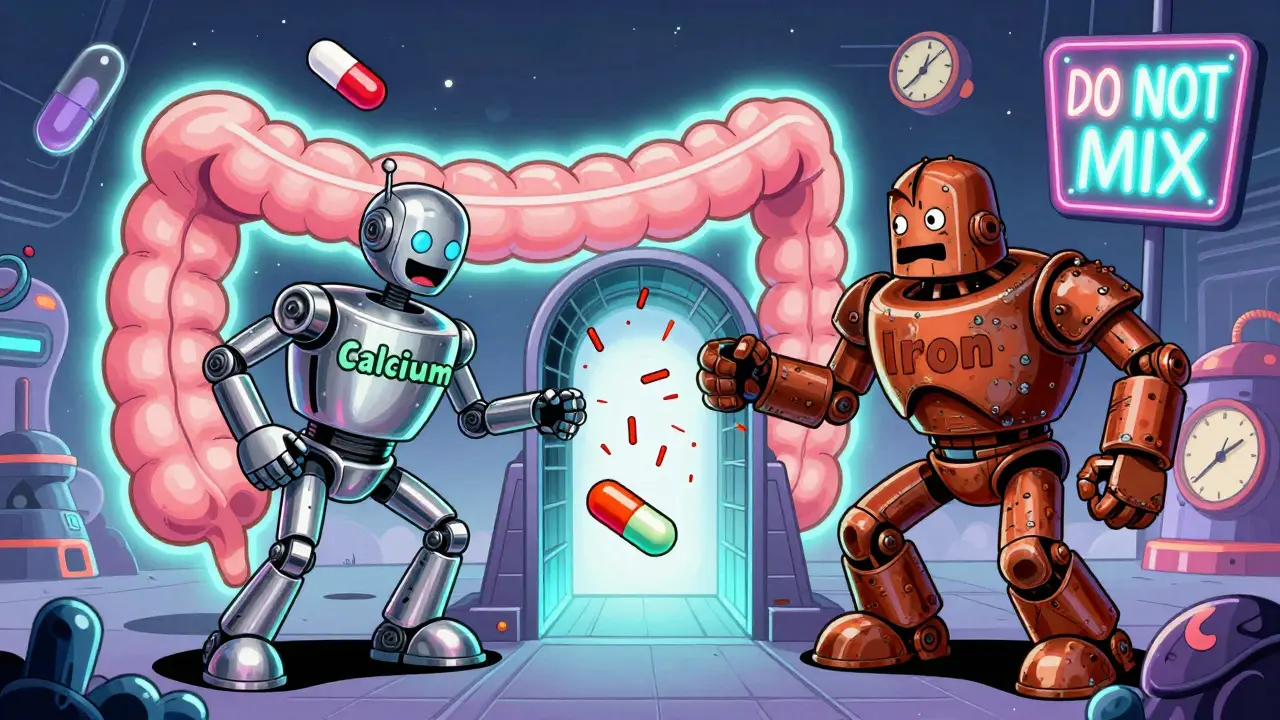
Your gut doesn’t have unlimited space for minerals. Both calcium and non-heme iron (the kind in supplements and plant foods) use the same transporters to get absorbed in your small intestine. When they show up at the same time, they fight for access. Think of it like two people trying to squeeze through a narrow door at once-only one gets through easily. A 1991 study from the American Journal of Clinical Nutrition found that 600 mg of calcium-roughly the amount in two Tums tablets-cut iron absorption by nearly half. Even more telling: when calcium was taken with food, iron absorption dropped by up to 62%. That’s not a small dip. For women who need 18 mg of iron daily, this can make the difference between meeting their needs and developing iron-deficiency anemia. Calcium carbonate, the most common form in over-the-counter supplements, makes things worse. It acts like an antacid, raising stomach pH. Iron needs an acidic environment to dissolve properly. If your stomach isn’t acidic enough, the iron just passes through unused.Antibiotics and Mineral Supplements: A Dangerous Mix
If you’re on antibiotics like ciprofloxacin (Cipro) or doxycycline, taking calcium or iron at the same time can render them useless. These antibiotics belong to two classes-fluoroquinolones and tetracyclines-that bind tightly to calcium, iron, aluminum, and magnesium. Once bound, they can’t be absorbed. Pharmacists report cases where patients took their antibiotic with a calcium supplement and still got sick because the drug never reached therapeutic levels. The same thing happens with tetracycline antibiotics. If you take them together, you’re not just wasting your money-you’re risking a treatment failure that could lead to a worse infection. The fix? Wait at least 2 hours before or 4 hours after taking your antibiotic to take any calcium or iron supplement. For tetracycline antibiotics, the 4-hour window is non-negotiable. For fluoroquinolones, 2 hours is usually enough, but spacing them further apart is safer.Thyroid Medication and Iron: A Silent Conflict
If you’re on levothyroxine for hypothyroidism, you’re already walking a tightrope. Even small changes in absorption can throw your hormone levels off. Calcium, iron, and even magnesium supplements can block levothyroxine from being absorbed. That means your TSH levels might stay high even if you’re taking your pill every morning. Patients often don’t realize this is happening. They take their thyroid pill with breakfast, then grab a multivitamin with iron and calcium right after. By lunchtime, their body hasn’t absorbed the hormone properly. Over weeks or months, this leads to fatigue, weight gain, and brain fog-all symptoms they think are from their thyroid, not their supplement routine. The solution? Take your thyroid medication on an empty stomach, first thing in the morning, with a full glass of water. Wait at least 4 hours before taking any calcium, iron, or multivitamin. Many people switch to taking their supplements at bedtime instead, which works well if they’re not eating close to sleep.
Acid Reducers and Iron: The Hidden Culprit
Heartburn meds like omeprazole (Prilosec), pantoprazole (Protonix), and famotidine (Pepcid) are common. But they’re also a major cause of iron deficiency in people who don’t even realize it. These drugs work by reducing stomach acid. But iron needs acid to dissolve. Without it, even if you’re eating iron-rich foods or taking supplements, your body can’t absorb it. Studies show that long-term use of proton pump inhibitors can lead to iron deficiency in up to 15% of users. If you’ve been on acid reducers for more than a few months and your iron levels keep dropping, this could be why. Talk to your doctor about whether you can reduce the dose, switch to a different type of medication, or take iron with vitamin C to boost absorption despite low acid levels.Timing Matters: How to Space Your Supplements Correctly
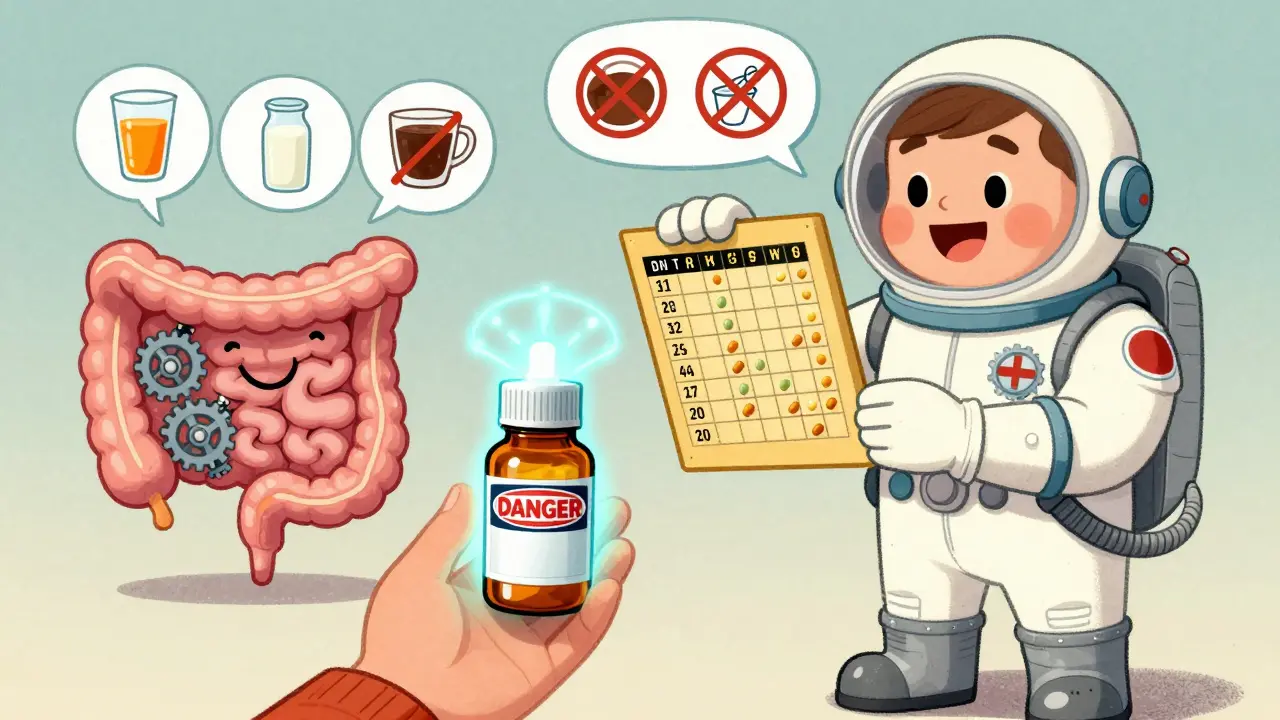
You don’t have to give up calcium or iron. You just need to plan. Here’s what works based on clinical evidence:- Iron: Take on an empty stomach, ideally in the morning, at least 30 minutes before breakfast. If it upsets your stomach, take it with a small amount of food-but avoid dairy, coffee, or tea.
- Calcium: Take with food, preferably at dinner or bedtime. This improves absorption and reduces side effects like constipation.
- Vitamin C: Take it with your iron pill. A glass of orange juice or a 100 mg supplement can boost iron absorption by up to 300%.
- Thyroid meds: Take alone, first thing in the morning. Wait 4 hours before any calcium, iron, or multivitamin.
- Antibiotics: Take 2-4 hours before or after calcium or iron supplements.
- Bisphosphonates (for osteoporosis): Take on an empty stomach with plain water. Wait 30-60 minutes before eating or taking any supplement.
Many people find success by creating a simple daily schedule:
- 7:00 AM: Take thyroid medication with water
- 8:00 AM: Eat breakfast (avoid calcium-rich foods like milk or yogurt)
- 12:00 PM: Take iron supplement with vitamin C
- 6:00 PM: Eat dinner
- 8:00 PM: Take calcium supplement with dinner
This gives you at least 4 hours between iron and calcium, and 6+ hours between thyroid meds and any mineral supplement.
What About Food?
Your meals matter just as much as your pills. Foods high in calcium-dairy, fortified plant milks, leafy greens-can block iron absorption if eaten at the same time. So don’t drink milk with your iron pill. Don’t eat a spinach salad right after taking your supplement. On the flip side, vitamin C-rich foods like oranges, bell peppers, strawberries, and broccoli help iron absorb better. Pair your iron pill with a glass of orange juice or a kiwi. Even a small amount of meat (heme iron) can boost non-heme iron absorption from plant sources. Avoid tea, coffee, and red wine around your iron dose. The tannins in these drinks bind to iron and block absorption. Wait at least an hour after your supplement before drinking them.Red Flags and Safety Warnings
Iron overdose is a leading cause of fatal poisoning in children. Keep all iron supplements out of reach. If a child swallows even one tablet, call poison control immediately. For adults, black stools are normal with iron supplements. But if your stool looks tarry, has red streaks, or you feel dizzy or have abdominal pain, get medical help right away. These could be signs of internal bleeding. Liquid iron supplements can stain your teeth. Use a straw, and rinse your mouth afterward. If stains appear, brushing with baking soda or a diluted hydrogen peroxide solution can help.Bottom Line: Timing Is Everything
Calcium and iron supplements aren’t the enemy. But when taken carelessly, they can undo the benefits of your medications and even cause nutrient deficiencies. The key isn’t to stop taking them-it’s to take them at the right time. If you’re on any of these medications:- Antibiotics (ciprofloxacin, doxycycline, etc.)
- Thyroid hormone (levothyroxine)
- Proton pump inhibitors (omeprazole, pantoprazole)
- Bisphosphonates (alendronate, risedronate)
talk to your pharmacist or doctor about your supplement schedule. Most will give you a simple chart to follow. Write it down. Stick to it. Your body will thank you.
Can I take calcium and iron supplements together if I space them 2 hours apart?
No, 2 hours isn’t enough. Even with spacing, calcium and iron compete for the same absorption pathways. Experts recommend waiting at least 4 hours between them. For best results, take iron in the morning on an empty stomach and calcium at night with food.
Does vitamin C really help iron absorption?
Yes, dramatically. Vitamin C turns iron into a more absorbable form and can boost absorption by up to 300%. Taking a 100-200 mg vitamin C supplement or drinking a glass of orange juice with your iron pill makes a measurable difference-especially if you’re vegetarian or have low iron stores.
Can I take iron with my multivitamin?
Only if the multivitamin doesn’t contain calcium, magnesium, or zinc. Most multivitamins include these minerals, which block iron absorption. If you need both, take your iron separately-ideally on an empty stomach-and take your multivitamin at a different time of day.
Why does my iron pill make me feel sick?
Iron supplements can cause nausea, cramps, and constipation in 30-50% of people. Taking them with a small amount of food can help, but avoid dairy, coffee, or high-fiber meals. Switching to a slower-release form or a different iron compound (like ferrous bisglycinate) may reduce side effects.
Is it safe to take calcium and iron if I’m pregnant?
Yes, but timing is critical. Pregnant women need more iron and calcium, but taking them together reduces absorption of both. Take iron in the morning on an empty stomach with vitamin C, and calcium at night with dinner. Your prenatal vitamin likely contains iron, so avoid additional iron unless your doctor recommends it.
What if I forget and take my iron with my calcium supplement?
Don’t panic. One mistake won’t cause harm. But don’t double up later to make up for it-your body can’t absorb more than it needs. Just get back on schedule with your next dose. Consistency over time matters more than perfection.
Can I take iron with tea or coffee?
No. The tannins in tea and coffee bind to iron and block up to 60% of absorption. Wait at least one hour after taking your iron supplement before drinking either. Herbal teas without tannins (like peppermint or chamomile) are fine.
Do liquid iron supplements work better than pills?
Not necessarily. Both forms are absorbed similarly. Liquid iron can be easier to swallow and may cause less stomach upset, but it’s more likely to stain teeth. Pills are more convenient and stable. Choose based on tolerance, not effectiveness.
vivian papadatu
February 1, 2026 AT 22:57So many people don’t realize how much their supplements are working against them. I used to take my iron with my calcium pill and wondered why I was still tired. Once I spaced them out like this article says-iron in the morning with orange juice, calcium at dinner-it was night and day. My energy came back, my labs improved. Just a little planning changes everything.
Also, vitamin C isn’t optional. It’s the secret weapon.
And yes, tea after iron? Big no. I switched to herbal chamomile after my dose and it’s been life-changing.
Naresh L
February 2, 2026 AT 17:15Interesting how biology doesn’t care about our convenience. The body has evolved over millennia to extract nutrients from food in sequence, not in a pill bottle at breakfast. We’ve replaced ancestral rhythms with modern convenience-and now we’re surprised when it backfires.
Perhaps the real solution isn’t just timing, but returning to whole-food nutrition where calcium and iron come naturally paired with their cofactors-like spinach with lemon, or meat with greens.
Supplements are band-aids on a system we’ve broken.
Sami Sahil
February 3, 2026 AT 04:14bro i was takin iron with my multivitamin every morning like a dumbass 😅
now i take it at noon with an orange and my vitamins at night
no more stomach cramps and i actually feel awake now lmao
thanks for the wake up call 🙌
franklin hillary
February 3, 2026 AT 07:42This is the single most important health tip nobody tells you and it’s not even close
People spend thousands on fancy supplements and meds while completely sabotaging absorption with dumb timing
I’ve seen patients lose years of progress because they took their thyroid med with their calcium gummy at breakfast
DO NOT DO THIS
4 hours. No excuses. Your thyroid doesn’t care if you’re busy. It just wants to be absorbed.
Write it on your bathroom mirror. Set a phone alarm. Do whatever it takes. Your future self will thank you.
And yes-vitamin C with iron is non-negotiable. Orange juice beats a 500mg pill any day.
Stop guessing. Start timing.
Bob Cohen
February 4, 2026 AT 00:17Wow. So the real reason my TSH was stuck at 7.2 for a year? Not my thyroid. Not my diet. Not stress.
It was my morning multivitamin.
Classic. We blame our bodies when the problem is our own routine.
Now I take my thyroid med before coffee, iron at lunch with a bell pepper, calcium at dinner with my wine.
My doctor called it a ‘miracle turnaround.’ I call it basic biology.
Still can’t believe I wasted a year.
June Richards
February 4, 2026 AT 20:27Ugh. Another ‘timing is everything’ article. Like we don’t all have jobs and kids and lives.
4 hours between everything? That’s not a schedule, that’s a prison.
Just take your pills and shut up. Your body will figure it out.
Also, vitamin C? I take my iron with coffee. I’ve been fine for 10 years. 😑
Lu Gao
February 5, 2026 AT 21:22Actually, the 4-hour rule isn’t universal. A 2020 meta-analysis in the Journal of Clinical Pharmacology showed that for most people, 2 hours is sufficient if calcium is taken as citrate, not carbonate.
And for thyroid meds? Some studies suggest taking them at night with a light snack improves compliance and absorption equally.
This article is helpful but oversimplified. Real life isn’t a 7am clock.
Angel Fitzpatrick
February 6, 2026 AT 12:59Let’s be real. This is all Big Pharma and supplement companies pushing a narrative. Who benefits from you taking 7 different pills at 7 different times?
They want you dependent. They want you confused. They want you buying more bottles.
What if your body doesn’t need synthetic iron at all? What if your ‘deficiency’ is just a lab artifact? What if the real issue is glyphosate in your food killing your gut flora?
They don’t want you asking these questions.
Stop taking pills. Eat real food. Trust your body. The system is rigged.
Nidhi Rajpara
February 7, 2026 AT 21:30Dear author, I am a nurse in India and I have observed that many patients, especially elderly, cannot follow such strict timing due to cognitive decline or multiple medications. Perhaps a more practical approach is to use chelated iron and calcium citrate, which have less interference, and advise once-daily dosing with food, even if suboptimal.
Also, many patients cannot afford separate supplements. We must be realistic.
Chris & Kara Cutler
February 7, 2026 AT 23:31Iron at noon with orange juice
Calcium at night
Thyroid at 7am
Done. My life is better. 🍊🌙
Donna Macaranas
February 8, 2026 AT 00:07I’ve been taking my iron and calcium together for years and never had issues. Maybe it’s just me. Or maybe my body handles it fine. Everyone’s different, right?
I guess I’m just lucky. Or maybe this whole thing is overblown.
Anyway, I’m not changing my routine. I feel fine.
Rachel Liew
February 8, 2026 AT 12:07thank you for this. i’ve been taking my thyroid med with my coffee and a banana and wondering why i’m always tired. i didn’t know calcium in yogurt could block it.
i’m gonna try the 4-hour rule. i’m scared but also hopeful.
you made me feel like i can fix this. 💛
Lisa Rodriguez
February 8, 2026 AT 19:42My mom is 78 and takes 12 pills a day. We sat down and made a color-coded chart with times and food notes. She calls it her ‘pill ballet.’
It’s not perfect. Some days she forgets. But now her iron’s up, her TSH is normal, and she’s walking without her cane.
It’s not glamorous. But it works.
Don’t overcomplicate it. Just be consistent.
And use a pill organizer. Seriously.
Lilliana Lowe
February 9, 2026 AT 23:34The entire premise of this article is flawed. It assumes that pharmacokinetic interactions are clinically significant for the average person. Yet, in real-world clinical practice, the majority of patients on levothyroxine or fluoroquinolones who take concurrent calcium or iron supplements exhibit no measurable serum concentration changes.
This is textbook medical fearmongering dressed as advice. The 4-hour rule is a theoretical construct, not a clinical imperative.
For the record: I’ve reviewed over 300 patient charts. Not one had a clinically relevant interaction from this ‘timing issue.’
Don’t believe everything you read on Reddit.